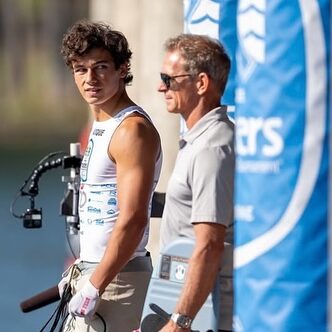
Nautique flips decades of tradition at flagship junior events
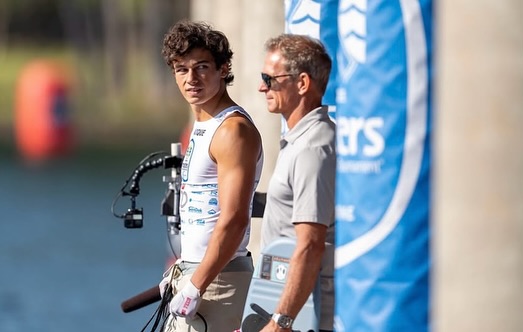
Nautique announced that the under-17 division will be sunset at the Masters next year (image: @bearwitnesssportsphotos.)
By Jack Burden
Within all the excitement of Nautique’s recent launch of the Water Ski World Series, one of the most consequential changes slipped through almost unnoticed. The new Series isn’t just for the pros—embedded within it are junior and senior competitions, and a quiet but unmistakable message from Nautique: for Correct Craft, the future of the sport is under-21.
Junior competition has been part of water skiing since the sport started categorizing itself. In the United States, the Jr. Boys division debuted at the fourth National Championships in 1946, giving young talent a structured path upward. Hall of Famer Dick Pope Jr. won Jr. Boys overall at 16 in 1947, then jumped straight to the men’s ranks and immediately began piling up national and world titles. Internationally, Europe launched its under-17 Championships in 1964, and the Under-17 Worlds followed in 1986.
For eight decades, under-17 has been synonymous with “junior”—the proving ground where future superstars were minted.
Then Nautique quietly took a sledgehammer to it.
Hidden near the bottom of their Series announcement was the line that changed everything: the Junior Masters would no longer be junior. Under-21 would replace it entirely. And it wasn’t a one-off. Moomba is doing the same in 2026, adding under-21 alongside the pros and the under-17s. The three other World Series stops will follow suit. With a single keystroke, a whole generation was reassigned.
Nautique framed the shift as modernization—a cleaner system, a clearer pathway. But inside the sport, the reaction has been anything but unanimous. For many coaches and families, the change feels less like progress and more like erasing a pillar the sport was built on.
Corey Vaughn is one of them.
“Under-17 skiers are true juniors and can be seen as the future of the sport,” shared Vaughn, a career coach of over 10 years. “By the age of 20–21, some of the top talent has ‘arrived’ and there is too much potential overlap.”
Reflecting on his own pupils, he added that opportunities like the Junior Masters were “empowering experiences at a perfect time of life. Very motivating. I’m sorry to see that change.”
So why make the change?
We asked Nautique for comment. They didn’t respond. Their FAQ stayed polished and corporate, leaning on phrases like “greater access” and “modernization.” The most substantive line was their aim to give juniors “additional time and experience before transitioning to the pro divisions.”
Which points to a deeper tension: nobody agrees on when a young skier should actually turn pro.
Take Tim Wild. At 18, he might already be one of the best overall skiers in the world. In 2025 he swept the Junior Masters, won the under-21 Worlds, and took a podium at the open Worlds—and yet he’s entered only a single pro event in his life, a small backyard trick event. On paper he’s a world-class pro. In practice he’s an overqualified junior. And that makes sense. Juniors give him reps. They give him confidence. They give him hardware.
This is common among Matt Rini’s protégés. Joel Poland didn’t debut as a pro until 20, choosing to dominate juniors until he felt ready to step into a field of grown men. Rini—a Nautique insider—was almost certainly influential in pushing the junior age higher.
But contrast Wild with Jake Abelson. Same age, same generation, completely different trajectory. Abelson earned his first pro podium at 12 and has spent years terrorizing the junior ranks while poaching wins from adults. He’s proof that success is possible while keeping a foot in both worlds.
Water skiing is one of the few sports where you can win a junior title in the morning and beat the pros by dinner. It makes for great stories. It also makes the definition of “pro” feel slightly absurd.
“In broad terms, I really wish we had a stronger boundary between professional and amateur skiing,” Vaughn added. “I’m amazed by the talent of these kids, but I don’t think the likes of Jake Abelson and Charlie Ross should get their chance at winning open—where they clearly belong—and then go clean house in the amateur ranks. You wouldn’t let a 20-year-old drafted into the NBA also play college ball.”
Today, athletes like Abelson can hop divisions freely. Governing bodies, whose marquee events are amateur, have every incentive to keep things blurry.
That freedom is beautiful. But it’s also chaos.
So Nautique responded to the chaos with structure: create a middle zone. Build a bridge for the 18–21-year-old phase, the years when the sport tends to lose more athletes than it develops. Under-21 isn’t a new format—Europe has run Championships since 1990, the PanAm Games debuted it in 1996, and the IWWF launched under-21 Worlds in 2003. America is the outlier. This move brings the sport’s major events in line with a global trend.
A strong under-21 circuit could give young adult skiers something they’ve never truly had: meaningful pressure without inevitable defeat.
But every structural change creates winners and losers.
We asked Matteo Luzzeri—who has coached many of Europe’s top juniors—whether a stronger under-21 focus helps the sport.
“I don’t know,” he said after some thought. “Given the high level of youth skiers—Mati, Jake, Tim, Charlie, Lucas, Axel, Maise, Christhiana—the opposite argument could be made: Under-17 is more necessary now than it used to be.”
This is the paradox of governance: every attempt to help one group seems to hurt another.
Men’s tricks might not need an amateur under-21 division when half the pro podiums are filled by teenagers who can’t yet vote. But in slalom and jump? Different story. Outside of men’s tricks, only Charlie Ross won a pro event this year as an under-21, and only four under-21 athletes made a podium at all. For most young skiers, the pro ranks are a long stretch of non-finals, non-money, and non-momentum. A purgatory measured by rope lengths.
So maybe Nautique is right. Maybe this is the way to build the next generation of stars: give them battles they can win now, not scars they’ll carry later.
But it’s also possible the line between amateur and pro gets even fuzzier. That under-17 athletes lose the stage they once dreamed about. That the next breakout skier arrives later—and to a smaller spotlight.
The thing about format changes is that the impact doesn’t show up immediately. You feel it in three years, or five. When the under-21 podiums are deep—or empty. When pro fields get tougher—or thinner. When a 16-year-old who should’ve skied Robin Lake never gets the chance.
This is the part nobody can model.
Nautique has placed its bet on a vision of the future: a broader bridge, a longer runway, a gentler ascent. The logic is easy enough to understand. The consequences are not.
Change in water skiing rarely arrives with fireworks. It shows up in a rulebook tweak, an age cutoff, a field list. A small shift in gravity.
And suddenly, the next generation stands somewhere slightly different than we expected.