WWS Overall Tour: A Platform for the Forgotten Event
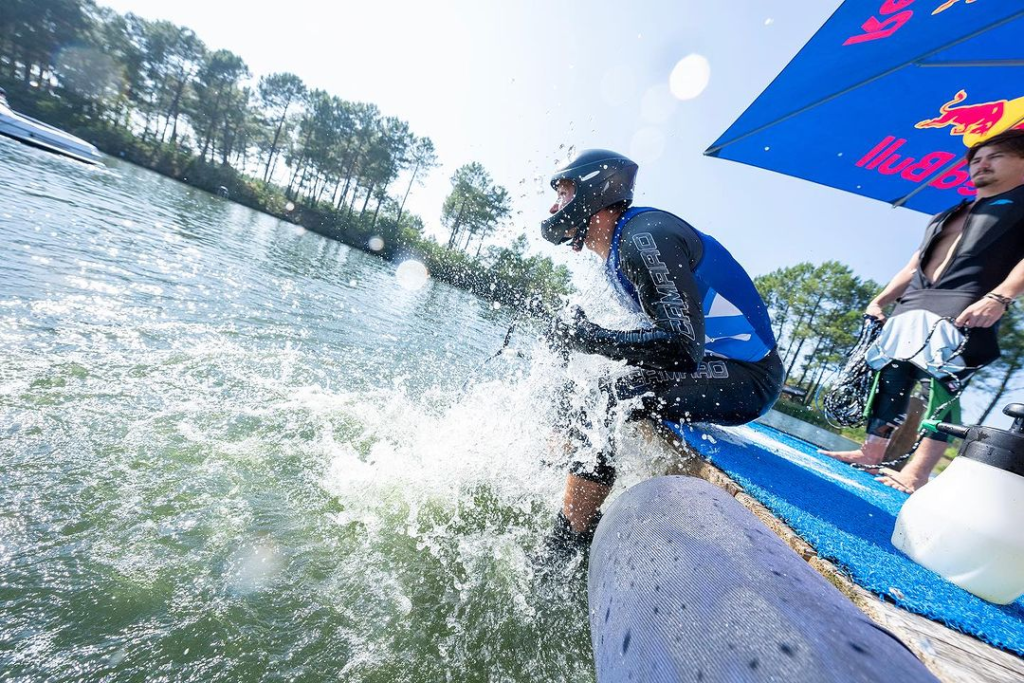
Image: Johnny Hayward
By Jack Burden
On a beautiful sunny afternoon in the south of France, Frenchman Louis Duplan-Fribourg set a new national jump record, igniting the local crowd and taking the lead in the overall competition. Announcer Glen Williams acknowledged Duplan-Fribourg’s achievement, stating, “We’ve talked for a long time about Joel Poland and Dorien Llewellyn, and now there are three names in that category.” Duplan-Fribourg’s performance positioned him among the world’s top overall skiers. “I was a little stressed after Louis’ big jump, when someone goes out and jumps that far it’s intimidating,” said Poland in his post-jump interview. Poland had just won the event by less than 3 overall points, a margin smaller than a quarter buoy or a side slide. The event, a professional overall tournament, is part of the WorldWaterSkiers Overall Tour.
In recent years, the topic of competing tours and leagues has sparked controversy in various sports, such as the PGA’s standoff with Saudi-owned LIV Golf and football’s proposed Super League. This raises the question of whether fragmenting an already small sport is a wise decision. The Waterski Pro Tour has revitalized professional water skiing, encouraging and promoting numerous events across the United States and Europe. It is important to consider whether we have the necessary resources to support two professional tours.
Comparing the work of the non-profit foundation WWS to the elitist and ethically questionable LIV Golf or European Super League Company would be unfair. Established in 2018 by seven-time world champion Jaret Llewellyn, along with Tom and David Grey, WWS aims to promote the sport of water skiing through technology. Their website, worldwaterskiers.com, serves as a news hub and social media platform. They describe their foundation as setup to counteract “the fragmented nature of waterskiing” and actively promote the Waterski Pro Tour on their website. This year, two of their stops are being run in conjunction with Pro Tour slalom events. Instead of competing for a share of the pie, they have secured sponsorship from outside the industry and actively work towards expanding it.
Cataloguing WWS’ initiatives and achievements reads almost like a sitcom trope with Llewellyn as the bumbling but likeable main character, always in the wrong place at the wrong time. Fed up with the difficultly finding schedules, live scores, and webcast links for tournaments, WWS provides a repository for all major tournaments – a key function of the Waterski Pro Tour website. Their Water Sports Connect software created a competitively-priced and slick event management system (EMS) to create consistency across an archaic variety of systems used around the world – meanwhile the IWWF launched a free-to-use international EMS funded through their mandatory license fees. Their tournament promotion packages include webcast services – as The Waterski Broadcasting Company (TWBC) was evolving from a lo-fi one-man-band to the industry leader it is today. They launched a professional water ski tour during the Waterski Pro Tour’s inaugural season – you get the picture.
On the surface they’re Betamax. They’re New Coke. They’re Homer Simpson keeping his Enron stock and giving away his Microsoft stock in the nineties. But this simple caricature is just that – a caricature. The fact is that WWS have anticipated some of the most important developments in the sport in the five years since it was founded. They clearly have their finger on the technology pulse. Despite constantly being eclipsed, seeing their ideas succeed in others’ hands, they continue to work tirelessly to push the boundaries and promote competitive water skiing.
The WWS Overall Tour is a contrasting and, in many ways, superior product to the Waterski Pro Tour. Overall is not recognized as an event by the Pro Tour, which has primarily focused on promoting slalom tournaments. Operationally, WWS closely resembles the “pro tours” of the 1980s and 1990s, with a single organizing body securing tour sponsors, host sites, and encouraging skier participation by offering a meaningful year-end bonus ($14,000 in 2023). WWS has real skin in the game, whereas the Pro Tour operates with a much lighter touch, offering a brand name and publicity but little else.
In a world where attention spans are decreasing, water skiing is competing not just with other sports, but Netflix, video games, TikTok, and Instagram. Eight hours of slalom skiing, with endless warm up passes and video reviews, is a tough value proposition for prospective viewers. These live streams, taken to new levels in recent years through the excellent work of TWBC, often struggle to engage many beyond the die-hard water ski fans. In short, they’re preaching to the converted.
On the other hand, a fast-paced three-hour broadcast is highly accessible and could serve as an excellent introduction to our sport for casual viewers. The overall format showcases all three events with a consistent group of skiers, allowing fans to become more invested.
At present, the broadcasts feel more like experiments rather than finished products. However, with each tournament, they continue to improve. WWS is unafraid to be early adopters of new technology, such as SplashEye’s eyeTrick program. Their ambition is plain to see.
I don’t know if the WWS Overall Tour will succeed in the long run. Breathing new life into three-event water skiing may be a sisyphean task. In our nostalgia for the ‘good ol’ days’ of professional water skiing we often forget that the Coors Light Water Ski Tour changed ownership four times in its first three years, including a period of insolvency where skiers’ prize money checks bounced mid-season.
Like all of WWS’ projects, the vision is there. You could picture this tour as a pilot, to be picked up by TWBC, or even Red Bull TV, and executed as a polished product. A future where overall is recognized as an event and included in the Waterski Pro Tour. One thing is certain: without innovators, disruptors, and risk-takers, our sport has no chance to grow. We should commend Llewellyn and the WWS team and, most importantly, tune in for more thrilling action!