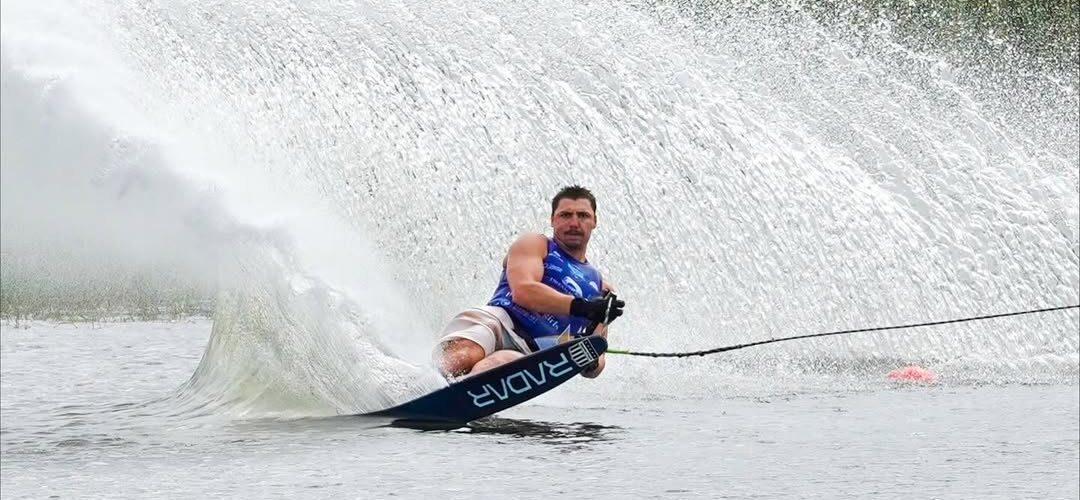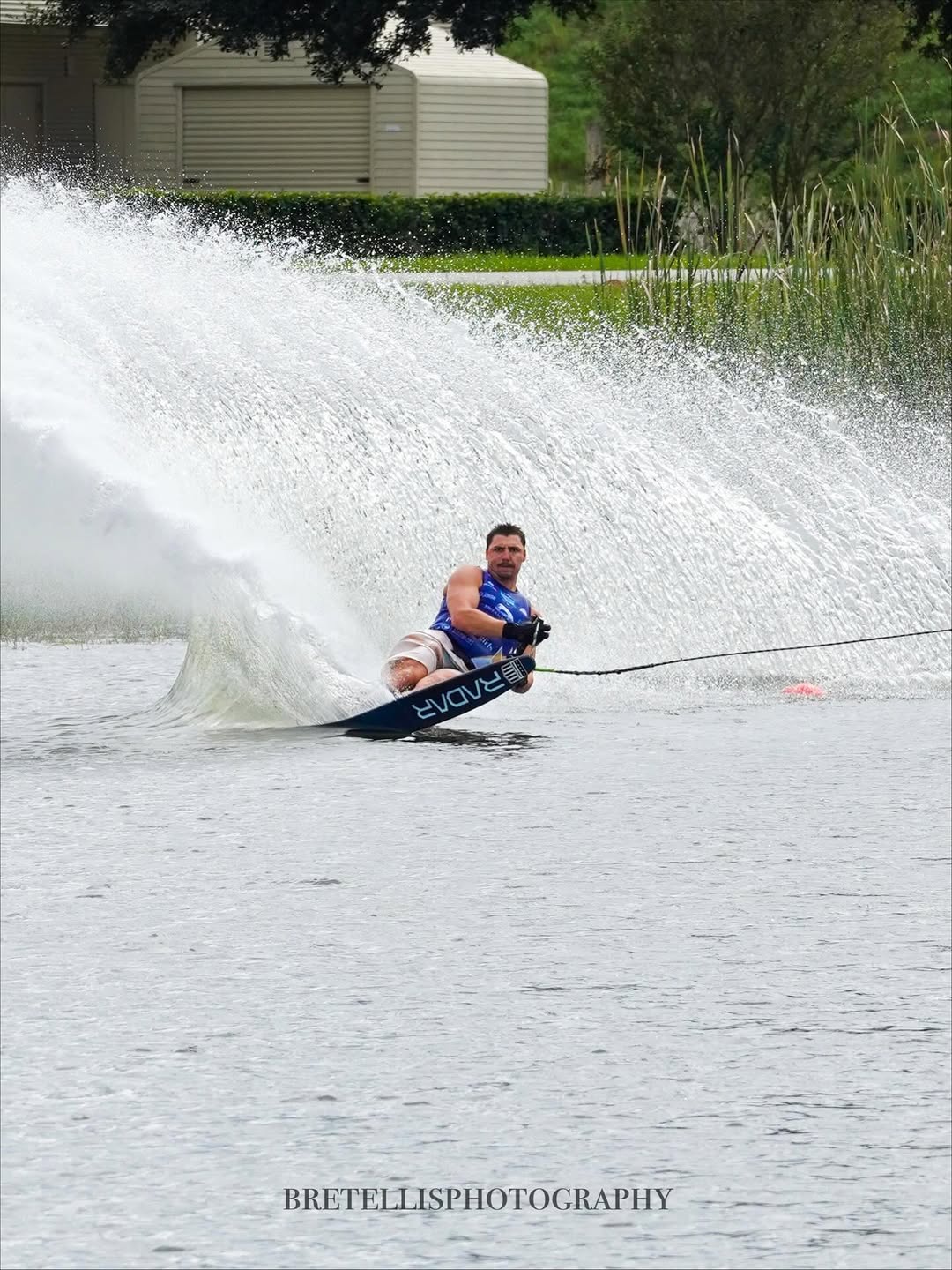
Joel Poland at the WWS Canada Cup

Versatile Elite: The Skiers Who Have Won Professional Titles in All Three Events

Analysis

Versatile elite: The skiers who have won professional titles in all three events
Joel Poland at the WWS Canada Cup

Image: @johnnyhayward_photo

By Jack Burden


Modern water skiing has become increasingly specialized. The best slalom skiers are chasing fractions of a buoy at short line, trickers are pushing the limits of speed, precision and difficulty, and jumpers are reaching distances that demand an entirely different set of physical and technical skills.

That makes Joel Poland’s achievement in Calgary particularly significant. He did not simply add a professional slalom title to an already impressive résumé; he completed a feat that has become increasingly rare as the sport has evolved. Poland has spent years competing at the highest level in all three disciplines, against specialists who have never been better.

It is a club dominated by Australians, largely because Australia was the birthplace of professional water skiing. For its first 11 years, the Moomba Masters was the world’s only professional water ski tournament, before the California International Cup launched the first American professional event in 1972. Those early competitions gave Australian skiers a head start in building the kind of all-around résumés that have become increasingly difficult to replicate.

Poland is now the latest to do it.

Here are the 12 athletes who have conquered all three of water skiing’s disciplines at the highest level.
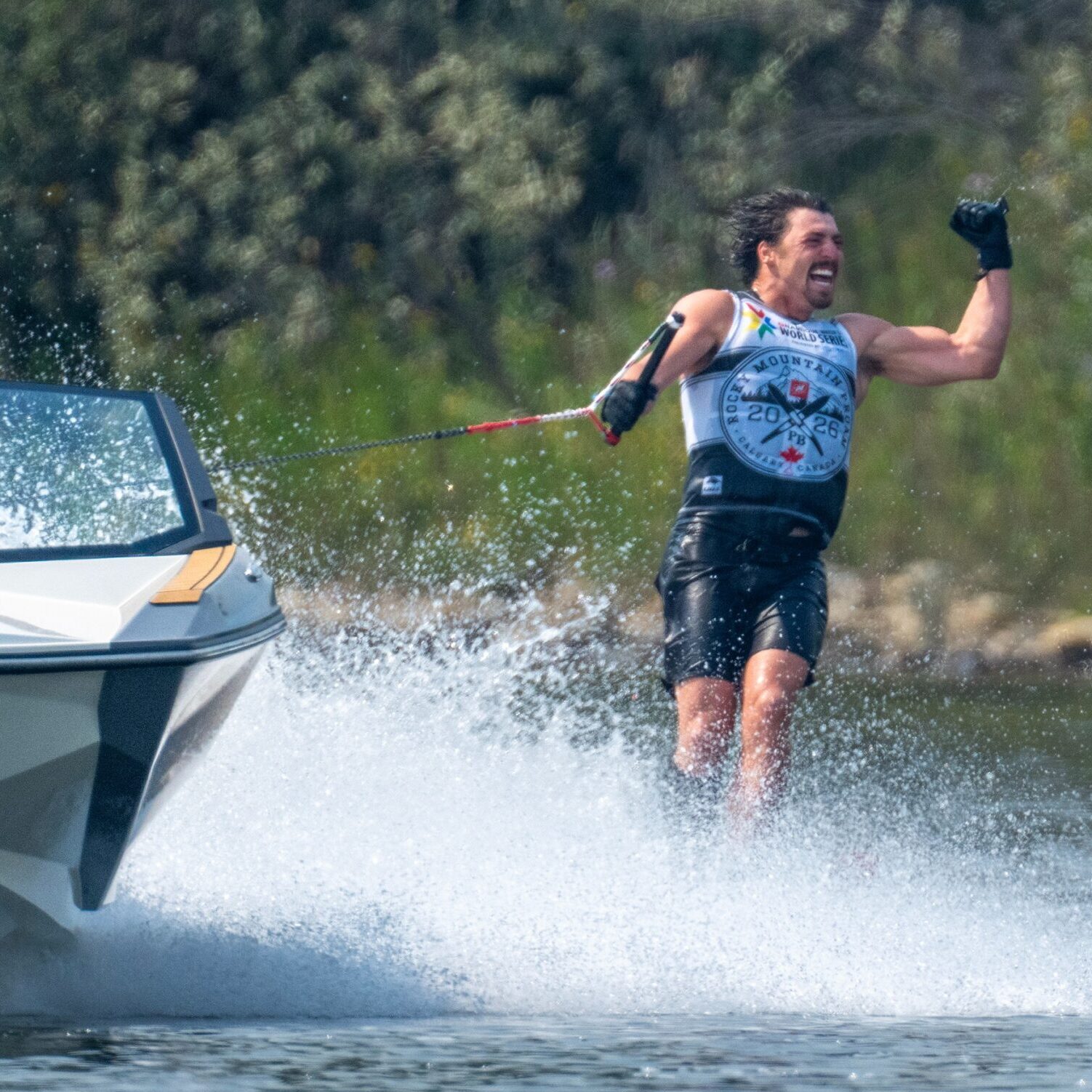
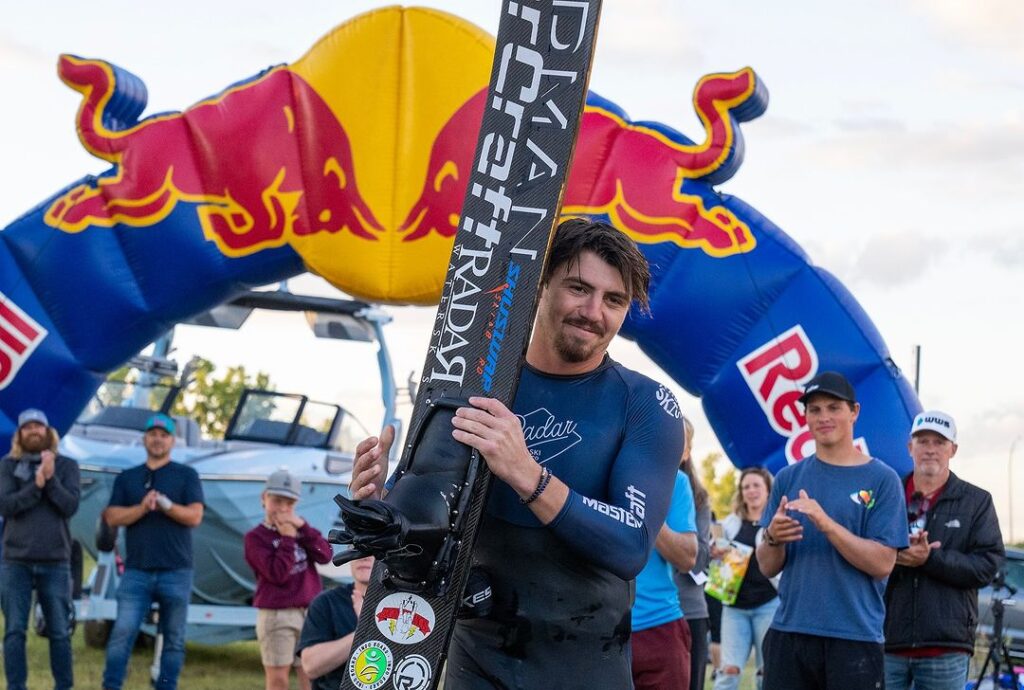
@joelpoland celebrates his slalom win during the Rocky Mountain Pro Am at @predatorbay in Calgary, Alberta, Canada.

Poland celebrates his maiden professional slalom victory (image: @johnnyhayward_photo)

Joel Poland

Confirmed professional titles (2021-Present): 35 — 1 slalom, 2 tricks, 15 jump, 17 overall

Poland’s arrival is perhaps the most fitting addition to the group because versatility has been the defining characteristic of his career.

After a breakout 2021 season in which he broke the world overall record and became embroiled in one of the great modern overall battles with Dorien Llewellyn, Poland has gone on to win four consecutive WWS Overall Tour season titles, remaining undefeated since 2022 and setting nine world records.

The Brit has also developed a reputation as one of the sport’s most innovative and exciting trick skiers, inventing multiple new flips while consistently featuring on professional trick podiums. In jump, he has established himself among the best in the world, winning back-to-back Waterski Pro Tour season titles and the 2025 World Championship.

Until Calgary, though, there was one conspicuous omission.

Slalom.

The water skiing world had few doubts about Poland’s ceiling in the event, particularly after his redemptive and dramatic entry into the 41-off club at the 2023 World Championships. He had found his way onto multiple professional slalom podiums, but gold had eluded him.

That changed at the Rocky Mountain ProAm.

After tying Charlie Ross at 3 @ 10.25m (41′ off) in the final, Poland took the runoff when Ross fell coming out of five at 10.75m (39.5′ off). Poland then completed the six-buoy pass to claim his maiden professional slalom title.

The reaction made clear what the victory meant. Poland had won almost everything else there was to win. Now he could finally say he had won professionally in all three events.

At 27, there is still plenty of time for 35 titles to become a much larger number.
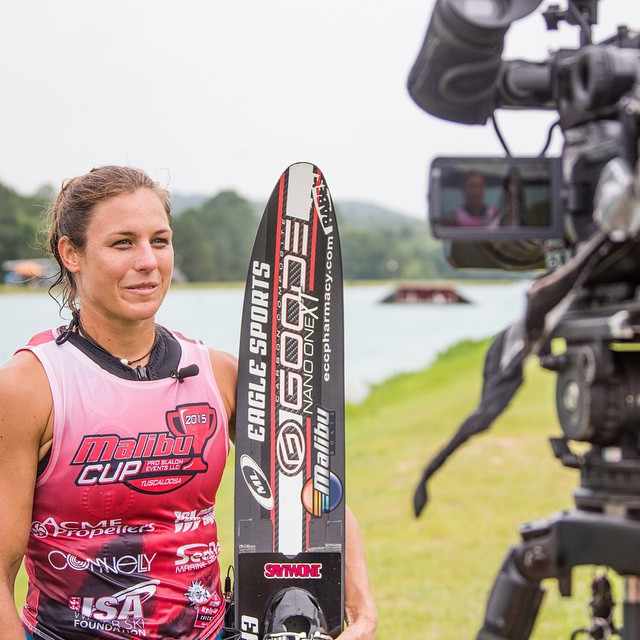
Regina Jaquess at the 2015 Malibu Cup

Jaquess is arguably the greatest water skier of all time, male or female (image: @regina_jaquess)

Regina Jaquess

Confirmed professional titles (2000-Present): 84 — 72 slalom, 5 tricks, 5 jump, 2 overall

If Poland’s inclusion is new, Regina Jaquess has been sitting in the club for years.

It is difficult to find a more complete résumé in the history of the sport. Jaquess won her first World Championship title in tricks at 17 and went on to win five World Championship overall titles, along with 19 World Championship medals and three Pan American Games overall titles.

Slalom, however, became the foundation of her career.

She has broken or equaled the women’s slalom world record nine times and has held the record continuously since 2009. She has run 10.75m more times than every other woman combined and has won more than 60 percent of the professional slalom tournaments she has ever entered.

Her professional record now stands at 84 titles.

That includes five professional trick titles, five in jump and two overall titles, enough to make her the only woman this century in the three-event professional club.

Her longevity is almost as remarkable as her dominance. Jaquess has continued to win professional titles into her 40s while also running a business outside the sport.

Poland joining her in this particular club feels appropriate. Both are skiers who have spent much of their careers refusing to be defined by a single event.
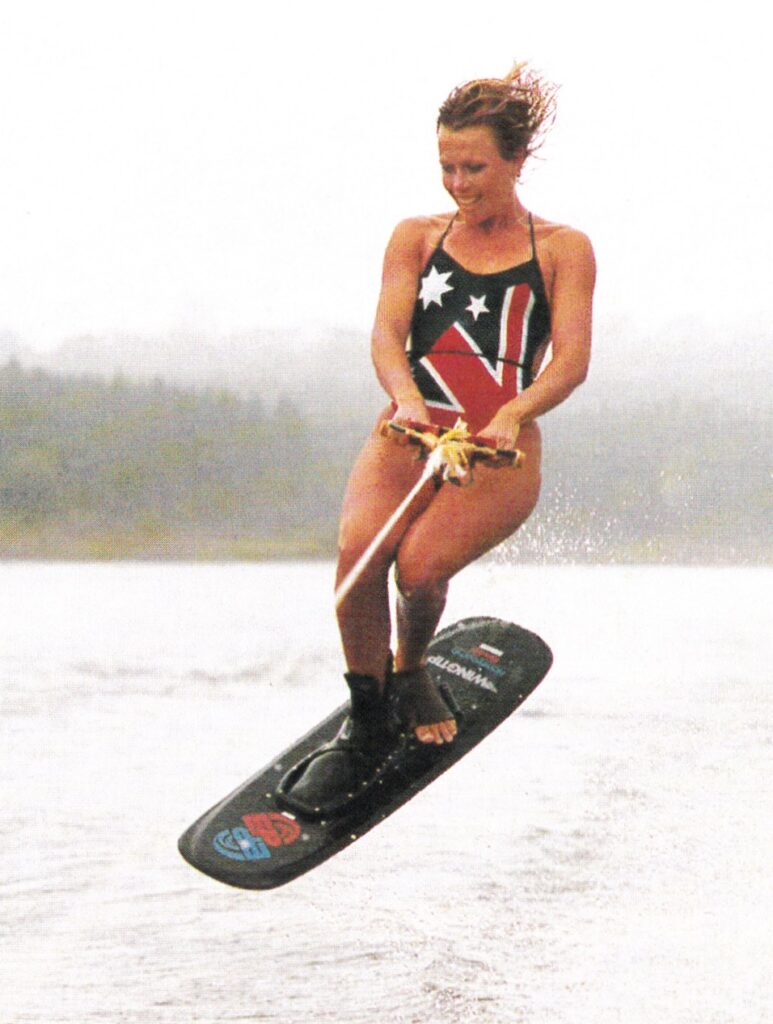
Waterski champion Karen Bowkett Neville

Karen and her husband Mick made up one of the sport’s greatest duos through the 1980s (image: VINTAGE WATER SKI PHOTOS)

Karen Bowkett Neville

Confirmed professional titles (1979-1993): 26 — 3 slalom, 9 tricks, 2 jump, 12 overall

Karen Bowkett Neville was one of the central figures of Australia’s golden generation and one of the greatest overall skiers of the 1980s.

She won the World Championship overall title in 1985 and 1991 and stood on the overall podium at four consecutive World Championships. Her influence extended beyond her individual results, too, as she helped lead Australia to three consecutive runner-up finishes in the team competition from 1985 through 1989.

The Moomba Masters was where Neville was particularly dominant. She won eight overall titles and accumulated 20 titles across the four disciplines, placing her alongside Kaye Thurlow Faulkner as the most successful skier in the history of the tournament by total victories.

Her versatility was not an accident. Tricks were arguably her strongest event, but she was capable of winning wherever she competed, including overall victories at both the U.S. Masters and U.S. Open.

She remains one of only six women to have won the World Championship overall title more than once.
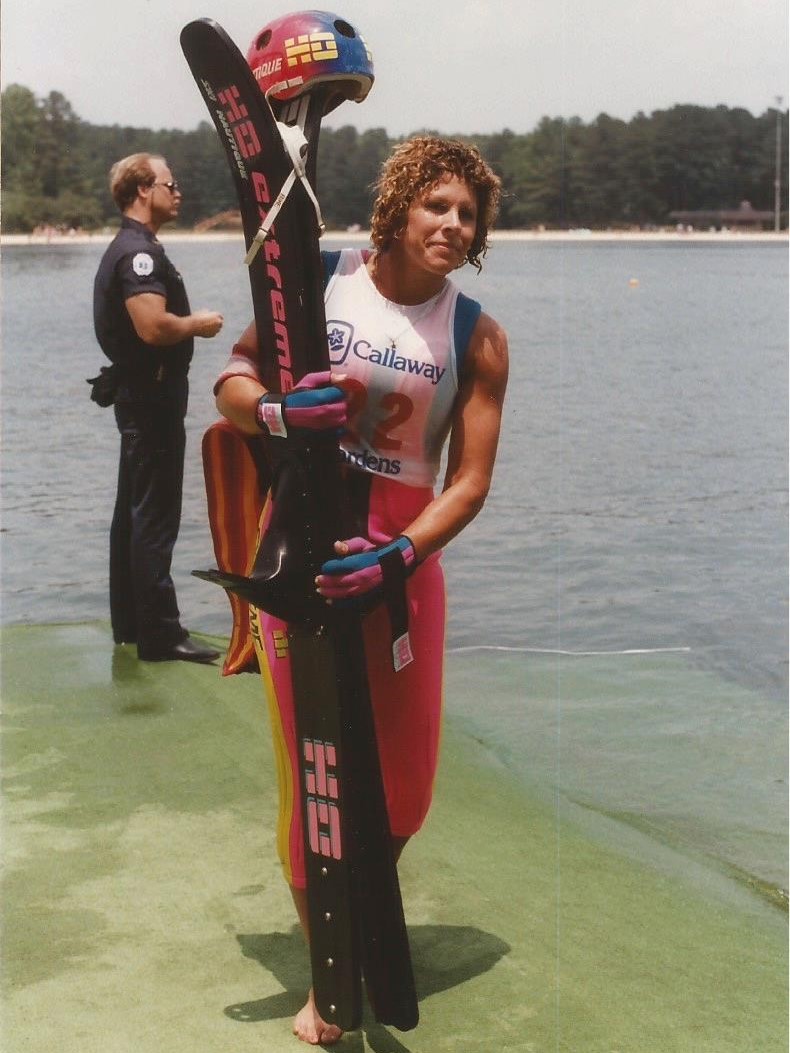
Deena Brush Mapple at the U.S. Masters

The Queen of Water Skiing (image: VINTAGE WATER SKI PHOTOS)

Deena Brush Mapple

Confirmed professional titles (1977-1993): 99 — 25 slalom, 1 tricks, 58 jump, 15 overall

Deena Brush Mapple’s résumé is enormous even by the standards of this group.

Known as the “Queen of Water Skiing,” the American spent 25 years at the top of the sport, winning back-to-back World Championship overall titles in 1987 and 1989 and collecting 15 World Championship medals.

Her dominance at the U.S. Masters was even more striking. She won 20 titles across slalom, jump and overall, including 14 after the event became professional in 1985. In women’s overall, she lost only once at the Masters between 1985 and 1993.

Jump was her defining event. She won four World Championship jump titles and broke the world jump record five times, pushing the mark from 39.3 meters (129 feet) in 1979 to 47.5 meters (156 feet) by 1988.

But she was hardly a one-event skier.

Brush Mapple also broke or tied the world slalom record five times, won three U.S. Masters slalom titles and claimed a Moomba Masters slalom title. She even won the overall season championship on the PAWS Budget Rent-a-Car Waterski Tour in 1990.

Her presumed 100-plus professional titles remain one of the largest totals in the history of the sport.
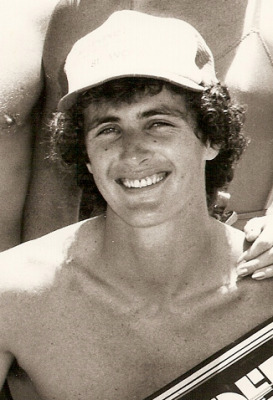
Mick Neville of Australia

Mick Neville

Confirmed professional titles (1981-1990): 15 — 2 slalom, 8 tricks, 1 jump, 4 overall

Mick Neville was the last man to accomplish what Poland just did.

Neville was one of the great trick skiers of the 1980s, winning the Moomba Masters trick title seven times and appearing on every World Championship tricks podium from 1981 through 1987.

He was also a formidable overall skier, winning two World Championship silver medals in two of the closest overall races in the history of the tournament.

His greatest season came toward the end of his career in 1990. Neville won overall at the U.S. Masters, took the tricks title at the U.S. Open and added two tour victories on the Michelob Dry Waterski Tour, one in slalom and one in jump.

That was enough to give him professional victories in all three events.

It took 36 years for another man to join him.
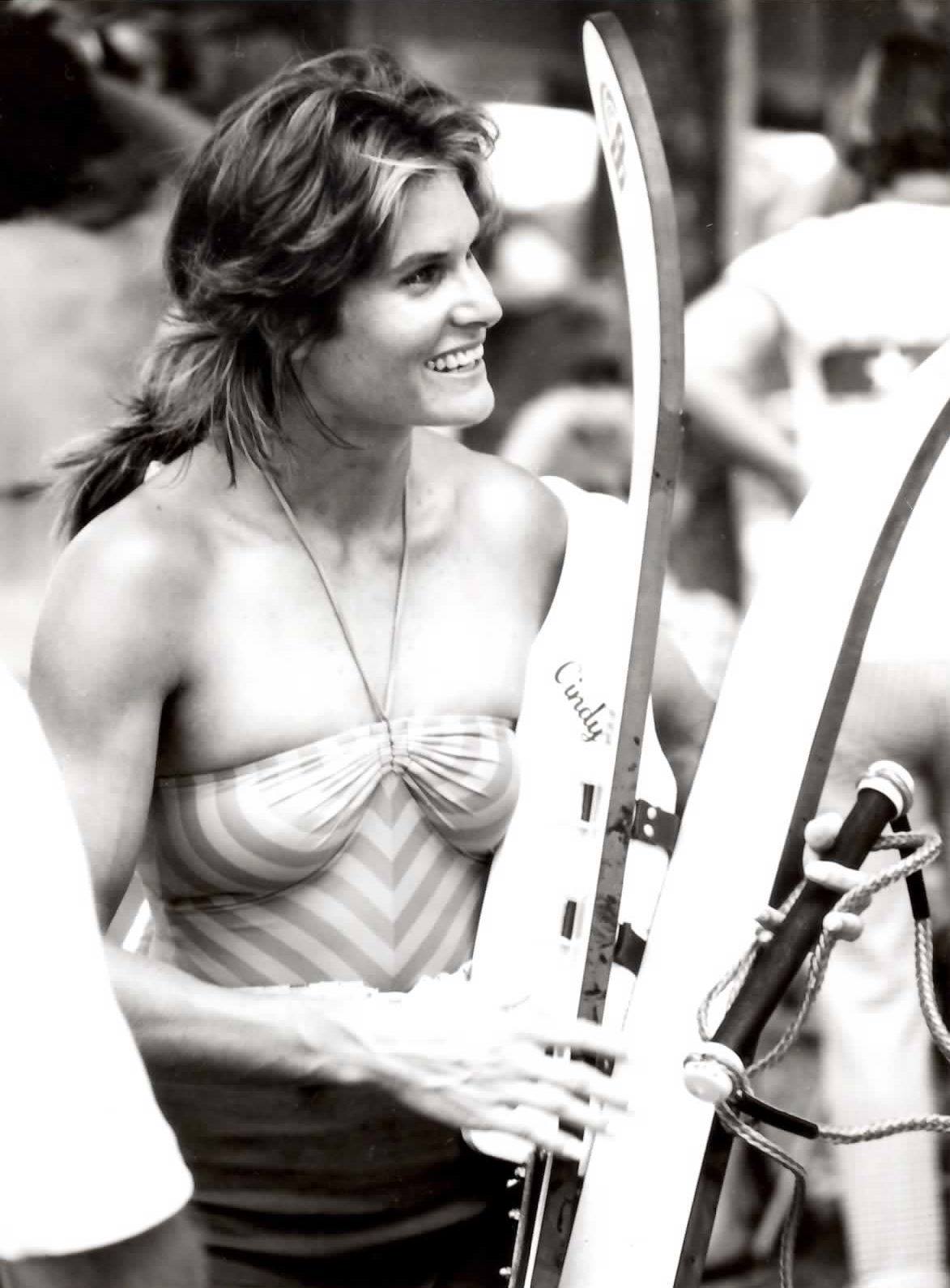
World Champion Cindy Todd

Todd’s comeback season in 1975 was an almost instant success (image: VINTAGE WATER SKI PHOTOS)

Cindy Hutcherson Todd

Confirmed professional titles (1977-1988): 25 — 10 slalom, 2 tricks, 9 jump, 4 overall

Cindy Hutcherson Todd was one of the defining figures of professional water skiing before the U.S. Pro Tour fully took shape.

After stepping away from the sport as a teenager, Todd returned to competition in the mid-1970s and immediately made up for lost time. In her comeback season in 1975, she broke the world slalom record and won the Open Women’s title at the U.S. Nationals.

Over the course of her career, she would break the slalom record four more times, moving the mark from 2 @ 12m (35 off) to 2 @ 11.25m (38 off).

Her versatility was remarkable. Todd won three World Championship slalom titles, four U.S. Masters overall titles and eight Masters titles across slalom, tricks and jump.

She was also a seven-time World Championship medalist and one of the great overall competitors of her generation.
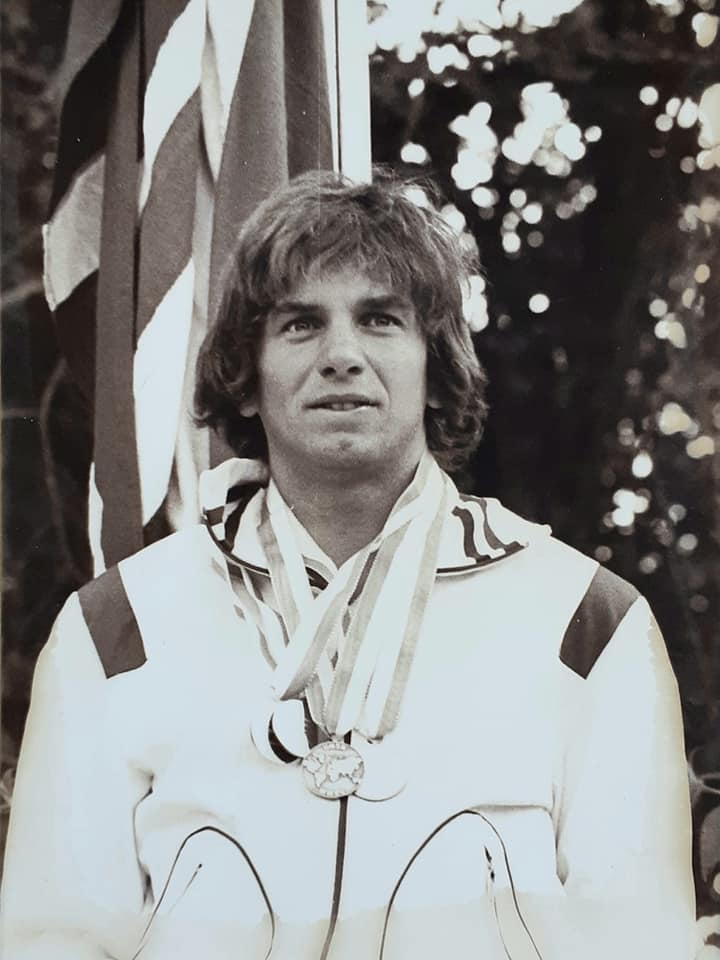
World Overall Champion Mike Hazelwood

Image: Yvon le Gall

Mike Hazelwood

Confirmed professional titles (1977-1987): 50 — 3 slalom, 2 tricks, 39 jump, 6 overall

Mike Hazelwood is perhaps the most obvious example of how many great jumpers begin as talented overall skiers.

The Brit became one of the biggest names on the professional circuit during the 1980s, winning jump in three of the first four seasons of the Coors Light Water Ski Tour. But his career began much earlier as an extraordinary three-event skier.

Hazelwood won the men’s overall title at the 1977 World Championships and remained a fixture on the World Championship podium for the next six years. He won eight consecutive European overall titles from 1976 through 1983 and four consecutive U.S. Masters overall titles from 1978 through 1981.

One of very few skiers who can sincerely say they conquered the Yarra River, Hazelwood won titles in slalom, tricks, jump and overall during his golden run in the late 1970s and early 1980s. That included setting his first world jump record at Moomba in 1980 and an incredible five consecutive Moomba overall titles from 1977 to 1981.
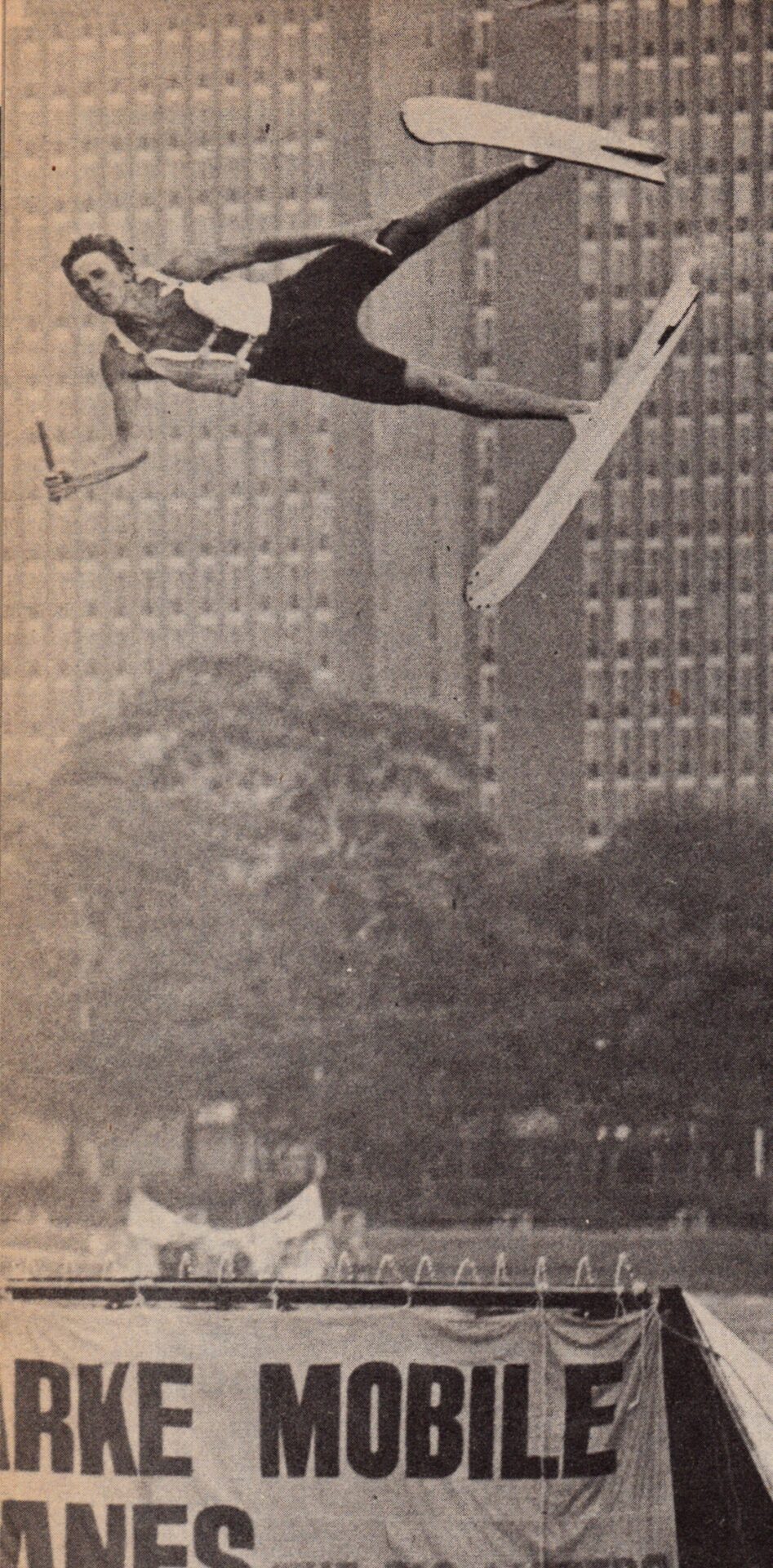
Bruce Cockburn jumps at the Moomba Masters

Image: Graine de Sport

Bruce Cockburn

Confirmed professional titles (1970-1978): 14 — 5 slalom, 3 tricks, 4 jump, 2 overall

Bruce Cockburn was a prodigy in tricks before becoming one of the best slalom skiers and jumpers of his generation.

He won the World Trick Championship in 1969 and helped pioneer tricks such as reverse toe turns that would become staples of the event. As his career progressed, he shifted toward slalom and jump, eventually becoming a dominant force on the Yarra River.

When professional skiing got a foothold in the United States, Cockburn became the first Australian to regularly compete abroad, winning multiple titles at the California International Cup in the mid-1970s.

His 14 professional titles were spread across all three events and overall, making him one of the earliest examples of the kind of versatility that would become increasingly difficult to find as the sport specialized.
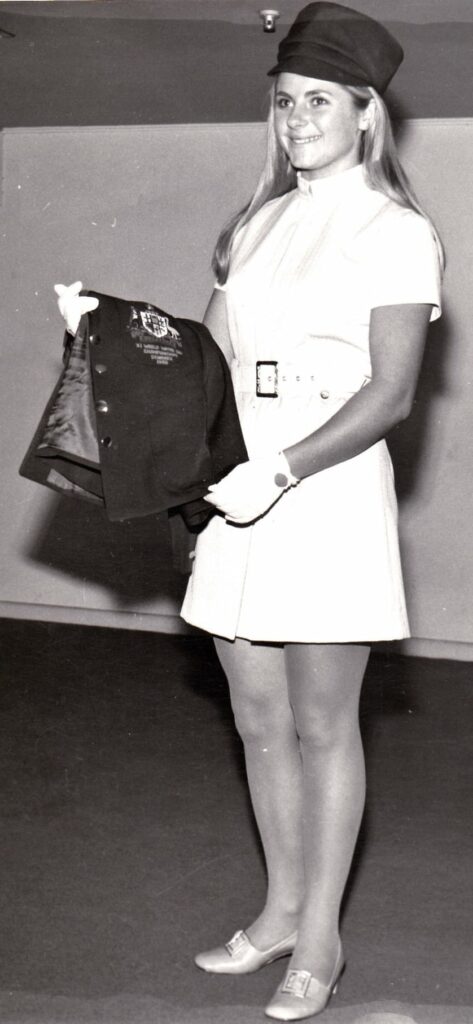
Kaye Thurlow at the 1969 World Water Ski Championships

Kaye Thurlow receives her Australian team blazer for the 1969 World Championships in Denmark (image: VINTAGE WATER SKI PHOTOS)

Kaye Thurlow Faulkner

Confirmed professional titles (1968-1977): 23 — 2 slalom, 5 tricks, 7 jump, 9 overall

Kaye Thurlow Faulkner was one of the dominant women of the early professional era.

She represented Australia at five consecutive World Championships from 1967 through 1975, collecting eight medals across tricks, jump and overall. She also competed in the 1972 Olympic demonstration in Munich, finishing second in tricks, jump and overall.

Her greatest stage was the Moomba Masters.

Thurlow Faulkner won 20 titles on the Yarra River, including eight overall championships. To this day, no skier has exceeded her record haul of Moomba Masters victories.

In the early years of professional skiing in the United States, she also tasted success. At the 1976 California International Cup, she narrowly missed a clean sweep after falling in tricks to Florida’s Pam Folsom, but took the slalom, jump and overall titles.
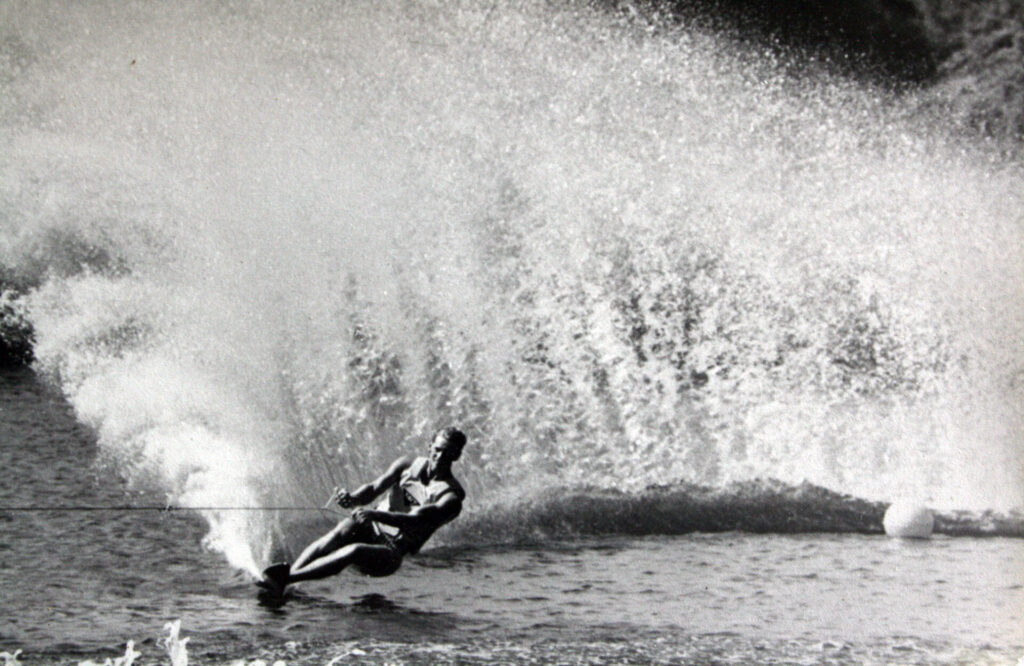
Colin Faulkner slalom skiing

image: VINTAGE WATER SKI PHOTOS

Colin Faulkner

Confirmed professional titles (1965-1970): 4 . 1 Slalom, 1 Tricks, 1 jump, 1 overall

Completing the second husband-and-wife duo on this list, Colin Faulkner was a mainstay during the first decade of the Moomba Masters, winning jump in 1965, slalom and overall in 1967, and finally tricks in 1970.

It may be tempting to dismiss his achievements as coming at a far-flung tournament that was still in its fledgling years, but Faulkner’s victories came against visiting superstars such as Chuck Stearns, Mike Suyderhoud and Ricky McCormick throughout the late 1960s. They were no small feats.

Faulkner also set an unofficial world slalom record in 1966, before the IWWF kept official records, with two buoys at roughly 13 meters (32 off) and 61 kph (38 mph). It came in the last year before the men’s top speed was reduced to 58 kph (36 mph).

During this period, he also became the first Australian to win a World Championship medal, finishing runner-up in men’s slalom in both 1967 and 1969.

Margaret Calvert Australian Waterski Hall of Fame

Image: Waterski and Wakeboard Australia

Margaret Calvert

Confirmed professional titles (1963-1967): 10 — 2 slalom, 3 tricks, 3 jump, 2 overall

Margaret Calvert was the greatest champion of the early years of the Moomba Masters.

In 1965, she became the first, and to this day the only, woman to sweep the Moomba Masters, winning slalom, tricks and jump and, naturally, the overall title.

She came close to repeating the feat in 1967, again winning all three events, although the overall title ultimately went to South Africa’s Deidre Barnard under the scoring system used at the time.

A professional show skier who honed her craft at Surfers Paradise Ski Gardens, Calvert’s winning streak across the Moomba Masters and Australian Nationals during her short competitive career remains unmatched.

Colin Birmingham 1961 World Championships

image: VINTAGE WATER SKI PHOTOS

Colin Birmingham (1962)

Confirmed professional titles (1962): 4 . 1 Slalom, 1 Tricks, 1 jump, 1 overall

At the second edition of the Moomba Masters, Colin Birmingham became the first, and to this day the only, man to sweep a professional tournament.

Admittedly, Moomba was effectively a local derby in its first two years. It was not until 1963 that organizers managed to lure big names from abroad, including Hall of Famers Jimmy Jackson and Chuck Stearns.

But Birmingham was a mainstay of the Australian team from 1961 through 1967 and won four Australian titles. His sweep in Melbourne established the standard that every subsequent member of this club would strive to meet.

More than six decades later, Joel Poland has joined him.


Note: The records of professional wins from the last century are incomplete, and despite extensive research, some totals are almost certainly undercounts.

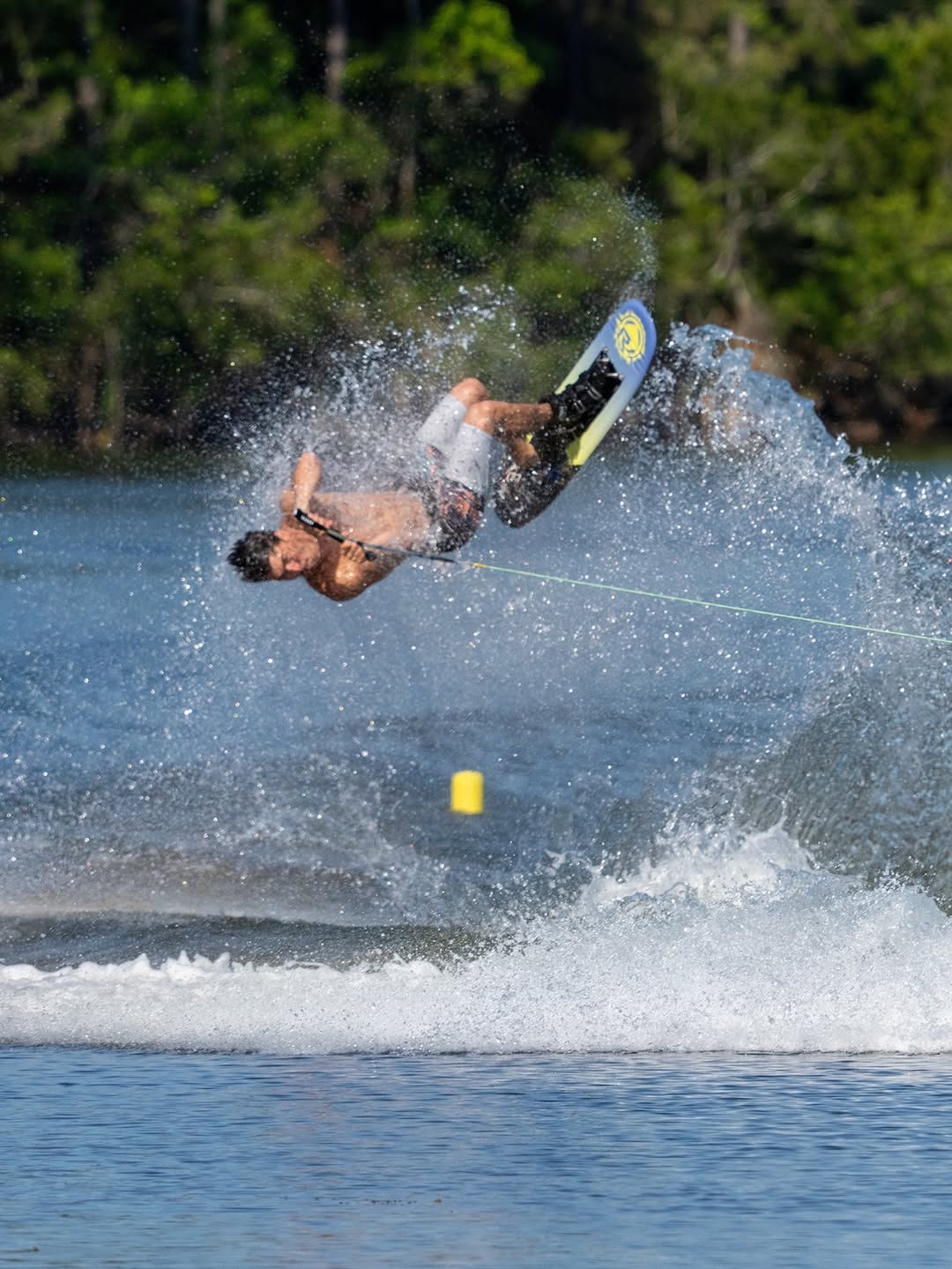
Joel Poland has set a pending Overall World Record (number 9 for Joel) at the Ski Fluid Classic in Florida, USA.

World Records in April? Water Skiing’s 2026 Season Is Already Out of Control

News

World Records in April? Water Skiing’s 2026 Season Is Already Out of Control

oel Poland has set a pending Overall World Record (number 9 for Joel) at the Ski Fluid Classic in Florida, USA.

Image: Johnny Hayward

By Jack Burden


Every water ski season begins with optimism.

Someone spent the winter visualizing a new gate. Someone found ten extra feet in the gym. Someone swears the new ski is different this time. Spring in central Florida is built on these small acts of faith.

Most years, April offers hints.

This year, it has offered a warning.

In the space of barely ten days, central Florida has produced pending world records in men’s tricks, women’s tricks, men’s overall, U21 men’s slalom, and U17 girls’ slalom. It has produced a trick skier who seems to have decided that 12,000 points is now simply his normal operating temperature. It has produced a women’s trick field where 10,000 points no longer feels like a headline, just the price of admission.

The sport has not eased into 2026. It has kicked the door off its hinges.

Trick skiing has entered its arms race phase

The loudest noise came first at Swiss Pro Tricks.

At times over the last decade, women’s trick skiing has felt like Erika Lang’s private territory, the kind of dominance that makes everyone else look like they’re playing a slightly different sport. In Clermont, she reminded everyone of that again, posting 11,610 points—a pending world record and her fourth consecutive Swiss Pro Tricks title.

“As if four consecutive titles weren’t enough,” the Waterski Pro Tour posted, “she also set a pending world record with 11,610 points.”

Normally, that would have been the week’s definitive women’s story. But Neilly Ross refused to leave it there.

At Swiss Pro Tricks, Ross ran three identical scores of 10,550—three rounds that were, by her own reckoning, a split-second timing decision away from 11,300. Days later at the Sunset Lakes EyeTrick Invitational, she removed the ambiguity entirely: 11,480 points, another pending world record if Lang’s is not approved.

“Beyond excited to put up this score especially this early in the season,” Ross wrote afterward, “and I can’t wait to try to keep pushing.”

That last part should concern everyone else.

Because behind Lang and Ross, the floor is rising too. Kennedy Hansen broke through with a personal best of 10,170. Alexia Abelson pushed to 9,490 at Swiss Pro Tricks and 9,740 at Ski Fluid, while also tying the U17 world slalom record with 3 at 10.75m (39.5 off).

Jake Abelson is making 12,000 look boring

The most dangerous sentence in trick skiing right now might be this: Jake Abelson scored another 12,000.

Because that sentence no longer surprises anyone.

At Swiss Pro Tricks, there were ten men’s scores over 12,000 points, with Abelson and Martin Labra both tricking over 12k in three consecutive rounds. Matias Gonzalez won with 12,860—a pro tournament record and his third straight Swiss Pro Tricks title—but even there, the larger story was the density of excellence.

The ceiling wasn’t just rising. The whole room was.

Then Abelson kept going.

At Sunset Lakes, he tricked over 12,000 again—four consecutive rounds. Then at the Ski Fluid Classic, he went 13,270, a pending men’s world record that eclipsed the current 13,020 mark and leapfrogged Gonzalez’s own pending 13,240 from earlier this season.

Ten consecutive rounds over 12,000 points in eight days.

That number deserves to be read twice.

For years, 12,000 was the frontier, the score that separated contenders from theorists. Abelson has turned it into background noise. He is not chasing the edge anymore; he is moving it.

And the terrifying part for everyone else is that this doesn’t look like a hot streak. It looks like a new baseline.

Joel Poland may have ended the overall conversation

World overall records are usually acts of patience.

A buoy here. Forty trick points there. Half a meter in jump after six months of trying. The record tends to move by inches because it has to—three events leave very little room for dramatic leaps.

Joel Poland ignored all of that.

At Ski Fluid Classic, he put together the kind of round overall skiers spend entire careers imagining: 3 at 10.25m (41 off), 12,160 trick points, and 71.4 meters (234 feet) in jump.

A pending world overall record. If approved, his ninth.

But more than that, it felt like a declaration.

After years of incremental improvement, Poland didn’t inch the mark forward—he leaped over it. This was not survival overalling, scraping enough in one event to support brilliance in another. This was near-best-level skiing in all three disciplines at once.

“I’ve been chasing a record like this for years,” Poland wrote. “3 huge scores in the same round. Feels absolutely insane.”

It should.

Because this is the kind of record that changes the psychology of a discipline. It doesn’t just set the standard; it makes everyone else recalculate what is even realistic.

For the rest of the current men’s overall field, the target may now feel less like a record and more like a distant weather system.

The Ross family is apparently not interested in moderation

While Joel was rewriting overall math and Jake was redrawing trick boundaries, Charlie Ross quietly produced one of the scariest slalom tournaments of the year.

At April Turns on Lake Ledbetter, he ran 2 at 9.75m (43 off), a pending U21 world record and Open Canadian record. More ominously, he ran 10.25m (41 off) in three consecutive rounds and looked, by his own admission, like he left more out there.

“Felt close to WR… 👀”

That emoji may be the most threatening punctuation of the spring.

Because 43 off is never an accident. Repeating 41 off is even less so. This wasn’t one miracle pass. It was the profile of a skier who has moved into a different category.

And in a family already producing world records through Neilly, it feels almost unfair.

Florida has always been full of talented ski families. Some seasons, though, one family starts to feel like its own federation.

A season that already feels too big for April

Sports are at their best when records stop feeling exceptional.

Not because records matter less, but because expectations change. The audience recalibrates. Athletes recalibrate. What looked impossible six months ago becomes the thing you’re annoyed not to see.

That is where water skiing seems to be heading.

Women’s trick is becoming a record race. Men’s trick is turning into a weekly escalation. Overall may have just been blown open by one absurd round. Slalom’s next generation is running 41 off and hinting that it should have been more.

Usually, April is for possibility. This year, April has looked like prophecy.

There will be bad weekends. There will be missed gates, edges caught, tailwinds, and all the usual reminders that water skiing remains gloriously unreasonable. Not every pending record will survive paperwork and video review.

But that almost misses the point.

The point is that the sport already feels faster, higher, and less polite. The point is that ten days in central Florida made the rest of the 2026 season feel like required viewing.

And if this is what spring looks like, summer might get ridiculous.

Joel Poland overall World Record

Joel Poland’s WWS Fluid Cup Overall Record Officially Ratified by IWWF

Repost

New IWWF World Open Men’s Waterski Overall Record Approved

Joel Poland overall World Record

Image: @bretellisphotography

IWWF


IWWF’s 2024 Male Athlete of the Year, Joel Poland of Great Britain, has once again rewritten the history books. The IWWF World Waterski Council has officially approved a new World Open Men’s Waterski Overall Record, following another exceptional overall performance during the WWS Fluid Cup, held at Lake Grew in Polk City, Florida.

During round the finals of the event on 12 October 2025, Joel posted the following scores:

Slalom: 1.50 buoys at 10.25m (58kph)

Tricks: 12,160 points

Jump: 70.1 metres

These scores combined for an Overall Total of 2,716.07 points, surpassing his previous world record and marking yet another milestone in his already remarkable career.

This new achievement follows Joel’s 2023 and 2024 world overall record-breaking performances, cementing himself as the most dominant overall skier in history.

Congratulations Joel!

Champions Crowned! Travers Cup

Watch: Champions Crowned! Travers Cup | World Water Skiers

Video


Champions Crowned! Travers Cup – Overall Tour Finals Highlights – (S2:E4)

World Water Skiers


Epic Finish to the WWS Overall Tour — The Travers Cup Did Not Disappoint! The final stop of the 2025 World Water Skiers Overall Tour brought incredible skiing across the board — men and women going all-out for the win, shaking up the Travers Cup podium and final Tour standings for 2025!

Congrats to all the athletes who left everything on the water — true overall champions in every sense.

Travers Cup Official Event Page – https://worldwaterskiers.com/tourname…

2025 WWS Fluid Cup

Watch: Records Shatter Again at Fluid | World Water Skiers

Video


Records Shatter Again at Fluid – 2025 WWS Overall Tour (S2:E3)

World Water Skiers


Fluid where legends are made! Another tight race to the top, and the tightest cut in history to make it to the finals. 16-minute action-packed recap at the Fluid Cup, of the world best men and women overall skiers in the world!

Watch the world’s best water skiers face off in a battle of skill, resilience, and determination. Every storyline, every stop, every moment has built up to this – who will claim the top spot on the podium at the 3rd Stop of the 2025 season?

🔗 Official Event Page: https://worldwaterskiers.com/tourname…

Joel Poland Keeps Breaking World Records — and Making It Look Easy

The Joel Poland Effect: When World Records Become Routine

News

The Joel Poland effect: When world records become routine

Joel Poland Keeps Breaking World Records — and Making It Look Easy

Image: @bretellisphotography

By Jack Burden


POLK CITY, Fla. — At this point, Joel Poland breaking world records is starting to feel routine. It shouldn’t.

At the WWS Fluid Cup this past weekend, Poland posted 1.5 @ 10.25m (41 off), 12,160 points, and a 70.1m (230 ft) jump to set a new pending men’s world overall record—again. The scores not only secured his 11th consecutive victory on the World Water Skiers Overall Tour, but also locked up his 2025 season championship.

This is now the fifth time Poland has set a pending world record in a professional event. That detail matters. For most of the 21st century, world records and professional competition existed in separate universes. Records fell in quiet backyard settings—perfect lakes, no pressure, no crowds—while the pro circuit was left to battle under public scrutiny. Before Poland’s 2023 record at the Overall Tour Finals, no skier had broken a world record in a professional tournament in 15 years.

“I came in today with no expectations,” Poland said after the round. “Just tried to survive, and that’s usually when things click. To put that together in a pro tournament—it means a lot.”

Since that breakthrough, Poland’s dominance has helped collapse the wall between record chasing and professional competition. The sport has followed his lead. Regina Jaquess’s 5 @ 10.25m at the 2023 Malibu Open marked the first slalom record in pro competition since 2008. Pato Font has equaled or exceeded the world trick record multiple times at pro events in the past two seasons. Erika Lang and Neilly Ross traded records this summer at the Botaski ProAm.

In the early 2000s, world records at pro events were common; between 2006 and 2022, they virtually vanished. That they’re now reappearing points to something bigger—the collective level is simply that high.

And it’s not just Poland pushing it. At this year’s World Championships, both Louis Duplan-Fribourg and Dorien Llewellyn posted preliminary-round scores higher than any world record prior to Poland’s current reign. Even Tim Wild’s bronze-medal total would have won nearly any Worlds this century. The field has caught up—and in doing so, it keeps pushing Poland even higher.

That’s the Joel Poland Effect: a circular feedback loop of greatness. His world-record form forces everyone else to raise their ceiling, and their response, in turn, drives him to break through again. What began as one skier’s exceptional run has become a rising tide for the entire sport.

At the Fluid Cup, Edoardo Marenzi, Rob Hazelwood, and Jake Abelson—all ranked inside the world’s top ten—missed the finals cut entirely. Poland himself trailed both Duplan-Fribourg and Llewellyn in prelims before storming back in the final.

“It’s a challenge to stay even across all three events,” Poland said. “You have moments when jump’s good, slalom’s good, tricks good—but getting them all in one round is hard.”

The women’s side mirrored that same depth. Just days before the event, the IWWF officially approved Hanna Straltsova’s world overall record, surpassing Natallia Berdnikava’s 13-year-old mark. And at Fluid, Kennedy Hansen, Giannina Bonnemann Mechler, and Regina Jaquess delivered one of the season’s tightest title battles, with Hansen emerging victorious.

Overall records are supposed to be the hardest to break. Every variable—conditions, timing, performance—has to align perfectly. Before Poland, no skier in history had broken an overall record more than four times in their entire career. Poland now stands on the verge of his eighth in just three and a half years.

He’s 27. His best may be yet to come.

Hanna Straltsova world record

Straltsova Ends 13-Year Reign with New World Record

Media

Hanna Straltsova ends 13-year reign with new women’s overall world record

Hanna Straltsova world record

Image: @skifluid

By Jack Burden


Thirteen years. A third of a point. A new name at the top.

At the Bill Wenner Memorial Record tournament in central Florida earlier this summer, Hanna Straltsova delivered one of the most complete performances in the history of water skiing—setting a new women’s world overall record with 5 buoys at 11.25 meters (38’ off), 8,890 points in tricks, and a 59.8-meter (196 ft) jump. The combination earned her 2,581.39 overall points, edging past Natallia Berdnikava’s legendary 2012 mark by just 0.27 points—the narrowest margin ever to decide an overall world record.

It’s a fitting milestone for Straltsova, who this season defended both her World Overall and Jump titles at the IWWF World Championships in Recetto, Italy, and clinched the Waterski Pro Tour Jump crown after another undefeated season.

Berdnikava’s 13-year record—3@11.25m, 9,740 points, and a 58.0m jump—had withstood an entire generation of challengers. Straltsova had been knocking on the door for several seasons before finally combining her best across all three events to surpass it.

Once known primarily as a jumper, Straltsova has quietly evolved into one of the sport’s most complete athletes—her recent gains in slalom in particular pushing her into new territory. With this record, she doesn’t just add another accolade; she breaks through the old ceiling, potentially opening the door to a new era in women’s overall skiing alongside rising contenders like Giannina Bonnemann Mechler and Kennedy Hansen.

2025 WWS Austria Cup

Watch: Champions Collide in Austria | World Water Skiers

Video


Champions Collide in Austria – The Best Water Skiers in the World | 2025 WWS Austria Cup (S2:E2)

World Water Skiers


Welcome to the second stop of the 2025 World Water Skiers Overall Tour — the WWS Austria Cup in Linz, Austria, September 6–7. The world’s best water skiers battled across Slalom, Trick, and Jump, carrying the momentum from Canada into another weekend of spectacular performances.

With crucial Tour Points on the line, every pass, flip, and jump brought us closer to deciding the 2025 WWS Overall Tour Champions. Next up: Orlando, Florida, October 11–12, for Stop #3 of the Tour.

Enjoy the action — and be inspired by these incredible athletes!

🔗 Official Event Page: https://worldwaterskiers.com/tourname..

Charlie Ross slaloms at the 2025 World Championships

The Highest-Scoring Worlds in History? Recetto Delivers Water Skiing’s Next Level

News

The highest-scoring worlds in history? Recetto delivers water skiing’s next level

Charlie Ross slaloms at the 2025 World Championships

Image: @bearwitnesssportsphotos

By Jack Burden


RECETTO, Italy — For six days in northern Italy, water skiing seemed determined to burst out of its own history. The 2025 World Championships were not just a contest for medals but a collision of eras: champions fighting to defend their crowns, teenagers breaking through the gates, and performances that stretched the sport into new territory.

It didn’t start that way. The opening days were reshuffled by storms, rain smearing across the placid waters of Recetto. But by Friday the skies cleared, the wind fell flat, and the lake turned to stillness. What followed was a rush of personal bests — especially in jump, where skiers pushed themselves farther than anyone thought possible.

The Prelims: Cracks in the Armor

Joel Poland walked down the dock on Friday with the casual confidence of a man who had won everything there was to win. Tricks has always been his insurance policy in overall, the foundation of his dominance. And yet, in a mirror of his stumble at the last Worlds, he went down early.

“That was just heartbreaking,” Poland admitted later, frustration in his voice. “Like a dream… gone, again.”

The mistake rattled the field. Pato Font and Mati Gonzalez wobbled through their passes. The cut line fell to its lowest in nearly a decade — not from weakness, but nerves. Suddenly, the men’s trick final looked wide open.

On the women’s side, it was the opposite. Regina Jaquess and Jaimee Bull tore through 10.75m (39.5′ off) with machine precision, while 22-year-old Kennedy Hansen quietly put together personal bests in both slalom and jump. By the end of Friday, she was in the mix for overall medals — and a genuine threat to Hanna Straltsova’s iron hold on the crown.

Saturday Fireworks

By Saturday the tournament had caught fire.

Men’s slalom provided the starkest reminder of how far the sport has evolved. For the first time in history, a piece of three at 10.25m wasn’t enough to guarantee a finals spot. Twelve skiers, all within a buoy of one another, crammed the leaderboard. Even Poland, hoping to rebound, was squeezed out with 2.25 at the pass.

Tricks went ballistic: seven women cracked 9,000, with Erika Lang and Neilly Ross punching past 11,000 for the first time ever at Worlds. “It’s hard in prelims — you just want to secure your spot,” Ross said afterward. “Hopefully tomorrow I can just go and go fully.”

And then came men’s jump. Dorien Llewellyn, after three years battling injury and inconsistency, soared 69.6m (228 feet) — his longest since 2021. The leap pushed him into the overall lead, just 13 points clear of Louis Duplan-Fribourg, setting up the tightest overall showdown in recent memory.

Ryan Dodd and Poland tied for the lead at 70.5m (231′), a strange echo of their summer duel at the California ProAm. Everywhere you looked, it felt as if the old guard and the new blood were destined to collide.

Finals Sunday: A Collision of Eras

By Sunday the tournament had shed its nerves. The storms were gone, the prelim jitters gone. The water in Recetto lay flat, as if it knew history was waiting.

Tricks: Margins Measured in Frames

Tricks is the cruelest event because immortality and anonymity can hinge on a single freeze-frame. For decades, only the judges saw those margins. This time, thanks to EyeTrick, everyone did. Fans could watch a world title swing on whether a toe slide was rotated 90 degrees or 85.

The women’s final was billed as a heavyweight clash: Lang’s innovation, Ross’s precision, Anna Gay Hunter’s pedigree. But the first half of the field faltered, pressing too hard on risky runs. Hunter steadied things with 10,730, matching her prelims to lock in a medal. Lang went next, laying down a world record run, but missed the rope on her ski-line back-to-back. Three hundred points vanished in an instant.

That left Ross. At 24, she has often played second fiddle to the older Lang or Hunter. But in the past year has found another gear. Two immaculate passes later, the scoreboard confirmed what her posture already said: World Champion.

“I haven’t won a Worlds since 2017,” Ross said, shaking her head. “Every single one since then I’ve just kinda blown it. We made this the goal — do my run. Today I just went for it. I really wanted this one.”

The men’s event spiraled into chaos. Defending champion Font posted 12,010. Then Gonzalez — all velocity and audacity — strung together a blistering 5,500-point toe run, backing it with a clean hand pass for 12,410. It forced the rest into desperation.

Llewellyn, trying to put the overall race out of reach, sank in disbelief after a miscued landing. Abelson, the wunderkind and world record holder, seemed composed — until the scoring system caught him. A rushed toe slide, four judges ruling it under-rotated, pushed his buzzer beating toe-line-front out of time. His final total: 12,400. Ten points short.

Ten points. The smallest possible increment in trick skiing. The kind of number that sticks forever.

When Duplan-Fribourg couldn’t repeat his prelim magic, Gonzalez was champion — speechless on the dock. “It feels amazing,” he stammered. “It was my dream… now I can say I did it. Congrats to Jake too — he’s one of the best in the world. We have the best here.”

Slalom: The Old Guard Meets the Future

Women’s slalom opened with an unlikely spark. Sade Ferguson, once a junior jump prodigy until injuries derailed her career, returned as if she’d never missed a season. Her 5 @ 10.75m was a huge personal best and an early lead.

Allie Nicholson scraped half a buoy past it. Jaimee Bull, calm as a metronome, became the first to run 10.75, but faltered at 10.25 with a botched S-turn for just one and a half. Regina Jaquess, chasing history, fought through 10.75 off but couldn’t get her ski outside of two at 10.25. The shoreline knew instantly what it meant: Bull, 25 years old, three straight World titles.

“I can’t really believe three in a row,” Bull said. “Two felt crazy. Today I didn’t think that was enough — but it was.”

The men’s final felt like two different sports at once: veterans clinging to relevance and a new generation kicking the door down. Freddie Winter bowed out early. Will Asher, seemingly reborn, posted five at 10.25 and celebrated like a man half his age. Then Nate Smith made 10.25 look like a warm-up, forcing the others to gamble.

One by one they failed — until Charlie Ross, 20 and fresh off his first pro wins, matched Smith. He ran 10.25 smoother than anyone, tying at 9.75 to force the runoff. Smith, the most reliable closer the sport has ever known, prevailed. But Ross walked away with proof he belonged in the deepest end of the pool.

“I’ve never even tried 41 off the dock in practice,” Smith admitted afterward. “At two, a lot goes through your head — should I stand up, should I turn it? But today, yeah… I’m pretty happy. That’s cool.”

Jump: Shaved Heads and Broken Dynasties

Jump was the crescendo, the shoreline swelling with every flight. The women’s final opened with personal bests — Maise Jacobsen, Aaliyah Yoong Hannifah both cracking 50 meters — before Brittany Greenwood Wharton, back from injury, hit 54.4m (178 feet), her longest in years. Straltsova needed only two jumps to secure the crown and her golden double. “I’m so happy,” she said simply. “It’s hard to defend.”

The men’s jump final had more plotlines than an HBO drama. Tim Wild, just 18, came off the lower ramp and went 68.1m — ten days earlier he’d never cracked 60. Bronze overall, his name now etched into the sport’s future. Duplan-Fribourg faltered in his overall defense, leaving Llewellyn to claim the title he’d chased for years.

But the jump crown itself belonged to Poland. His opening leap — 72.1m, the biggest of his life and a new European record — stopped the shoreline in its tracks. He passed his next two, gambling it would hold. It did.

Ryan Dodd, five-time champion, threw everything he had, cracked 70, but fell short. With that, three decades of North American dominance — Krueger, Jaret, Dodd — ended. Poland’s elation as he hit the water carried something more than victory. It carried release.

“Yeah, that was unreal,” he said, still buzzing. “This shaved head… I might have to keep it. It seems to be working. Over the moon.”

A New Benchmark for the World Championships

In the end, the numbers told the story. Recetto didn’t just host a World Championships — it redefined what one looks like. The cut to make the finals in men’s slalom, men’s jump, and women’s tricks was the highest in history, a staggering testament to the depth of talent on display. Tournament records fell or were matched in women’s tricks, men’s slalom, and women’s slalom, while the podiums in both men’s and women’s slalom and tricks went down as the four highest-scoring in the sport’s history.

The pattern extended across every discipline. The men’s jump final produced the second-highest podium ever, as did the men’s overall — each pushed to the brink by athletes refusing to give an inch. And beyond the headlines and record books came the quieter triumphs: the countless personal bests, the season-best performances, the moments where skiers left the dock knowing they had just redefined their own ceiling.

That’s what made Recetto different. This wasn’t simply another Worlds where one or two stars lifted the level. It was a collective surge, a field-wide elevation that left even veterans shaking their heads. When the dust settles, 2025 may well be remembered as the World Championships where water skiing itself moved to the next level.

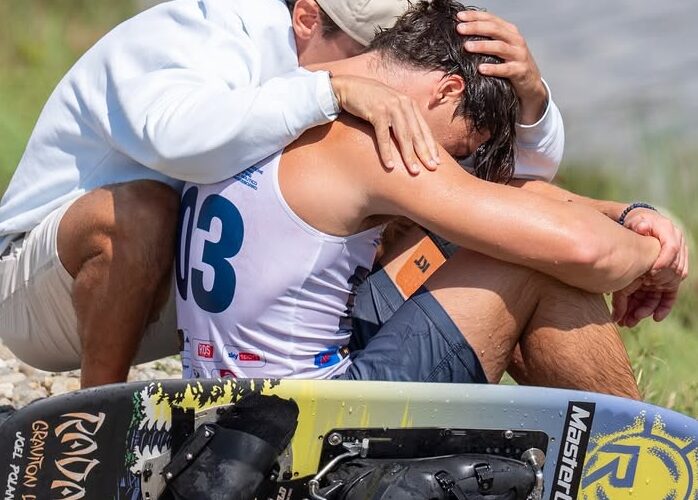
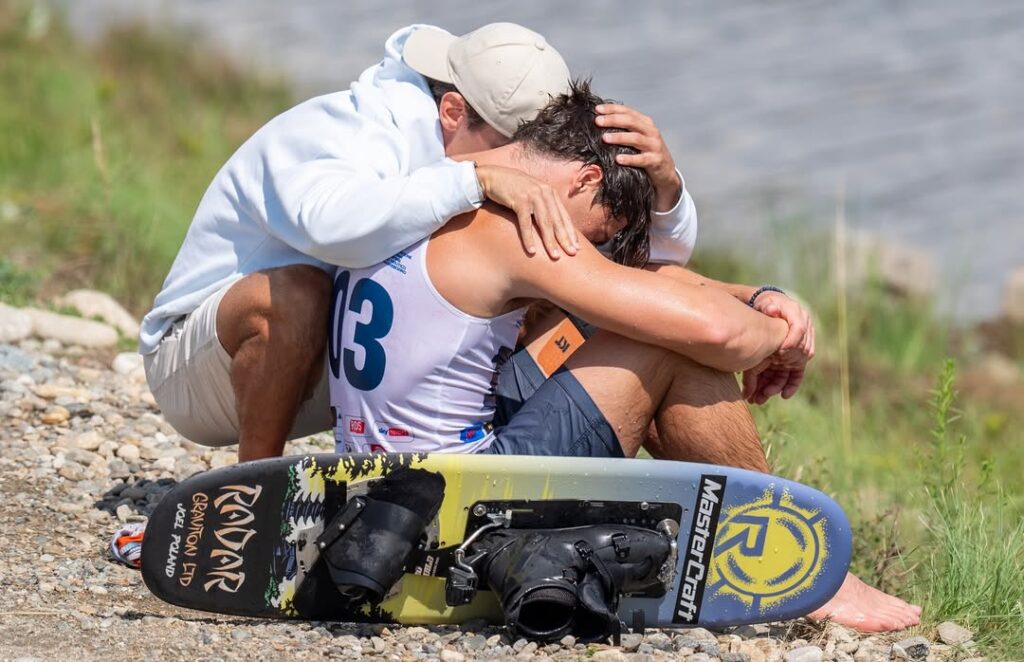
Joel Poland of Great Britain is consoled by friend Edoardo Marenzi of Italy after Poland fell early in his trick run during the 2025 IWWF World Waterski Championships at Parco Nautico del Sesia in Novara, Italy.

The Unsolvable Puzzle of Joel Poland at the World Championships

Articles

The unsolvable puzzle of Joel Poland at the World Championships

Joel Poland of Great Britain is consoled by friend Edoardo Marenzi of Italy after Poland fell early in his trick run during the 2025 IWWF World Waterski Championships at Parco Nautico del Sesia in Novara, Italy.

Image: @bearwitnesssportsphotos

By Jack Burden


The storm had blown through. The lake flattened. The crowd, swelling with anticipation all week, angled in for a clear view of the skier many consider the greatest of his generation. After seven world records and nine consecutive professional overall titles, a Joel Poland world crown was beginning to feel like a foregone conclusion.

His toe pass was vintage Poland: powerful, explosive, all big tricks and high-octane energy where most competitors rely on precision and speed. Only a slight miscue at the end hinted at vulnerability. Then came his hand pass — his strongest suit. Commentators couldn’t help but bring up the ghosts of two years earlier, when he submarined on his signature super-mobe-five, only to mount one of the most famous comebacks in World Championship history.

But this time, Poland never even got that far. Midway through an otherwise routine sequence — mobe, mobe, half-jack — he stumbled on a front flip, one of the most basic tricks in his arsenal. Suddenly, the man who makes the impossible look effortless was swimming, staring in disbelief as the moment slipped away.

On the shore, images of Poland sitting slumped, head in hands, echoed the heartbreak of 2023. For the swashbuckling superstar who has turned everything he touches to gold, it was another inexplicable collapse on the sport’s biggest stage.

Since claiming his first world title in 2021, Poland has been untouchable on the professional circuit. He has entered 14 pro overall events, winning all but two, and hasn’t lost a WWS Overall Tour event since October 2022. Tricks — the most cutthroat of the three disciplines — have been the foundation of that success.

In 26 rounds of tricking on the Overall Tour, he’s dipped below 10,000 points only twice, both back in 2022. Across 35 pro starts in tricks, he’s failed to hit that mark only once in the last three years. His career average since 2021 sits comfortably above 11,000. Most remarkably, he has never missed a final at a professional overall or trick event.

Measured by consistency, no male tricker can match him. Pato Font and Matias Gonzalez have piled up more outright wins, but neither boasts Poland’s 80-plus percent podium rate. As Joel himself has put it countless times: “Overall’s about not screwing up.” For half a decade, no one has been better at not screwing up.

Except, it seems, at the World Championships.

For the second straight cycle, Poland’s Worlds campaign unraveled in tricks. The contrast couldn’t be sharper: invincible on the Tour, error-prone at the marquee event. It’s hard to reconcile the two Joels — the unstoppable force who has redefined overall skiing, and the athlete undone by the same mistakes at the same tournament.

This wasn’t always the case. Poland burst into public consciousness with a triple-gold performance at the 2019 Under-21 Worlds, nearly breaking the world overall record in the process. Later that year, he shocked pundits by medaling twice at the Open Worlds. His defining moment came in 2021, in a gladiatorial duel with Dorien Llewellyn that ended with Poland setting a new world overall record to clinch gold.

But since then, Worlds has turned from proving ground into stumbling block. Whether it’s the weight of favoritism, overtraining, or just cruel coincidence, no one — perhaps not even Poland himself — can explain why the sport’s most consistent tricker has reserved his only missed finals for its most important event.

Poland’s misstep reopens an old tension in water skiing: is the World Championships truly the measure of the world’s best?

Many argue no. After winning Worlds in 2023, Freddie Winter himself admitted he had spent the year chasing Nate Smith, usually finishing second to him on Tour. By every measure of consistency, Smith was the best slalomer that year — yet Winter walked away with the title that mattered most.

There’s logic in rewarding consistency. Series and season-long circuits, like the Waterski Pro Tour, offer larger sample sizes that cut through the noise of off-days or lucky breaks. By that standard, Poland — undefeated for 11 months in jump and two years in overall, breaking multiple world records, and banking more prize money than anyone else — is indisputably the best skier on Earth. No one, male or female, has been more dominant in 2024 and 2025.

But the counterargument carries weight too. Not every elite skier can travel the Tour. Financial realities mean many of the sport’s best — Nate Smith, Regina Jaquess — skip most pro stops. The Worlds remains the one event where the entire field gathers, each athlete peaking for that week. Its self-fulfilling prestige lies in that convergence.

For Poland, the paradox endures. By almost every metric, he’s the standard-bearer of modern skiing — a generational talent redefining what’s possible. Yet on the one stage that crowns legends, he has twice fallen short.

Maybe it’s fate. Maybe it’s the cruel symmetry of sport. Or maybe it’s just a reminder that no matter how inevitable greatness feels, nothing in the World Championships is ever guaranteed.

The World Championships run from August 26-31 and will be broadcast live on TWBC.