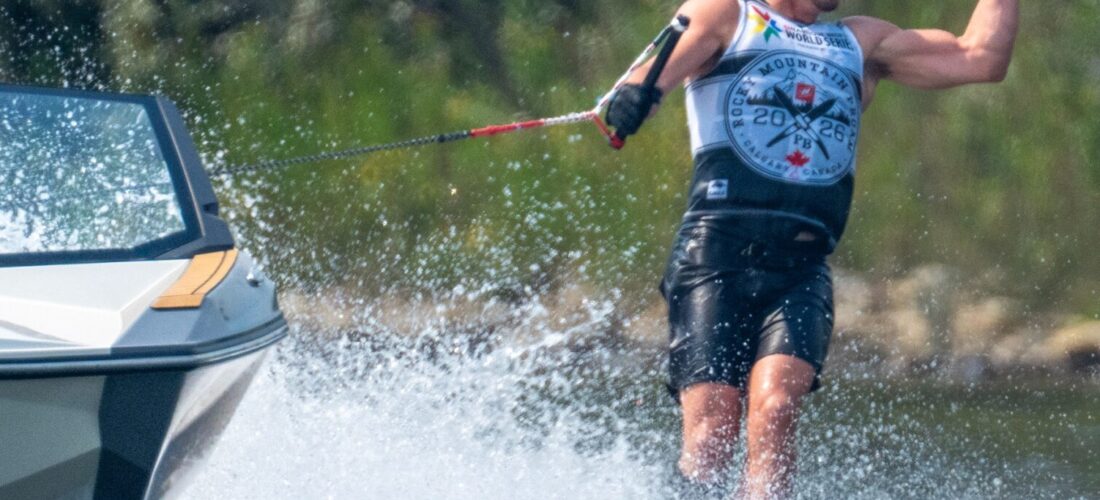
Joel Poland makes history at a Rocky Mountain ProAm full of drama
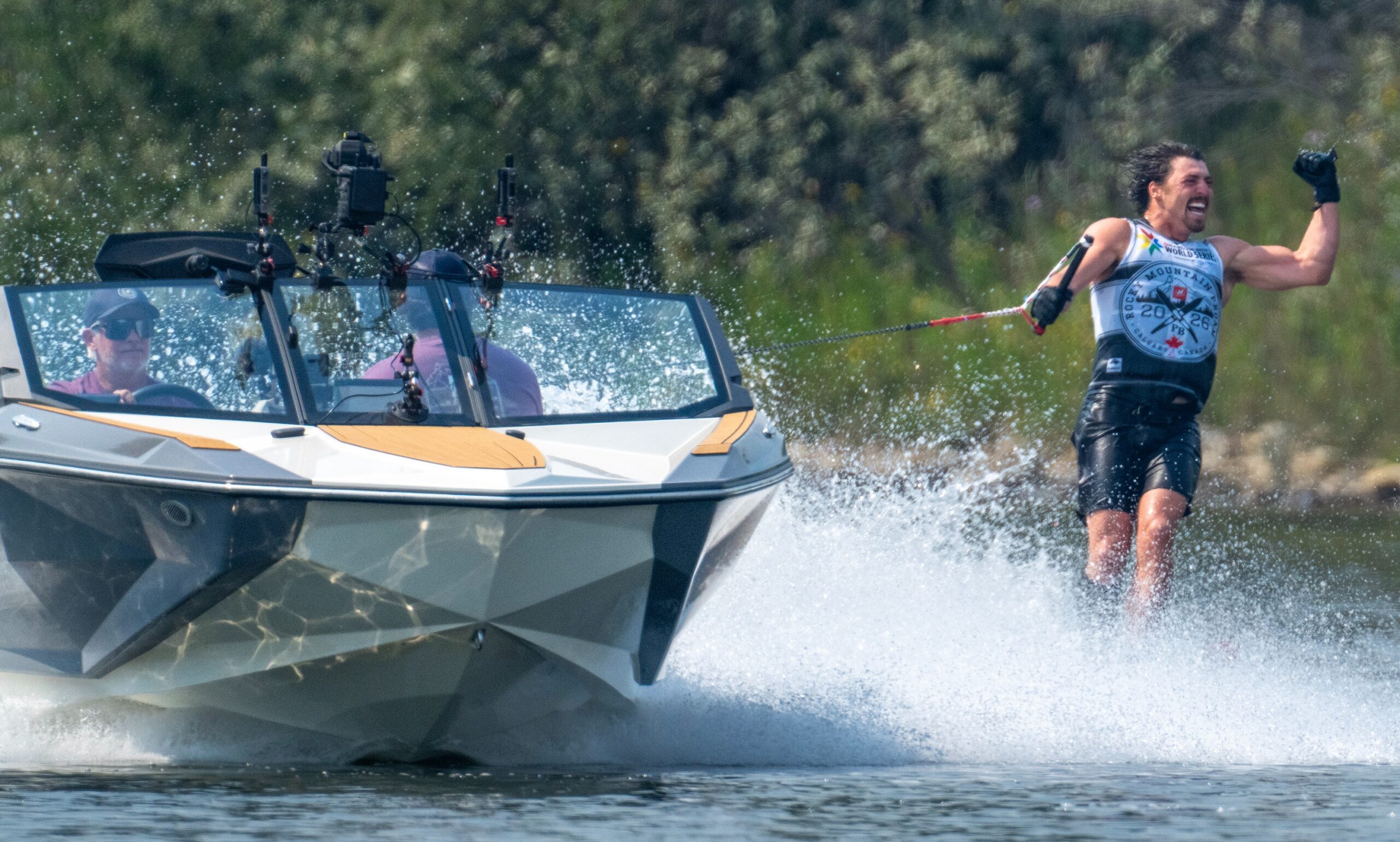
Image: @bearwitnesssportsphotos
By Jack Burden
For a tournament making its debut, the Rocky Mountain ProAm did not lack for material.
There were world-record performances, national records, personal bests, a runaway winning streak extended, a handful of bone-crunching crashes and, at the center of it all, a professional water skiing milestone more than a decade in the making.
Joel Poland finally won a professional slalom title.
Poland had already done almost everything there is to do in professional water skiing. He has won world titles, professional jump titles, overall titles and trick titles. He has been the dominant overall skier of his generation and, in recent seasons, the best jumper in the world. Slalom, however, had remained the conspicuous omission from his résumé.
It took a fairly chaotic final to change that.
Poland opened the men’s slalom final with 3 @ 10.25m (41 off). It was a good score, but not one that seemed likely to hold up. Poland himself looked frustrated after failing to turn the third buoy and missing the opportunity to push farther down the pass.
Then the specialists started skiing, and one after another they failed to beat him.
Charlie Ross, celebrating his 21st birthday, matched Poland with 3 @ 10.25m, continuing a remarkable 2026 season in which the Canadian has established himself as the dominant force in men’s slalom. With Will Asher still waiting on the dock, however, it looked as though the veteran might once again find a way through. Asher had posted the best score of the preliminary rounds, 5 @ 10.25m.
Instead, Asher popped the handle around one at 10.25m.
He came out of the water with both hands raised, seemingly unable to believe what had just happened.
That left Poland and Ross tied for the win and headed into a runoff.
Ross went first and looked to be cruising through the opening 10.75m (39.5′ off) pass before falling coming out of five. Poland then had six buoys standing between himself and the title. He made no mistake.
The celebration that followed said more than the result itself. Poland threw his arms into the air and celebrated on the water with the kind of emotion that comes when something has been sitting in the back of your mind for a long time. He had finally won a professional slalom title.
The victory also completed an unusually difficult three-event résumé. Poland became only the second skier this century, after Regina Jaquess, to win professional titles in slalom, tricks and jump. The last man to accomplish the feat was Australia’s Mick Neville over 35 years ago.
For a skier whose career has been built around being good at everything, it was a fitting box to finally check.
Tricks were just as good
The men’s trick competition produced some of the biggest numbers of the weekend, beginning with Matias Gonzalez’s 13,140-point performance in the first preliminary round. The score is pending as a new world record and continued a remarkable run of record-level tricking from Gonzalez this season.
He did not win the tournament.
Jake Abelson took the final, but only just. Thirty points separated Abelson from Gonzalez, a margin smaller than a side slide, in another men’s final contested around the 13,000-point mark. Abelson’s 12,820 was enough to beat Gonzalez’s 12,790 and give him his fourth professional victory of the season.
The depth of the field was notable, too. Dominic Kuhn broke 11,000 points in qualifying, setting a new personal best and Austrian national record, while Gonzalez and Abelson once again showed that 13,000-point performances are becoming less of an anomaly and more of a regular feature of elite skiing.
The women’s trick event was similarly deep.
Five women broke 10,000 points across the two preliminary rounds, something that had never happened at a single tournament before. Neilly Ross opened the weekend by setting a new Predator Bay course record with 10,280 points, only for Erika Lang to move the mark to 11,310 in the second round.
None of it ultimately mattered in the final.
Ross was the first skier to break 10,000, but Anna Hunter edged her by 40 points. That left Lang, who had just scored 11,310 in qualifying, with a chance to win the tournament. Instead, she fell on her second flip and finished well short of the score she had produced the day before.
Anna Hunter took the win with 10,500, just ahead of Ross at 10,460.
The most interesting number from the weekend, though, may have been 10,030. That was the score posted by 16-year-old Alexia Abelson, who broke 10,000 points for the first time and became just the eighth woman to reach the mark.
That list is getting longer.
Jaquess is still the standard
Women’s slalom offered another familiar result, although the way the weekend began suggested that it might not be so straightforward.
Jaimee Bull had one of the standout performances of the preliminary rounds, running 3 @ 10.25m and setting both a new personal best and Canadian national record. She matched Regina Jaquess’s score, and for a moment it looked as though the tournament might finally produce a different winner.
Bull could not repeat it in the final. She pulled up short at 3 @ 10.75m, leaving Jaquess in position to win yet another tournament.
Jaquess did exactly that, running 1.5 @ 10.25m to take her fifth professional slalom title of the season.
The 42-year-old remains undefeated in professional slalom in 2026. She may not appear at every event on the schedule, but when she does, the standard in women’s slalom still seems to move with her.
Jaquess also finished third in women’s jump, giving her another podium across the weekend.
Another win for Danisheuskaya, another for Poland
Aliaksandra Danisheuskaya began finals day by doing what she has done at every professional event she has entered this season: winning. Her victory in women’s jump extended her unbeaten run to all six professional events she has entered in 2026.
Poland followed with his first win of the day, taking men’s jump ahead of Luca Rauchenwald.
Poland jumped 64.4m (211′) in the final, enough to hold off Rauchenwald’s 63.3m (208′). Rauchenwald came into the event off two consecutive victories in Europe, but could not reproduce that form when the title was on the line.
It was Poland’s fourth professional jump victory of the season.
The cost of jump
For all the good skiing at Predator Bay, jump also provided the most uncomfortable moments of the weekend.
Maise Jacobsen and Damien Eade, two of the younger names beginning to establish themselves in the professional water skiing scene, suffered serious crashes that are expected to end their seasons. Will Roberts also took a nasty spill in the finals.
It was a reminder that the pursuit of bigger and bigger jump scores comes with a difficult trade-off.
The Rocky Mountain ProAm produced some spectacular skiing. It also produced several moments where there was nothing particularly spectacular about what happened afterward.
A tournament that still has some work to do
The skiing was not the problem in Calgary. The format was.
The best-of-two qualifying format is popular with athletes because it gives them two opportunities to put together a score and generally rewards consistency. It is much harder to make it compelling viewing, particularly when the field is small.
That problem was especially obvious at Predator Bay. In four of the six professional disciplines, there were not enough entries to require a cut to the finals, meaning everyone advanced automatically. The first two days therefore contained plenty of excellent skiing but very little that actually changed the outcome of the tournament.
For the athletes, that is probably not a bad thing. For spectators, it can feel like watching a series of practice rounds with a broadcast attached.
The distinction became obvious on Sunday.
When Poland and Ross took to the water, every pass mattered. When Asher unexpectedly dropped the handle, it mattered. When Ross faltered in the runoff, it mattered. When Poland went out knowing that six buoys at 10.75m would win him his first professional slalom title, there was no need to explain the stakes.
The same was true in tricks. Thirty points separated Abelson and Gonzalez, forty separated Hunter and Ross. One side slide could have changed either winner.
That is what professional water skiing needs more of. The skiing is already extraordinary. The challenge is creating a format that makes the audience feel the significance of what they are watching while it is happening.
Weather complicated things further. Strong winds affected Saturday’s skiing, and the Sunday schedule was rearranged so that the jumpers were on the water as the sun was still rising, followed by slalom and then tricks.
It was not an easy weekend to stage a tournament, but Predator Bay still delivered some remarkable numbers.
The Rocky Mountain ProAm was also the first event held as part of the new partnership between Nautique and Predator Bay, and the second stop of the inaugural Nautique Water Ski World Series. The series arrived in Calgary after a record-heavy opening event at Botaski and left with another collection of course records and a pending world record.
That is a pretty good start.
The next question is whether the series can turn those performances into a better sporting product for the people watching. Calgary showed that the athletes are capable of producing the drama. The next step is making sure the format gets out of the way and lets that drama breathe.
For one afternoon, at least, it did.
Joel Poland had five and a half buoys to win the slalom title he had been chasing for years. Erika Lang showed us that even the greatest of champions are mortal. Danisheuskaya put her winning streak on the line one more time. Nobody knew what was going to happen when each skier left the dock.
That is professional sport.
Water skiing can produce plenty of moments like that. It just needs more of them to feel like they matter.

Jake had another pending world record too.
I guess I got the timing wrong, I thought his 13,040 had already been approved. Incredible skiing regardless!
13040 was approved but at this torment he tricked 13070