2025 San Gervasio ProAm: Final Highlights – Waterski Pro Tour Stop 7
Catch all the excitement from the finals of the San Gervasio ProAm.
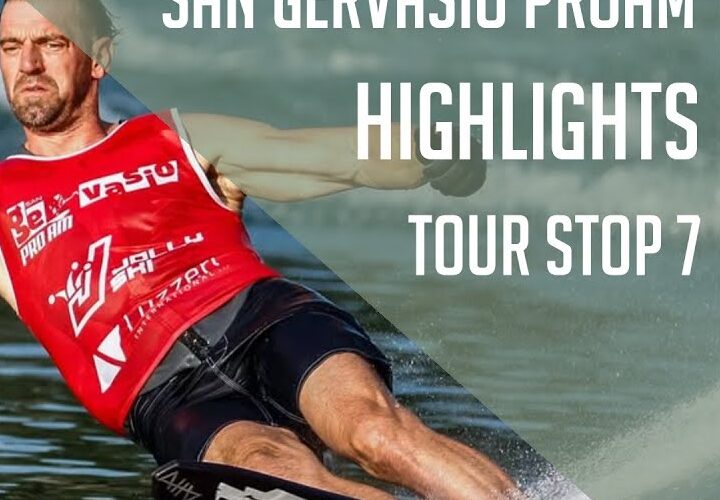
Catch all the excitement from the finals of the San Gervasio ProAm.
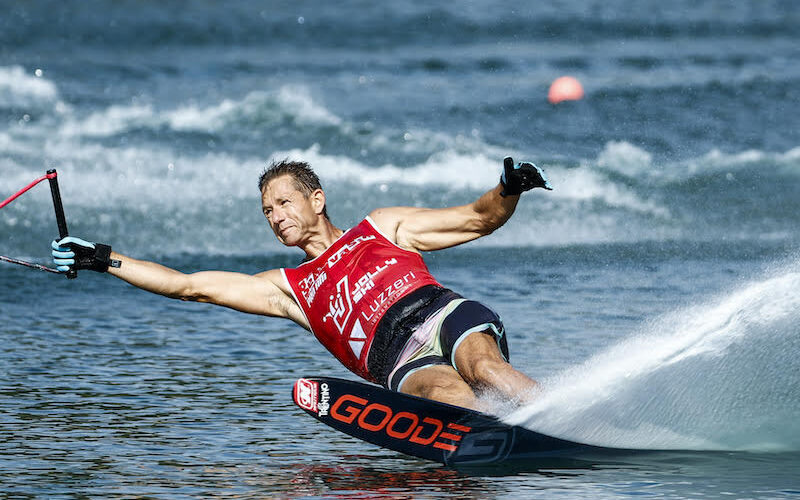

Image: @andrea_gilardi_fotografo
SAN GERVASIO, ITALY — The 11th edition of the San Gervasio Pro Am came to a close today, Sunday, July 6. One of the most anticipated stops on the world slalom (waterski) tour, the event offered a total prize purse of $24,000 and welcomed athletes from 23 countries, including both amateurs and professionals.
The final day delivered intense excitement with the Pro head-to-head finals, full of surprises and close battles. This eleventh edition was undoubtedly one of the most hard-fought, featuring some of the tightest matchups ever seen in both the men’s and women’s fields. The crowd was especially electrified by the final showdown between Italy’s multi-time European champion Thomas Degasperi and Great Britain’s Frederick Winter, a four-time winner of the event. Degasperi came out on top with a strong score of 1@10.25m, securing his second San Gervasio Pro Am title after his 2021 victory.
In the women’s competition, Canadian skier Jaimee Bull proved once again to be unbeatable. With a score of 5@10.75m, she successfully defended the title she won in 2024, reaffirming her status as the skier to beat—edging out a fierce young challenger, Alexandra Garcia from the USA.
A touch of disappointment for Brescia native and event organizer Matteo Luzzeri, who had been among the stars of Saturday’s qualifications with an excellent 3@10.25m, earning him fourth place. The local favorite was eliminated in the quarterfinals in a tight matchup against Degasperi, leaving the dream of a podium finish for another year. Similar fate for Italian skier Beatrice Ianni, who couldn’t get past American Allie Nicholson in the women’s quarterfinals.
There was also regret for rising local talent Florian Parth, and Italian teammates Vincenzo Marino and Carlo Allais, who did not qualify for the head-to-head finals.
Once again, the San Gervasio Pro Am confirmed itself as a must-attend event on the international waterski calendar—bringing together elite competition, pure passion, and a one-of-a-kind setting in the heart of Lombardy.
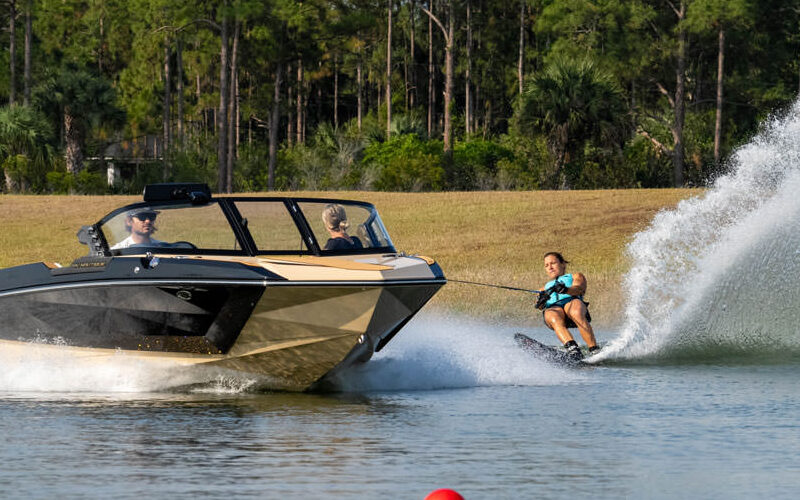
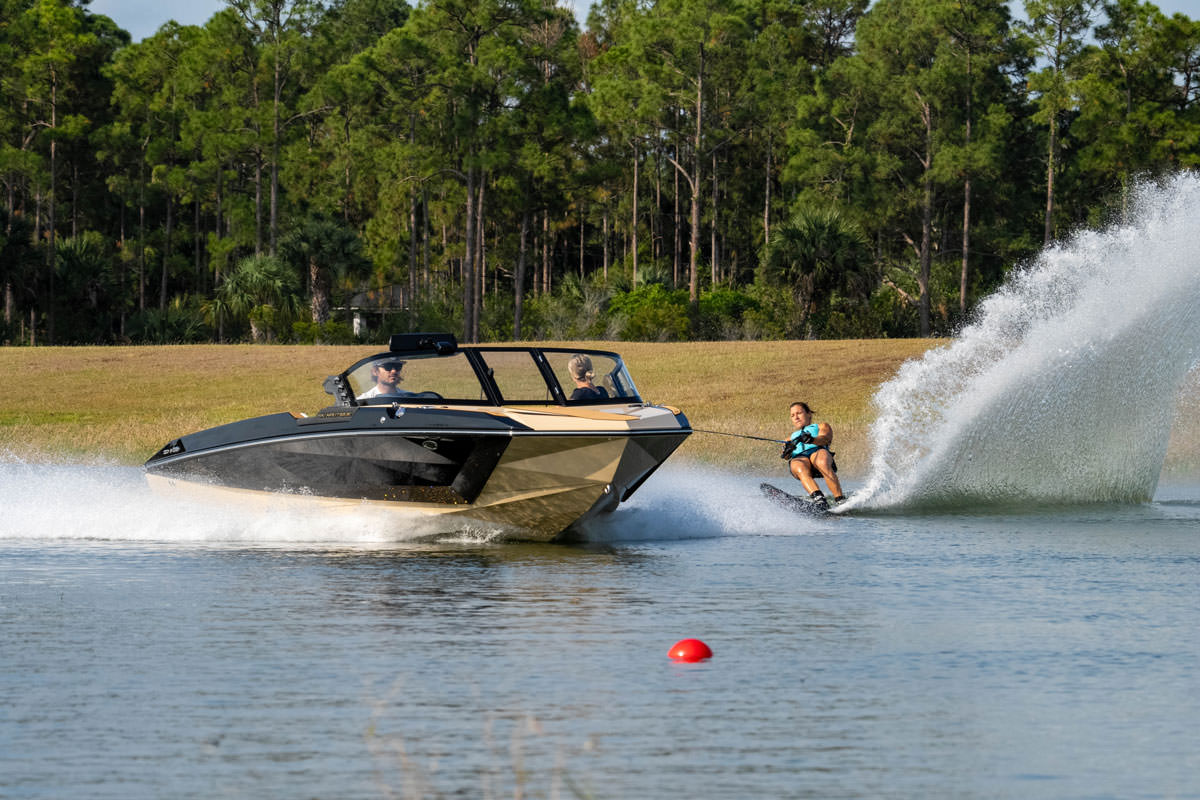
Image: Nautique Boats
By Jack Burden
On a flawless summer morning, with water so flat it blurs the line between lake and sky, some of the world’s best slalom skiers wait their turn. They stretch, limber up, and ready themselves to launch down a course they know as intimately as their own signatures. The cameras roll. The engine’s roar cuts clean through the still air. From a distance, professional water skiing appears unshaken.
But beneath the polish, the sport stands once again on uncertain footing.
Fractured tours, softening prize purses, splintered sponsorships—and a question as old as the slalom course itself: who, exactly, is steering water skiing’s future?
This winter, as tournament schedules for another pro season locked into place, Nautique—the boat manufacturer as synonymous with waterskiing as Wilson is with tennis—quietly severed its final ties with the Waterski Pro Tour for 2025. On paper, it was a footnote. In practice, it was an earthquake.
This is the equivalent of Wimbledon quietly pulling out of the ATP Tour. Or if Augusta told the PGA: We’re good on our own this year, thanks.
Since its inception in 2021, the Pro Tour has been professional skiing’s most unifying force. Born out of pandemic-era recalibration, it bundled previously disconnected events into a coherent narrative, raising prize purses and driving a resurgence of fan interest. It created a season-long arc, elevating once-forgotten stops into destination tournaments. And for a few glorious seasons, the fractured sport of competitive skiing looked, briefly, like a professional tour again.
Nautique’s quiet exit cracks that illusion.
The writing, truthfully, has been on the wall for some time. Nautique is the primary sponsor of water skiing’s two longest-running and highest-paying events—the Moomba Masters and the U.S. Masters—both widely regarded as the sport’s equivalent of Majors. Nautique also serves as the primary organizer of the latter tournament. After its inclusion in the Pro Tour’s inaugural season in 2021, Nautique pulled the Masters out of the Tour. Then, when Moomba returned post-COVID in 2022, they too declined to participate.
A third blow came when the Botaski ProAm, a newer but increasingly important event, stepped away in 2023 after a single season of Pro Tour involvement. Another Nautique-sponsored event, Botaski’s withdrawal reinforced a trend.
Now in 2025, after four seasons as a fixture on the Pro Tour, the California ProAm will join the ranks of the two majors and Botaski on the sidelines. And just like that, the longest-running event on the Pro Tour is relegated to a sideshow—no longer relevant to any season-long narrative, unless one considers qualifying for the U.S. Masters to be the be-all and end-all of the water ski season.
Their reasoning? Officially muted. Representatives from Nautique Boats declined requests for an interview for this article.
It’s difficult—even when granting Nautique every benefit of the doubt—to formulate a coherent rationale for their aversion to the Pro Tour. Let’s be clear: it costs nothing for an event to be included on the Waterski Pro Tour. The perks are numerous—pre- and post-event marketing, social media exposure, highlight packages, and, most importantly, inclusion in an absorbing season-long narrative that gives any result the potential for broader ramifications.
Sure, there’s a reasonable argument for the majors to stay independent. They have the history, they have the brand. Arguably, the Masters’ decision to remain separate from the fledgling Coors Light Water Ski Tour in the 1980s saved it from the fate of other legacy tournaments like the California International Cup and the Tournament of Champions—both subsumed into the Tour brand and ultimately victims of the organization’s financial woes.
But the Waterski Pro Tour is just that: a brand name. It doesn’t take over existing tournaments. It supports them. It adds value. It’s hard to see how a tournament like the Botaski ProAm—begun as a small, men’s-only slalom event in 2018 and since expanded to include women and, more recently, tricks—has a brand strong enough to stand entirely apart. Surely the season-long narrative and visibility the Pro Tour brings is a value-add, not a liability.
The closest thing to a justification is a vision, hinted at publicly by Nautique insider Matt Rini during last year’s California ProAm: the idea of a Nautique-backed international circuit.
“Nautique is all about three-event—building a three-event boat,” he said. “The goal is to have four [tournaments], each featuring all three events, in a season. There’s no jump at Botaski, but they want to add it there. And they want tricks here [in California]. That would be amazing.”
That vision has been echoed before by Brian Sullivan, Nautique’s VP of Marketing, who once described the company’s ambition as “wanting to keep doing bigger and better events, to keep growing the sport—that’s one of our main goals.”
But even that ambition raises questions—chief among them, whether a parallel circuit run by a single manufacturer can truly grow the sport, or simply divide it further.
Nautique’s recent maneuvers, however, haven’t occurred in a vacuum. Taken alongside a string of recent controversies, they appear less like isolated strategic pivots and more like part of a broader pattern: control, consolidation, and increasingly contentious relations with athletes.
In recent years, the company has faced criticism for its rigid gatekeeping of the Masters — from Byzantine qualification procedures to the banning of a world champion for alleged unsportsmanlike conduct — as well as the contentious dismissals of top athletes like Jonathan Travers, Jacinta Carroll, and Patricio Font, raising concerns about its approach to athlete management.
Seen in that light, Nautique’s retreat from the Pro Tour looks less like a routine reshuffle and more like a tightening grip on the sport’s levers of power.
If so, they are not the first to try.
Competing pro tours have been attempted before in water skiing. Rarely with much success. In 1987, the American Water Ski Association launched the short-lived U.S. Grand Prix of Water Skiing to compete with the Coors Light Water Ski Tour. Then again, more dramatically, in 1990, Camille Duvall and a cadre of frustrated skiers attempted a coup. They launched an upstart circuit promising more prize money, athlete control, and safer skiing conditions.
For one turbulent season, skiing had two competing tours: the rebel PAWS circuit and the establishment Michelob Dry Tour. Sherri Slone famously won two pro jump titles on the same day.
The experiment imploded. Both tours crumbled under legal battles, sponsor fatigue, and logistical overload. By 1991, PAWS was gone. The old tour limped along, wounded but intact. The sport never fully recovered its eighties-era swagger.
Today, no one has openly declared “war” like Duvall once did. But Nautique’s move—alongside an already splintered calendar featuring the WWS Overall Tour and standalone events—feels eerily like history tightening its rope again.
On paper, these should be boom times. Each of the past three seasons has brought the highest prize purses in over 15 years. The gender pay gap has shrunk dramatically, from 60 cents on the dollar to near parity. The Waterski Broadcasting Company streams nearly every pro event, in crisp HD, for free. Fans can sit in their living rooms and watch the world’s best almost every weekend.
But peel back the webcast polish and cracks show.
The Swiss Pro Slalom—the sport’s most-watched webcast annually—has just been demoted from the Pro Tour after failing to secure adequate sponsorship. Jumping, once the marquee discipline of water skiing, has seen prize money slashed by more than half in the last decade. Even trick skiing, despite a recent resurgence on the water, still lags far behind its 2000s heyday in financial support.
For the first time since 2020, when the global pandemic shuttered nearly all events, professional prize purses are forecast to decline in 2025.
Even Nate Smith, the most dominant slalom skier of his generation, has quietly taken on a “real job” in recent years to stay afloat. Coaching gigs and benevolent parents remain as crucial as gate setups at 41 off.
It begs the question: can the sport really sustain another professional circuit? Can a niche sport like water skiing afford this level of fragmentation?
The cameras are still rolling. The rope still hangs off the pylon. The skiers will ski. And for now, the sport holds together—if just barely.
But history in this sport doesn’t repeat itself quietly. Every time water skiing has splintered before, it’s taken years to recover. Some fractures have never fully healed.
Now, both sides risk losing something vital.
Nautique’s events—the crown jewels of professional skiing—draw their power from prestige, history, and the feeling that they are the center of the sport’s universe. Walling them off too far from the broader narrative risks dulling their shine, turning majors into outliers.
At the same time, the Pro Tour loses critical legitimacy without the weight of the sport’s longest-standing events on its calendar. Fans, athletes, and sponsors are left navigating a fragmented landscape—unsure which path truly leads to the sport’s future.
The truth is, no one wins a fractured season.
Not Nautique. Not the Tour. Not the athletes. Not the fans.
If the sport is to move forward, it needs everyone—manufacturers, organizers, and athletes—rowing in the same direction again.
There’s still time to course-correct.
Hopefully, someone picks up the rope.

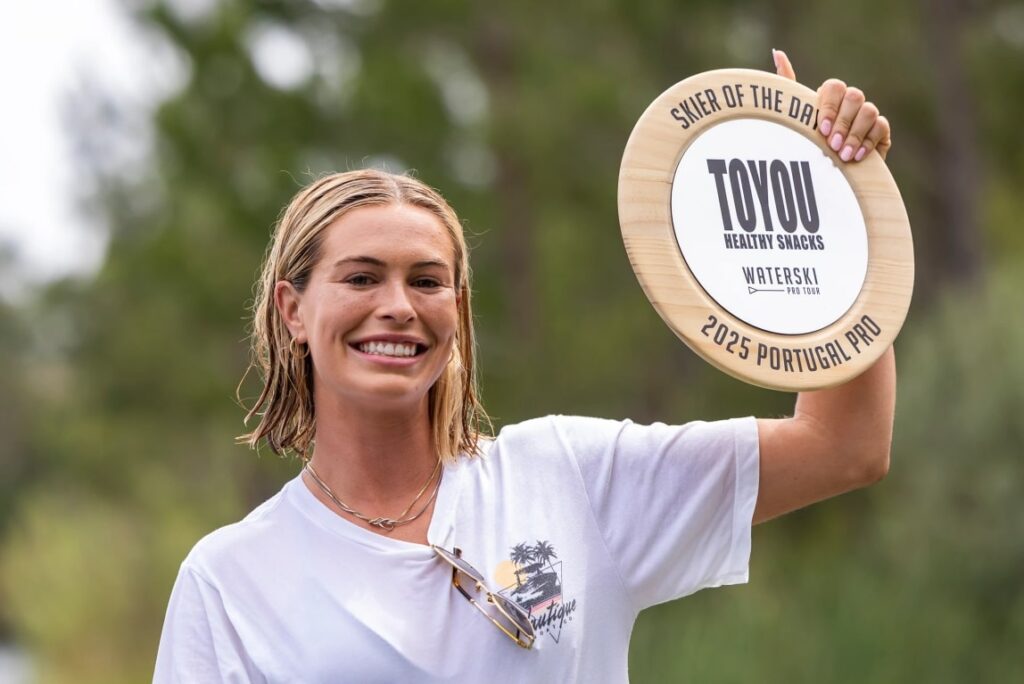
Image: @vasco__trindade
In a season full of firsts, the Waterski Pro Tour included a stop in Tomar, Portugal, just outside of Lisbon. The beautiful Portuguese countryside has never seen action like this before. Even the local mayor made an appearance, just to see it with their own eyes. There is one other thing that made this tournament extra unique: the slalom portion of the event only included women.
Yes, you heard that right. For the first time in Waterski Pro Tour history, the women athletes got the whole show to themselves. They certainly didn’t underdeliver on the action. 7 of the best female skiers in the world fought it out for the title in fairly challenging conditions. Abnormally high water levels and a wide open lake subjected the skiers to unexpected rollers and sudden gusts of wind. That didn’t seem to affect the scores, however. Neilly Ross continued to prove her slalom skills with a tied personal best (and new season best) of 3 at 10.75m to tie with Manon Costard in the finals. What’s even more impressive is that Neilly scored 2 in the previous qualifying round to vault herself ahead of Manon in seeding.
The penultimate athlete in finals was Allie Nicholson, who put out an extremely impressive score in qualifying. Allie took a risk in finals, aiming for a headwind on 10.75m, but unfortunately the risk didn’t pay off when she took an early fall at 11.25m. Last but not least, Jaimee Bull took to the water. Jaimee was the only skier to run 10.75m in qualifying and secured the highest score of the event. Now all eyes were on her as she made an attempt to match that score again in finals. Jaimee certainly didn’t disappoint when she made her 11.25m pass look like an opener before cruising around 5 at 10.75m to secure the title.
The excitement wasn’t exclusive to slalom, however. Some of the most talented trick skiers also joined the event. This year marks a big push for the trick discipline with events spanning across three continents. The world’s best are certainly seizing the opportunity. This time around 8 athletes, originating from 7 different countries, threw their hat in the ring for the Portugal Pro title.
Starting off with the women, Neilly Ross continued her dominance this weekend with an attempt at the world record. She just narrowly missed the time limit after a small bobble following her second flip sequence. Despite the significant point deduction, she still managed to claim top seed heading into finals. Brooke Baldwin and Kirsi Wolfisberg followed close behind in 2nd and 3rd place. As finals kicked off, the seeding was looking to hold true for placement. Neilly opted for an alternate run in finals, which didn’t quite score as high. However, it was still enough to position herself ahead of Brooke.
There were no men slalom skiers but there were some trick skiers. The suspense started building as early as the first qualifying round when Danylo Filchenko snapped his rope on his first toe trick. Additionally, Tue Neilsen had some of his high scoring toe tricks cut after intensive review from the judges panel. Just to top things off, Matias Gonzalez fell relatively early in his toe pass and fell short of his typical score range. The qualifying rounds surely shook up the seeding as we headed towards finals. However, we saw the highest scores of the weekend in finals when the pressure was on. Danylo managed two stand up passes and took the lead with only two skiers remaining. He was quickly overthrown by Pato Font, who became the first skier in finals to clear the 12k point barrier. Matias was the final athlete to ski.
The whole crowd went silent as Mati stood up both passes. It couldn’t get any closer! The suspense was building as the judges worked frantically to calculate the score. After what felt like forever, the final score came through the radio: 12,490! Matias slipped into first place over Pato by only 250 points.
All in all, it was an extremely successful event! In addition to the amazing skiing, the host town of Tomar was extremely beautiful and provided tons of historic scenery, flavorful food, and welcoming people. A massive thank you to The Waterski Academy, the city of Tomar, and all the other sponsors that made this event possible.

Catch all the excitement from the finals of the Portugal Pro.
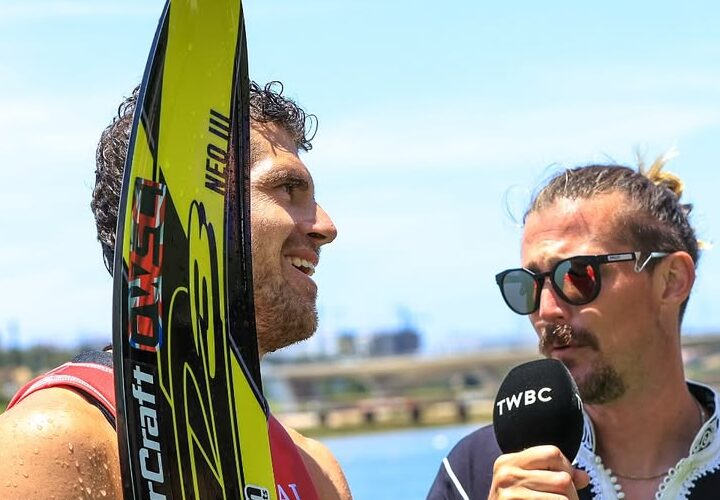
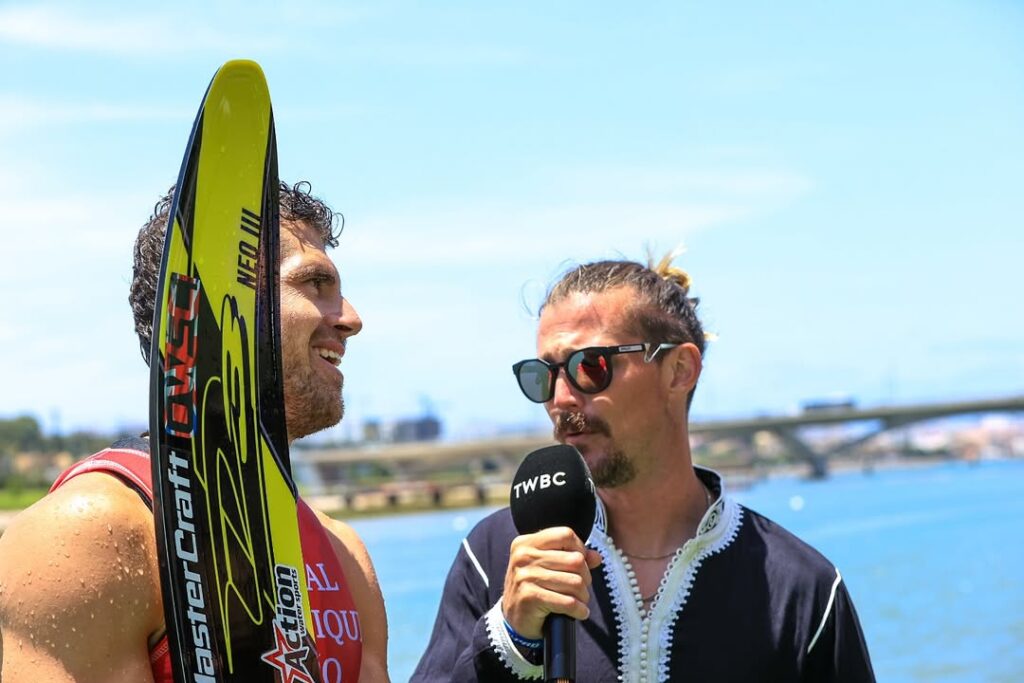
Image: @thomasgustafson
When the Tour landed in Marrakech, Morocco in the middle of last June it broke new ground for waterskiing. Until that day there had never been a professional event held on the continent of Africa. And what a first event it was. Hospitality was on a new level, as were the scores – we saw the first 10.25m/ 41off pass completed in 2024 and, simultaneously, in Africa – and the coverage from the wild desert outside Marrakesh from TWBC (also event organizers) was typically stellar. One could have been forgiven for wondering: how can the organizers follow this?
Well, very simply, they went bigger. The Royal Nautique Pro – so named because of its association with the Royal Nautique Club on the Bou Regreg river – had more disciplines with the addition of tricks and a far more ambitious venue. Last year’s remote man-made lake outside Marrakech was replaced by a tidal river directly in the center of the city of Rabat, between high-end hotels and the newly built Grand Theatre. More spectacle was on offer also, with a synchronised drone show that will likely never be topped in waterskiing for surprise – think animated waterskiers moving through the air followed by messages in the sky and tournament logos.
Of course the tidal river – so close to the sea that many skiers taxied just a mile up the road for a post-event surf session at the estuary – brought a unique challenge. Many of the athletes present have competed at the Moomba Masters in March of each year but the Yarra river has a peak current of a small handful of mph. In Rabat it was many multiples of that. Wind was a factor also on the wide open river, typically starting low and increasing throughout the day. After practice there were some concerned faces. With skiers so used to bespoke man-made lakes in the middle of nowhere, the curveballs of the venue would be a challenge. But, as many mentioned on the broadcast coverage, the sport needs diversity in its events to remain interesting and this could not fit the bill more.
Across two qualifying rounds, despite the challenging conditions, the standard was, perhaps surprisingly, high. On the men’s side it took a pair of 3s at 10.75m to make the final. Tim Tornquist was unfortunate to be first out with a 3 and a 2. Corey Vaughn topped the bill with 2@10.25m, heroically showing big scores were possible on the river. Jaimee Bull had earlier done the same, just missing her exit gate as she lost balance having stroked a 10.75m pass.
The trickers field had two seeding rounds to get used to the water, with scores into 10k and 11k by the women and men respectively. In the end Anna Gay, the class of the field all weekend triumphed, scoring just over 10,000. On the men’s side Pato Font ultimately took the win in the final with a huge 12,390. With consecutive wins in Monaco and now Morocco, Font’s resilience, after a disappointing 18 months or so having previously been undefeated for years, is commendable and another string added to his already impressive bow.
Jaimee Bull also took her second win of the season, winning every round. Last off the dock, she did enough by rounding 2 at 10.75, holding off TWBC’s audience-voted Skier of the Day Neily Ross who ran 1 early in the final. Allie Nicholson, never not a podium threat and winner at last year’s event, took third place with 5 at 11.25m. Bull, who was disappointed to lose the inaugural title last year, took her place as Queen of Africa.
The men’s final saw changing conditions as the tide changed. The risk of starting at 12m and taking 11.25m the trickier head current/ tail wind direction to have 10.75 the supposedly easier way resulted in split skier strategies. In the end only Freddie Winter and Corey Vaughn, who used it so successfully in the first round, rolled the dice. It came off for Winter, who scored 1.5@10.25m and then waited to see top seed Vaughn fall halfway down 11.25m to give him the title, his first on the Tour since catastrophically breaking his leg at Monaco less than a year ago.
In so many ways, these sorts of events don’t come along very often. Many comments from the pro waterski fanbase around the web mentioned their enjoyment of seeing the top skiers, usually so adept and graceful, seem human in their struggle in the conditions. But it should be noted that despite the huge tides, the big wind and the salty water, there were scores out on the river that would have won many pro events not so long ago. To do so in front of such scenery, in the capital of such a great country, in a continent still new to waterskiing, was exceptional to see. We couldn’t be more excited for next year’s event.

Catch all the excitement from the finals of the Royal Nautique Pro.
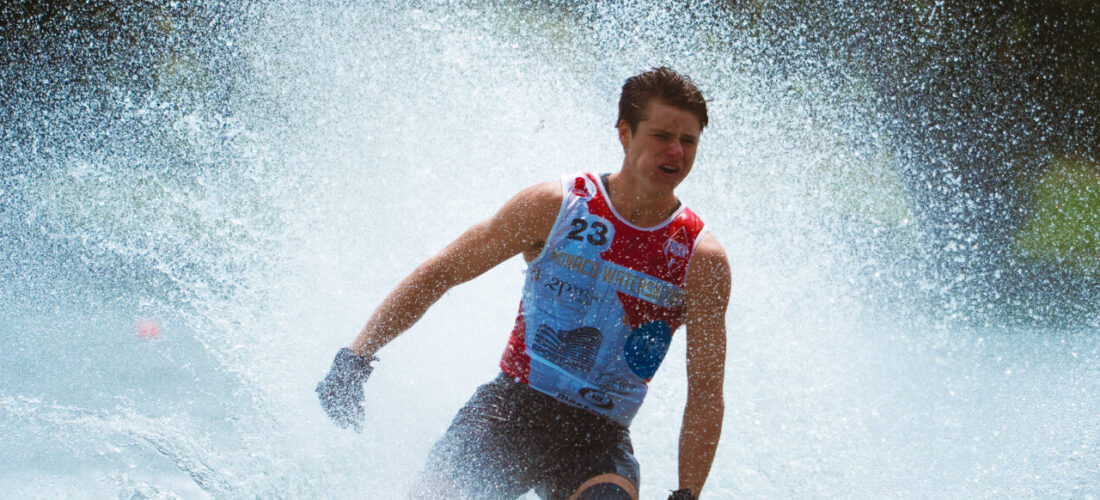
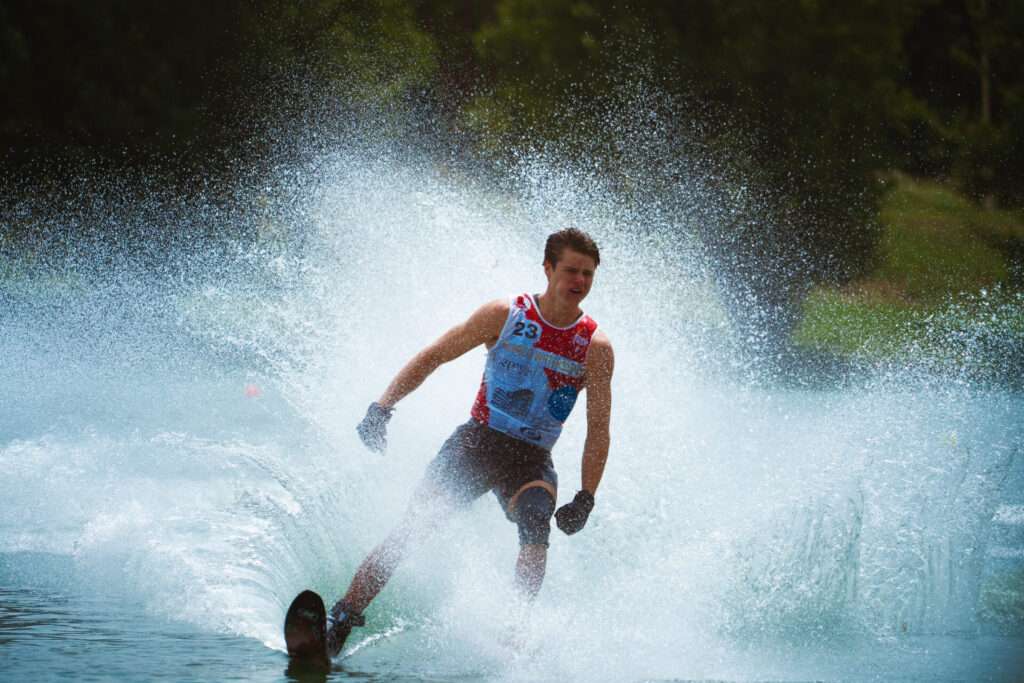
Image: Arthur Sayanoff
By TWBC
For the first time ever, TWBC made an appearance at the Monaco Waterski Cup in Roquebrune Sur Argens, France. The event was hosted by the Monaco Water Ski Federation and organized by Greg Desfond and Alexis Keusseoglou. These two absolutely killed it with a wonderful skiing setup, engaging format, top tier food, and homages to Monaco’s racing heritage. Greg and Alexis were so committed to the overall experience that they even arranged to have a retired F1 car displayed near the spectator seating. Additionally, they partnered with Fast Lane Drive to have a wide array of exotic vehicles displayed along the shoreline. How’s that for yard decoration?
As cool as the theme was, that’s not the real reason people showed up. The skiing was easily the main event with some incredibly competitive moments, a fair share of drama, unpredictable conditions, and even a pending world record. This year’s event featured both slalom and trick, with a special twist implemented in the trick division. It’s been a running theory that trick is the only of the three skiing events where men and women are on an even playing field. Well the Monaco Waterski Cup decided to put that to the test and formed one combined division for all of the interested trick competitors. In total, 8 trickers opted in to try the fused division, including some first time Waterski Pro Tour participants. The most interesting part… if placements lined up with seeding, we would have a mixed gender podium.
Full article at The Waterski Broadcasting Company
Catch all the excitement from the finals of the Monaco Waterski Cup.
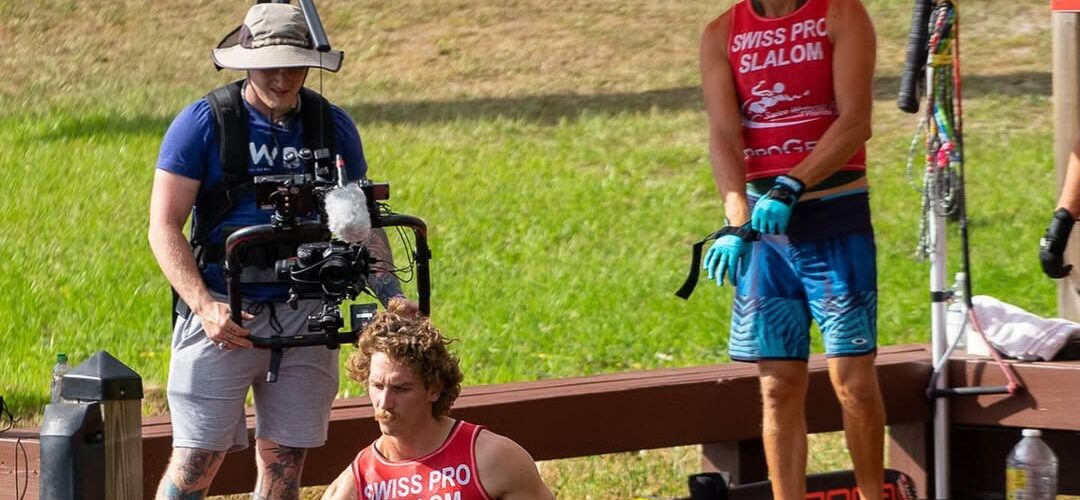
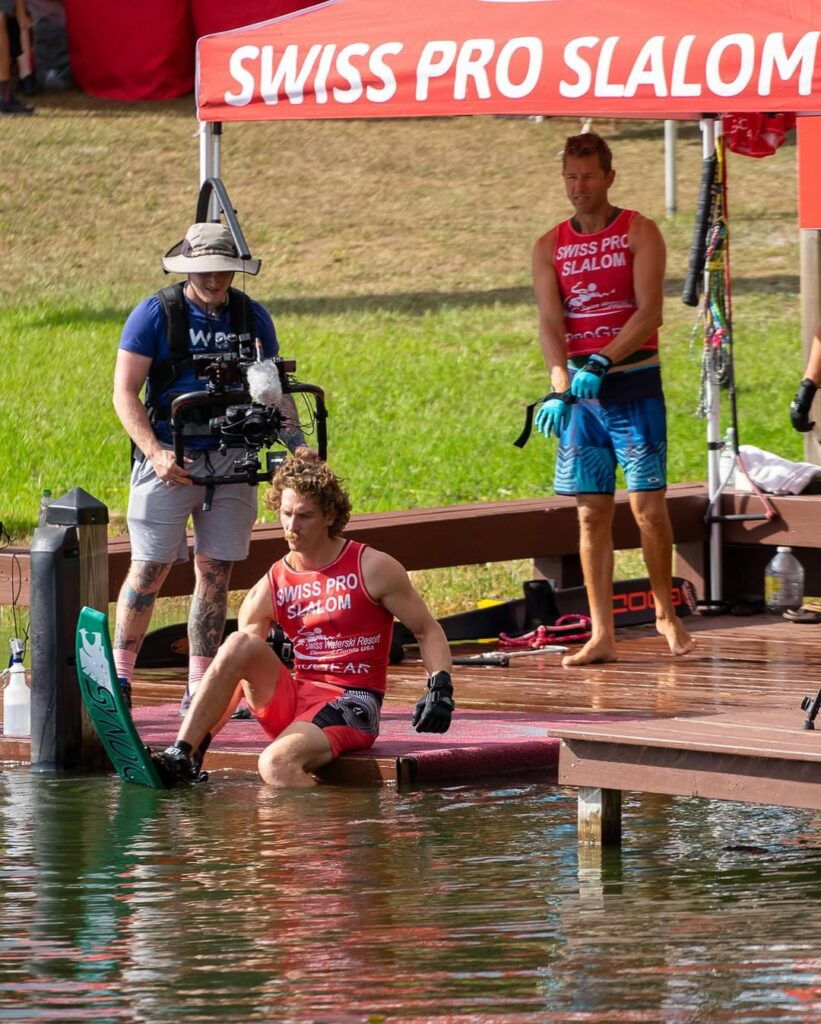
Image: @waterski_nation
By Jack Burden
The 2025 Swiss Pro Slalom will not feature on the Waterski Pro Tour after the event failed to meet the minimum prize purse threshold required for tour inclusion. A blip? A bureaucratic technicality? Or is it a mirror held up to the broader struggles of professional waterskiing?
The numbers are clear cut: a total prize purse of $12,000—half of last year’s offering—falls below the threshold required to maintain its star-level status. Technically, it could qualify as an introductory event, but only if it hadn’t worn the badge of a higher-tier competition in both 2023 and 2024. So here we are, with a top-tier webcast and world-class athletes, but an event that no longer qualifies for the official tour it helped define.
And therein lies the tension.
In many ways, the Swiss Pro Slalom is the blueprint for modern waterski events. Held in the heart of Central Florida—a stone’s throw for most of the world’s elite—it minimizes travel costs and sidesteps the logistical sprawl of international hosting. There’s no scramble to pack bleachers with spectators. Instead, the focus is squarely on the screen, with a heavy investment in producing a polished, professional webcast. In fact, the Swiss Pro has served as the unofficial proving ground for The Waterski Broadcasting Company (TWBC), the undisputed titan of waterski streaming. It’s their backyard. It’s their home court. And it shows.
But for all its polish, the money has rarely matched the production quality. Since its 2015 inception, the Swiss Pro Slalom has usually operated on the financial fringes. Its status has bobbed between introductory and non-qualifying levels, only recently ascending to a more lucrative tier in 2023 and 2024—before falling back again this year.
Yet despite modest prize purses, Swiss Pro Slalom remains TWBC’s most viewed webcast every year. It routinely eclipses richer, flashier tournaments with deeper sponsor pockets. Which begs the obvious question: does prize money matter as much as we think it does?
If viewership is the metric that counts, then maybe not. But if professional waterskiing becomes a loop of Central Florida-based events rewarding only the top three athletes, the ceiling lowers fast. There’s a real danger the sport becomes a closed circuit: elite, expensive to enter, and hard to sustain.
Current event funding models lean heavily on a trio of lifelines—endemic sponsors, community benefactors, and increasingly, athlete entry fees. That’s a brittle structure. One good gust and it all falls apart. And yet, the answer may not be to pour more into the prize pot, but to grow the audience instead.
Which is precisely what TWBC is trying to do.
Armed with high-tech cameras, drones, slick graphics, and expert commentators, TWBC has become the face of waterski broadcasting. In 2024 alone, it streamed 10 of the 13 Waterski Pro Tour events. Its influence is unmissable. Since COVID-era lockdowns drove viewership online, TWBC’s numbers have surged—at least initially. But since 2020, YouTube viewership has plateaued. Publicly available data shows a consistency in viewer counts, not growth. Maybe the deeper analytics tell a different story, but the surface stats suggest a ceiling has been hit.
Still, the ambition hasn’t waned. TWBC’s 2023 documentary project drew over 140,000 views, taking a page from Formula One’s “Drive to Survive” playbook. But the follow-up series, The Rise of Waterskiing, hasn’t yet caught fire. The sport is still waiting for its breakout moment.
Meanwhile, nearly every major player in the sport is all-in on TWBC. And for fans, this might just be the golden age. You can watch almost every event live, for free, and in better quality than ever before. But current viewership alone doesn’t pay the bills—or the prize checks. If it did, the Swiss Pro Slalom wouldn’t be fighting for tour status.
So here we are. The Swiss Pro Slalom won’t appear on the Waterski Pro Tour in 2025. But it’ll still feature a stacked field of athletes. It’ll still be produced with unmatched polish. And if history is any guide, it’ll still be the most watched event of the year. For all its flaws, it remains one of the best exhibitions of pro slalom skiing.
Will that be enough?
I’ll be watching. Odds are, if you’ve read this far, you will too. And maybe that’s the metric that matters most.
After all, if a rope is shortened at the lake and no one sees it, did it really happen?