2025 Royal Nautique Pro Waterski Cup: Final Highlights – Waterski Pro Tour Stop 5
Catch all the excitement from the finals of the Royal Nautique Pro.

Catch all the excitement from the finals of the Royal Nautique Pro.
Image: Johnny Hayward
By Jack Burden
POLK CITY, FL — There was a time when 13,000 points in men’s trick skiing felt like a myth. A ceiling. A number whispered with admiration but dismissed with realism. This weekend, Jake Abelson achieved the unthinkable.
On a hot June weekend at Ski Fluid in central Florida, Abelson tricked 13,020 points in the first round of the Bill Wenner Memorial Record tournament. It was a staggering score—one that broke the world record, pending ratification. The next round, he went out and did it again. This time: 13,270.
In a sport where progress inches forward, he had just taken a leap.
In its early decades, the world record climbed by a thousand points every few years—1975, ’77, ’79, ’81, and ’84 each saw new milestones breached as Cory Pickos took the sport over the threshold of 10,000. But as the level of difficulty increased and the stopwatch refused to budge from its 20-second window, progress slowed. From there, each new thousand took longer to fall—six years to reach 11,000 in 1990, another 11 to reach 12,000 in 2001. But 13,000? That mark seemed out of reach. Until now.
From 2005 to 2022, only two men’s world records were ratified—170 total points of progress in 17 years. Trick skiing was often called the most stagnant of the three events. Then came a renaissance, kicked off in late 2022 by Mexico’s Patricio Font, who broke Aliaksei Zharnasek’s 11-year-old record. In the span of 18 months, the event transformed from glacial to white-hot.
That sudden acceleration in progression? It didn’t come from nowhere.
No one embodies that shift more than Jake Abelson.
Abelson is 17. His dad was an elite-level trick skier. His mom? A Junior Masters champion and a regular on the pro slalom and trick scene in the 2000s. His cousin is Patricio Font. He’s a second-generation athlete with deep family ties to the sport—raised with access to the best coaches, the best equipment, and the best ski sites in the world. His story isn’t one of accidental talent. It’s one of purposeful design.
What separates Abelson isn’t just his résumé. It’s the way he blends nearly every key ingredient that defines the modern trick skiing elite.
He has the raw power and strength of Zharnasek, enabling him to throw audacious tricks like wake-seven-front-to-front and ski-line-seven-back-to-back. He has the speed and precision of Font, unlocking the ability to squeeze in one more trick before the 20-second buzzer. And perhaps most importantly, he skis with the quiet poise of a gymnast who’s spent years training for perfection under pressure.
That’s not just metaphor. Jake still competes as a level 10 gymnast. Like Erika Lang, who transferred her tumbling background into becoming one of the greatest women’s trickers of all time, Abelson has brought aerial awareness and body control into a sport that now demands both in spades.
“In trick skiing, the goal is to perform as many high scoring tricks as possible in 20 seconds,” he said. “At a high level, more speed is required to add another trick or upgrade a preexisting one.”
Abelson spent last winter hammering one trick over and over—wake-seven-front-to-front, a brutally difficult 800-point move with a 720-degree spin and two handle passes. By April’s Swiss Pro Tricks, he could land it cleanly and on time, without derailing the rest of the run. In May 2024, he nearly broke 13,000 at a Masters Qualifier, missing the mark by inches—falling on the last two tricks. It was the proof of concept.
Fast forward to June 2025, and he executed.
But there’s a deeper layer to why this is happening now—and why it might not last forever.
Tricking is, at its core, a race against time. And to move faster, it helps to be lighter.
“You’ve got to look at body types,” said Joel Poland on a recent episode of the Grab Matters podcast. “When you’re smaller, you weigh 130 to 150 pounds, faster is easier. You can go slower with the boat, you can move a little faster. As you become a bigger person, you can keep that speed and learn to go fast—but it definitely gets harder.”
That dynamic makes Abelson’s moment feel especially fleeting and perfectly timed. He has the technical base, the gymnastic strength, the trick lineage—but also, the age and size to make speed work for him, not against him. In a few years, his approach might need to change. For now, it’s the perfect storm.
Abelson is quick to credit others. Matias Gonzalez and Martin Labra, the young Chileans pushing boundaries in toe tricks. Joel Poland, whose creativity and flair have inspired Abelson to explore more ambitious sequences. And Font, who reimagined the hand pass with blistering speed and composure.
As Gonzalez put it: “To consistently trick over 12k, the most important thing [is] to focus on speed,” said the 17-year-old Chilean, who already has multiple professional titles under his belt. “Pato showed that 11 tricks on hands were possible. That set the new standard.”
Abelson echoed the point almost word-for-word, crediting “the increase in speed which was demonstrated by Font” as the catalyst for this new era.
The skiing world was forced to take notice. From 2019 to 2023, Font won two World Championships and eight pro titles—one of the highest winning percentages in the history of modern trick skiing. “His consistency,” Abelson said, “[forced] the other competitors to put more time on the water just to be able to compete.”
Abelson’s rise feels sudden, but the data tells a deeper story. In April 2024, his personal best was 11,980. Then, in the span of one month: six scores over 12,000, including two world records at 12,720 and 12,970. His form in 2025 has been unmatched—winning the Moomba Masters, then the US Masters, and now potentially breaking the world record twice.
His record-setting run wasn’t a spike. It was a detonation—evidence not of a fluke, but of an athlete who’s shifted the benchmark.
And he’s not alone. Gonzalez and Labra are close behind. Louis Duplan-Fribourg of France, the reigning world overall champion, has a personal best over 12,500. Font still looms—consistent, decorated, and hungry.
“We started pushing ourselves to a better level,” said Labra. “Being with Mati [Gonzalez] since we were kids… and after that Jake, it helped me a lot to improve… to try to beat [them], we helped each other to be better.”
But Abelson’s ceiling might be higher still.
He’s not just a phenomenal tricker. He’s emerging as one of the most complete skiers in the world—just named to the 2025 U.S. World Championship team in overall. He skis all three events. He tricks like a specialist. And he’s the first American man to hold the world trick record since Cory Pickos in 2001.
In that sense, Abelson’s moment is bigger than a number. It’s a glimpse of what’s possible: not just in trick, but in the sport as a whole.
The only question now: is this the new ceiling—or just the start of something even bigger?
Image: Arthur Sayanoff
By TWBC
For the first time ever, TWBC made an appearance at the Monaco Waterski Cup in Roquebrune Sur Argens, France. The event was hosted by the Monaco Water Ski Federation and organized by Greg Desfond and Alexis Keusseoglou. These two absolutely killed it with a wonderful skiing setup, engaging format, top tier food, and homages to Monaco’s racing heritage. Greg and Alexis were so committed to the overall experience that they even arranged to have a retired F1 car displayed near the spectator seating. Additionally, they partnered with Fast Lane Drive to have a wide array of exotic vehicles displayed along the shoreline. How’s that for yard decoration?
As cool as the theme was, that’s not the real reason people showed up. The skiing was easily the main event with some incredibly competitive moments, a fair share of drama, unpredictable conditions, and even a pending world record. This year’s event featured both slalom and trick, with a special twist implemented in the trick division. It’s been a running theory that trick is the only of the three skiing events where men and women are on an even playing field. Well the Monaco Waterski Cup decided to put that to the test and formed one combined division for all of the interested trick competitors. In total, 8 trickers opted in to try the fused division, including some first time Waterski Pro Tour participants. The most interesting part… if placements lined up with seeding, we would have a mixed gender podium.
Full article at The Waterski Broadcasting Company


Lang vs. Ross: The Ultimate Showdown
By Jack Burden
This past weekend, one of the sport’s most electric rivalries continued — not in a head-to-head showdown, but on opposite sides of the world.
In California, Erika Lang quietly added another pending world record to her résumé, scoring 11,450 points — equaling the mark she set last month, which is still awaiting IWWF approval. She’s already notched three straight wins in 2025, an unbroken streak that includes Moomba, Swiss Pro Tricks, and the Masters. Just months after losing the record to Canada’s Neilly Ross, Lang has left no doubt: she wants it back — and she wants it badly.
Meanwhile, Ross was in Monaco — a place better known for superyachts and Formula 1 than women’s trick skiing. She’d traveled there expecting to compete in her signature event, only to discover the women’s trick division had been quietly dropped. Rather than pack up and head home, Ross entered the men’s field. No shortcuts, no caveats — just her versus the world’s best male trick skiers.
It didn’t go to plan. She pushed for a massive score, overreached, and landed outside the prize money. A third-place finish in women’s slalom offered some consolation — and helped offset the cost of the trip.
But if the scoreboard favored Lang, the spotlight — such as it exists in professional waterskiing — leaned toward Ross. While Lang was setting records in the back corner of a lake, witnessed only by officials and a handful of skiers, Ross was putting herself on stage. The Monaco Waterski Cup drew fans, sponsors, and some of the sport’s best production value. The risks were high — but so was the visibility.
Both athletes are expected to headline this weekend’s Royal Nautique Pro in Rabat, Morocco. The event promises big prize money, an exotic setting, and a rare chance for direct competition in women’s tricks. The site — a downtown river with excellent spectator access — could produce anything from chaos to classic, depending on conditions.
But the contrast between scoring and competing runs deeper than a single weekend. Lang’s performance in California could trigger a substantial bonus from Nautique — potentially exceeding the entire trick purse at Monaco. She lives and works on the West Coast, holds a full-time job, and turns 30 later this year. Jetting across the globe for every introductory-level event doesn’t make sense — financially or professionally.
Ross, 24, is in a different phase. Fresh out of college, increasingly competitive in slalom, and not yet tethered by the same responsibilities. Her gamble in Monaco wasn’t just bold — it was brand-building. A shot across the bow in a sport still figuring out what the next generation looks like.
And that’s the rub. World records may make great marketing material. But putting yourself out there — in the crucible of competition, under pressure, in public — might actually grow the sport.
Records are impressive. But the real fireworks happen when these two are on the same starting dock, on the same day, with everything on the line.

Catch all the excitement from the finals of the Monaco Waterski Cup.
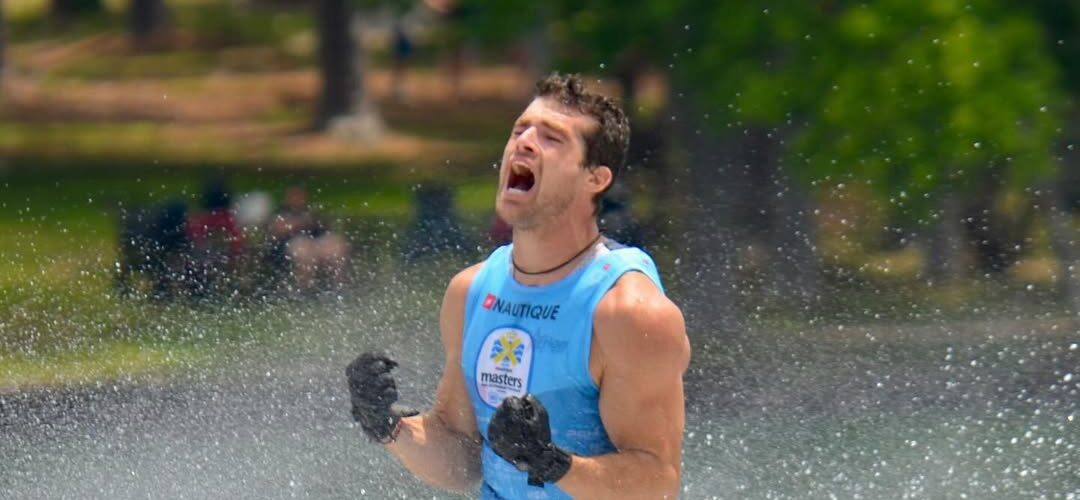
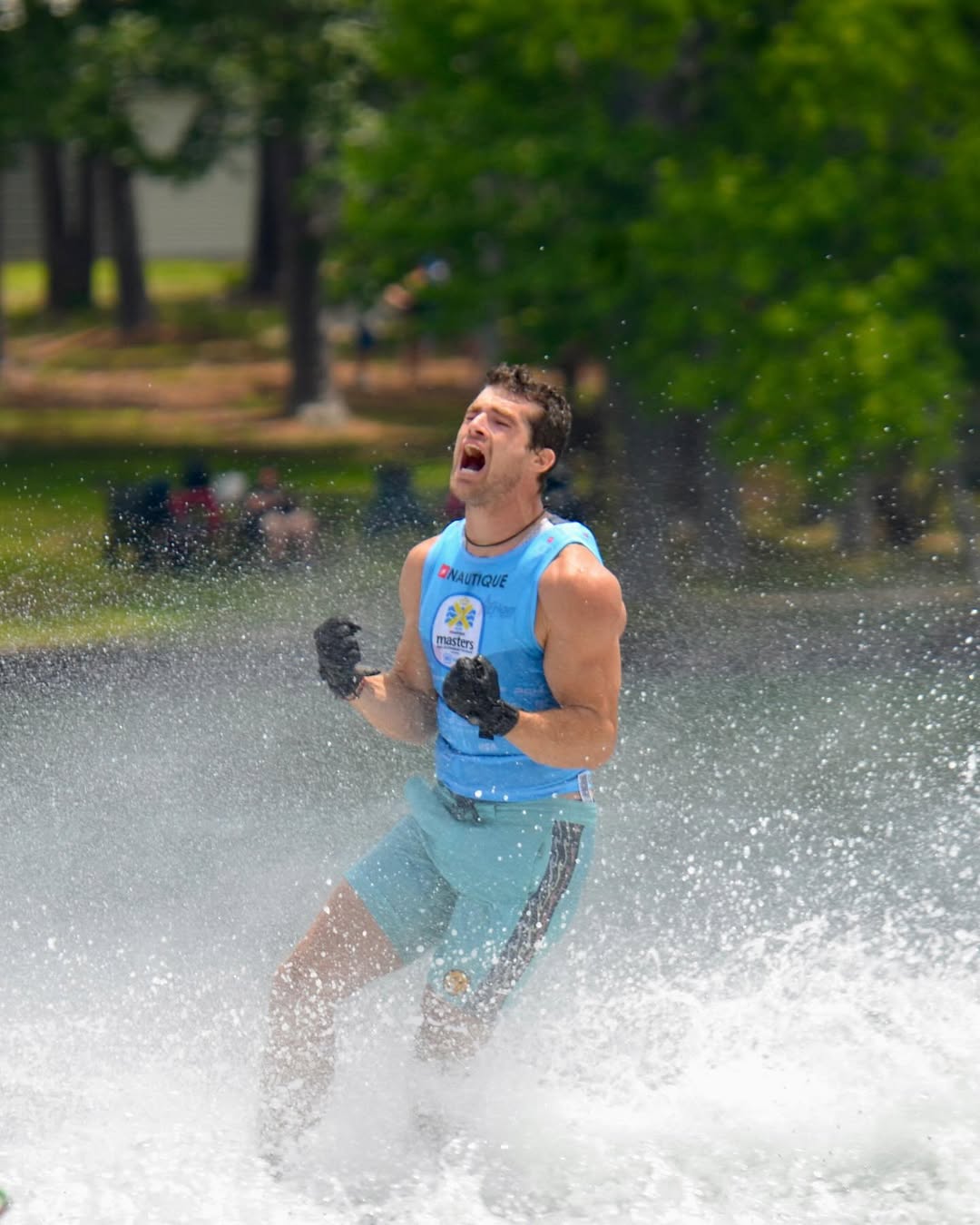
Freddie Winter celebrates his victory in men’s slalom (image: @bretellisphotography)
By Jack Burden
PINE MOUNTAIN, Ga. — The 65th Masters Water Ski & Wakeboard Tournament wrapped up Sunday beneath the tree-lined shores of Robin Lake, with records, redemption arcs, and rare feats all leaving their mark on one of the sport’s most storied stages.
History doesn’t just hang in the air at Callaway Gardens—it breathes down your neck. From the stirring boat parade to the veteran-honoring ceremonies, the Masters isn’t just a tournament; it’s a stage where legacies are made, and occasionally, broken. And this year, they cracked wide open.
Let’s start with the history on Friday. Germany’s Tim Wild delivered a performance for the ages, sweeping all four Junior Masters titles: slalom, tricks, jump, and overall. In doing so, he became the first male ever to achieve the sweep and only the third skier in Junior Masters history to pull it off—joining legends Regina Jaquess and Brandi Hunt. Wild’s path to perfection included victories over multiple reigning junior world champions and a tricks field featuring the 12,000-point club’s newest member.
By the end of Saturday’s brutal semifinals—where 45 skiers battled for just 12 final spots per gender—much of the sport’s royalty had been dethroned. Patricio Font. William Asher. Whitney McClintock Rini. Jaimee Bull. Gone. In their place: hungry challengers, career comebacks, and a few bold debutantes.
Sunday’s finals opened with one of the most anticipated showdowns, with the intensifying battle between Erika Lang and Neilly Ross for the world record expected to play out real time on the waters of Robin Lake.
Lang continued her stranglehold on the division, scoring 10,530 points to win her sixth Masters title. Her record in professional events since the start of 2023 now extends to 10 wins in 12 tournaments—including all three this year: Moomba Masters, Swiss Pro Tricks, and now the U.S. Masters.
Yet in many ways, it was Germany’s Giannina Bonnemann Mechler who stole the spotlight. Making a triumphant return to the podium less than a year after giving birth, she edged out defending champion Anna Gay Hunter and world record holder Ross with back-to-back 10,000+ scores.
In the men’s tricks final, Jake Abelson proved that last year’s world record was just the beginning. He threw down 12,190 points to win his second major title of 2025—a leap of faith rewarded after skipping Junior Masters eligibility to compete in the Open division.
“A dream come true,” shared the 17-year-old after his victory.
Joel Poland’s third-place finish may have come as a shock. After two stand-up passes and an exuberant celebration from the Brit—the top seed and last skier off the dock—the announcers couldn’t call it between Poland and Abelson, speculating, “I think it’s going to be extremely close, only a couple hundred points that separate them.”
But the final score told a different story: more than 1,500 points separated the two. Judges scrubbed multiple tricks from both of Poland’s runs—but even if all had been credited, his score still wouldn’t have caught Abelson’s winning mark. Nevertheless, the apparent controversy may have lit a fire under Poland for what came later.
If tricks was about cementing legacies, slalom was about redemption.
For the women, 41-year-old Vennesa Vieke, who seems to get better with each passing year, set the pace early with a gritty 1.5 @ 10.75m (39.5′ off). Her mark held through challenges from defending champion Jaquess and Ross. Then came Allie Nicholson, navigating the minefield to a clean 2 @ 10.75m—and her first Masters title.
Arguably the hardest-working skier in professional slalom today, Nicholson has competed in more pro events over the past two years than anyone—male or female. Often stuck behind the dominant trio of Bull, Jaquess, and McClintock Rini, she looked composed as the final skier off the dock—doing exactly what was needed to take the win and perhaps signaling a long-awaited sea change.
The men’s final? Pure Hollywood.
He was banned. He was broken. But now, he’s back.
Less than a year ago, Freddie Winter suffered a potentially career-ending injury—a shattered femur from a crash. Adding to the drama: he had been banned from the 2023 Masters for alleged unsportsmanlike conduct in 2022.
Now, back on Robin Lake, the fiery Brit skied like a man on a mission. Chasing a lead score of 2 @ 10.25m set by world record holder Nate Smith, Winter—last off the dock—threw himself outside of three ball for the win. His third Masters title. His sweetest yet.
“Probably the most emotional moment of my life,” Winter said. “So much self-doubt and fear I wouldn’t get back here over the last 10 months and 29 days.”
“I’ve won here before, but those meant nothing compared to this.”
In women’s jump, a Hanna Straltsova victory often feels inevitable in the post-Jacinta Carroll landscape. But this one felt anything but secure.
Americans Lauren Morgan and Brittany Greenwood Wharton came out swinging in prelims with 174- and 175-foot jumps, respectively—easily outdistancing Straltsova’s 169.
Then, skiing early in the finals, Straltsova posted 53.6 meters (176′). The door was open, but neither Morgan nor Wharton could capitalize.
“You are never prepared enough for the Masters,” shared a reflective Straltsova. “It shows you your weak points and teaches you lessons every time you come.”
Then came the grand finale.
Remember: Poland barely made the final, edging Louis Duplan-Fribourg by a single foot. First off the dock, he put any questions about his jump form to rest—launching a monster 70.1-meter (230′) leap to lay down a massive target.
The remaining finalists—Luca Rauchenwald, Igor Morozov, and Ryan Dodd—all charged hard at the lead. Poland watched nervously from the pavilion.
“Anticipation was 11/10,” he said. “Felt sick waiting for the results.”
Dodd, the world record holder and reigning world champion, came closest. But when the Canadian passed on his final attempt, Poland had his win—and a statement. It’s now been over a year since Dodd claimed a professional title, and the pressure is mounting ahead of his bid for an unprecedented sixth straight world championship.
By sunset, the story was clear. This wasn’t just another Masters. This was a turning point.
From milestone performances to long-awaited redemption, the 65th Masters was a showcase of resilience, risk, and razor-thin margins. And with the debut of the 2026 Ski Nautique onsite—complete with on-air walkthroughs—the event also hinted at what’s next.
For now, the numbers are in, the titles awarded, and the world’s best return to the road—leaving behind another unforgettable chapter on Robin Lake.
And the summer? It’s just getting started.
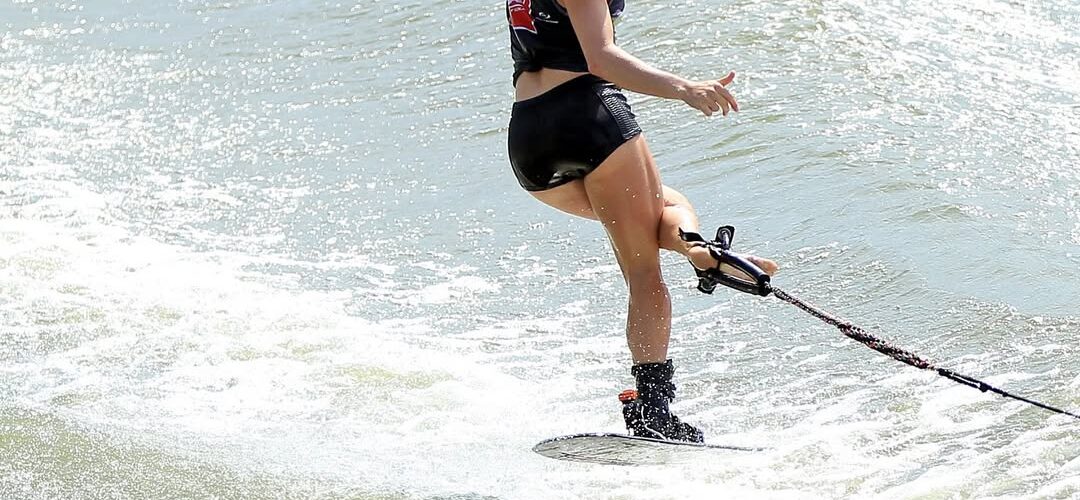

Image: @shotbythomasgustafson
By Jack Burden
PANAMA CITY, Fla. — Erika Lang, the most dominant women’s tricker of the past decade, has once again scaled the sport’s highest peak. On Sunday, at the Florida Inboards Open at Ski Lake Jillian, Lang laid down an 11,450-point run—her best ever, and a new pending world record.
If ratified, the score would reclaim the world record from Canadian rival Neilly Ross, who currently holds the official mark at 11,430, approved last fall after a dizzying back-and-forth between the two that turned the record chase into a season-long thriller.
Lang’s latest score is the highest ever tricked by a woman, equaling her previous pending mark of 11,450 from Timber Cove last November, which was ultimately not ratified. While the point total matches her earlier attempt, the sequence was slightly different—subtle evidence of offseason refinement and relentless pursuit.

Lang’s world record run
The Lang-Ross duel has breathed life into women’s tricks, a discipline that often struggles for visibility in a sport calendar dominated by slalom and jump. In an era where trickers can go entire seasons without meaningful prize money or true head-to-head battles, Lang and Ross have made record-breaking the main event.
Last fall, Ross snapped Lang’s eight-year reign as world record holder with an 11,380 at Okeeheelee. Lang responded seven days later in Texas with 11,450, a performance many believed had sealed her return to the top. But Ross struck back—double-tapping 11,430 in both rounds at Lake Ledbetter. That score was ratified. Lang’s was not.
Their duel has played out not on primetime broadcasts or in front of roaring crowds, but on quiet lakes, with just a camera, a few judges, and a tight circle of competitors. And yet, the skiing—like pirouettes on glass—has been nothing short of electric.
Ross’s rise has been more than just a challenge—it’s a shift. Young, fearless, and technically daring, she splits her six flips down the middle to perform a series of wake spins and ski line tricks with speed that’s redefining what’s possible. Her toe pass? Over 5,000 points—a rare feat for female skiers. She’s not following Lang’s footsteps—she’s forging her own path.
Lang, though, is far from fading. Since breaking her first world record in 2013, she’s extended the mark from just over 10,000 to a pending 11,450. Since the start of 2023, she’s won the world title, the Pan American Games, and 9 of 11 pro events, including this year’s Moomba Masters and Swiss Pro Tricks. She remains the only woman to score over 11,000 in professional competition.
Now, with her latest score under review by the International Waterski & Wakeboard Federation, Lang may finally reclaim the official record she first set more than a decade ago. Whether or not it’s ratified, she’s made a statement—and the timing couldn’t be sharper.
This coming weekend, Lang, Ross, and Anna Gay Hunter will go head-to-head at the U.S. Masters on Robin Lake, the richest trick skiing event of the year. It will mark the latest chapter in a rivalry that has defined women’s trick skiing for over a decade.
Between them, the trio has claimed 25 of the past 27 professional trick titles—a decade of dominance passed like a baton from one to the next and back again. There have been shifts in technique, peaks and valleys in form, and trick runs that redrew the boundaries of what’s possible. But the cast hasn’t changed.
And now, as Lang reasserts her hold on the highest score the sport has ever seen, the balance tips again. The story isn’t over. It’s just entering its next round.


Image: IWSF
By RTB
3 minute play
In this quiz, you need to name all the male skiers who have scored more than 12,000 points.
The list has 14 skiers, all of whom belong to the exclusive club of people who have tricked over 12,000 points at least once in a world ranking tournament. Half of the 14 men on this list have also tricked in excess of 12,500. We have mentioned the number of scores over 12,000, as well as the country and top score.
Data updated as of May 6, 2024
* Performed in a professional event that was not sanctioned as a world ranking tournament.
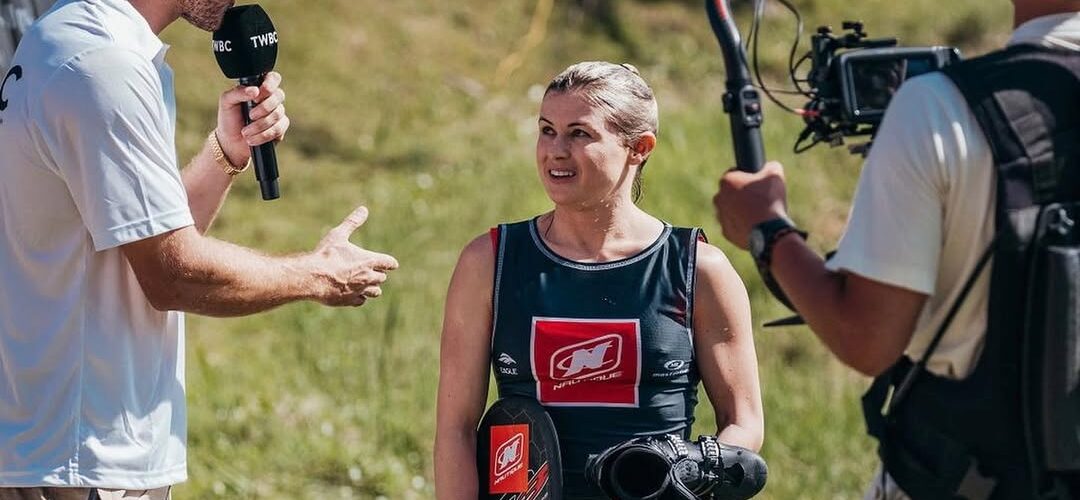
Image: @tiaremirandaphotography
Of the athletes from each of professional waterskiing’s three disciplines, trickers have the greatest preoccupation with tournament scores. Whereas pro slalomers and jumpers are, on the whole, primarily concerned with the placement their scores bring them, a conversation with a pro tricker about their season goals will often center around breaking a certain trick point barrier, frequently the world record.
This discrepancy across events – incredibly few slalom or jump skiers consider the world record as a primary goal – is a product of the health of tricks as a professional event, or lack thereof. The total number of pro trick events in the last decade is utterly dwarfed by those of jump, and especially slalom. Often there were only two events, Moomba and Masters, in which a tricker could compete for money. In these years the professional season was finished in May. Inevitably a focus on big scores ensued, as the hard working trickers sought a reason to continue their endeavor for the rest of the year.
Unfortunately this meant many of tricking’s most impressive feats occurred largely unseen: in events in someone or other’s backyard, with a handful of competitors and maybe the odd alligator as a ‘crowd’. Realistically these were more ‘trial’ rounds with real competition between athletes very thin on the ground. These scores might be posted on social media in grainy video at some point down the road, in the event of an approved record, but a huge majority of these performances would never be experienced by anyone much beyond the skier themselves. Indeed, presumably unless a personal best was broken the whole thing was considered a waste of time. A true shame given that pro level tricking – certainly waterskiing’s most diverse discipline – is extraordinarily impressive.
In the last years, new trick events have popped up to offer a platform to these athletes who so needed a greater, more consistent stage. This started two years ago with the first Swiss Pro Tricks, an event whose primary aim was to give tricking the front and center treatment: a full day of pure spins, flips, line-over and toeholds without any distraction from the other disciplines that often hog the limelight. Fortunately others have taken up the mantle: this summer there will be a handful of events across Europe making up a trick tour. And, even better, it is inarguable that when these athletes are given the opportunity to perform in front of the world they do so. And then some.
The Swiss Pro Tricks of 2025 not only saw the best ever scores in a pro event by both women and men but, in a confirmation that real competition brings out the best in top athletes, they each occurred exactly when it counted: in the final.
In the women’s event, across the opening two rounds there were few surprises. Erika Lang, Anna Gay and Neilly Ross, for so long the dominant trio of women’s tricking, cantered into the final with scores above 10k. Giannina Bonnemann claimed the comeback of the day, qualifying not too far behind in fourth, just eight months after bearing her first child.
In the final itself Neilly Ross’s final flip was out of time leaving her 10,300. Anna Gay’s 10,890 second to last off the dock left her leading as Erika Lang took to the water. But, as Gay herself mentioned in an interview, Lang is a hell of a competitor. No one was surprised the when she needed to go big for her 2nd win of the year she went huge: Erika broke the 11k barrier for the first time this year in women’s skiing while setting the best ever pro event score in the process.
Erika’s ascendency to the dominant tricker of recent times should be studied. In the decade after winning her first event in March 2013 she won a further 10 events. In the last 2 years and 2 months she has won 10 events of a possible 12. On today’s evidence no one would count against her continuing this run far into the future.
Conversely to the women’s division, men’s tricks has recently been a relative to-and-fro between a number of the experienced and up-and-comers. Pato Font’s own period of near-total dominance ended with wins from a broader pool of skiers. In the last year these have included Mati Gonzalez, Jake Abelson and Martin Labra (absent from this event due to a knee injury).
Gonzalez was the defending champion here after his debut win at last year’s event. The start of his defence did not go to plan as a judging camera malfunction meant he had to return to the water after what would have been a good run. The subsequent fall put him at risk of missing the final if he had a substandard second qualifying round. There would have been many viewers concerned for the visibly rattled 17 year old. Not to worry though: his second round saw him top score in qualifying with 12,510 despite claiming he was trying to go “very slow” to ensure he wouldn’t repeat a fall. But the best was yet to come.
Disappointing rounds in the final from Pato Font and Jake Abelson meant there was an opportunity. Louis Duplain-Fribourg, perhaps the best tricker without a pro win, came close with 11,850. Joel Poland must have thought he’d done enough with a personal best of 12,400 – superior to his winning score at this event two years ago. But then came something special. Mati Gonzalez, proving to be an old head on young shoulders as he completed the perfect comeback arc across three rounds, brought the house down with an astonishing 12,860. Amongst his elation, even he was surprised.
2025 will see the most professional trick events in a single year in living memory. This is a huge opportunity not only for the athletes to compete where it counts – in front of the eyes of the world – but also for fans of waterskiing and beyond to really get to grips with and buy into this hitherto unheralded discipline. As for today, at the 2025 Swiss Pro Tricks, a world record was not broken. No, the intensity of the competition, the diversity of athleticism and the magnitude of multiple performances made what we saw that much greater.

Relive all the action from the finals of the Swiss Pro Tricks.