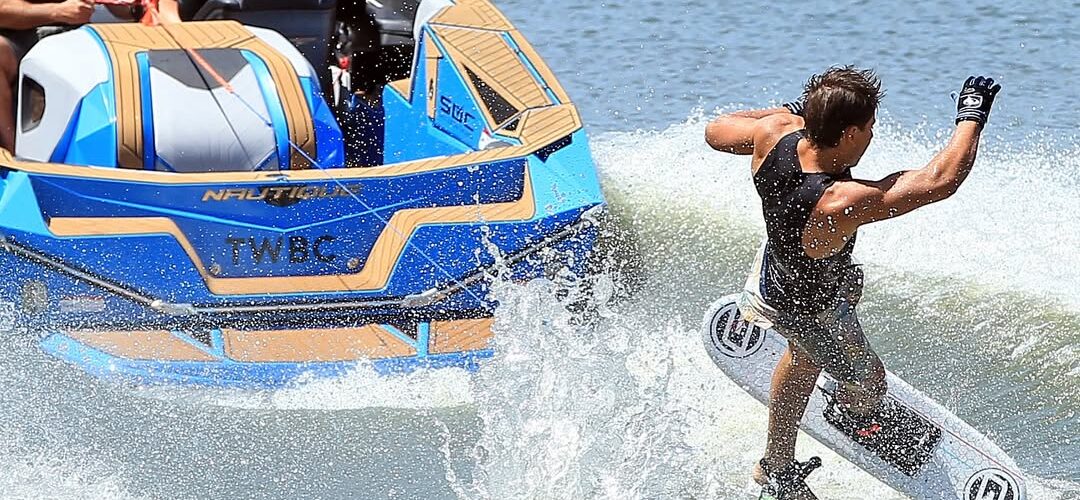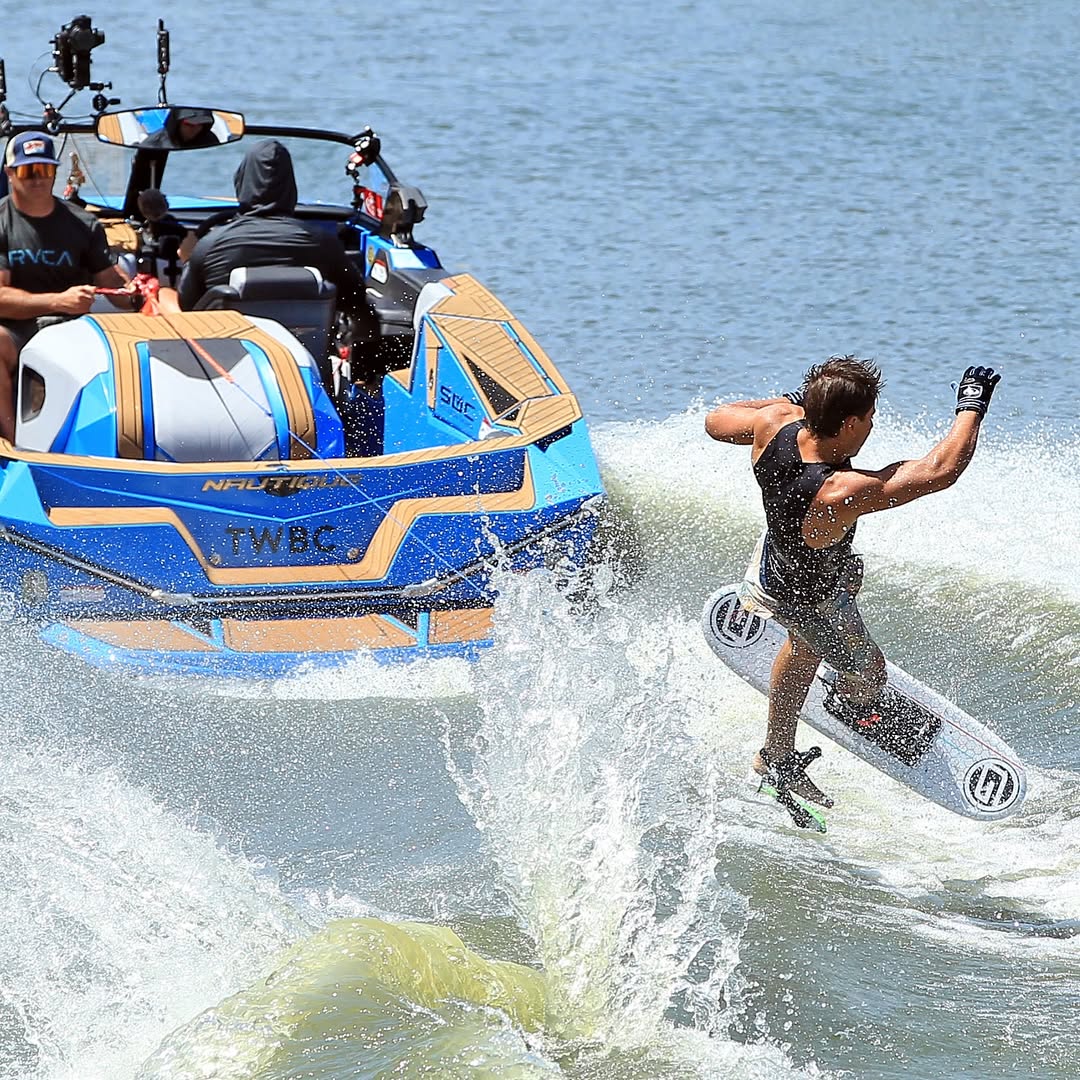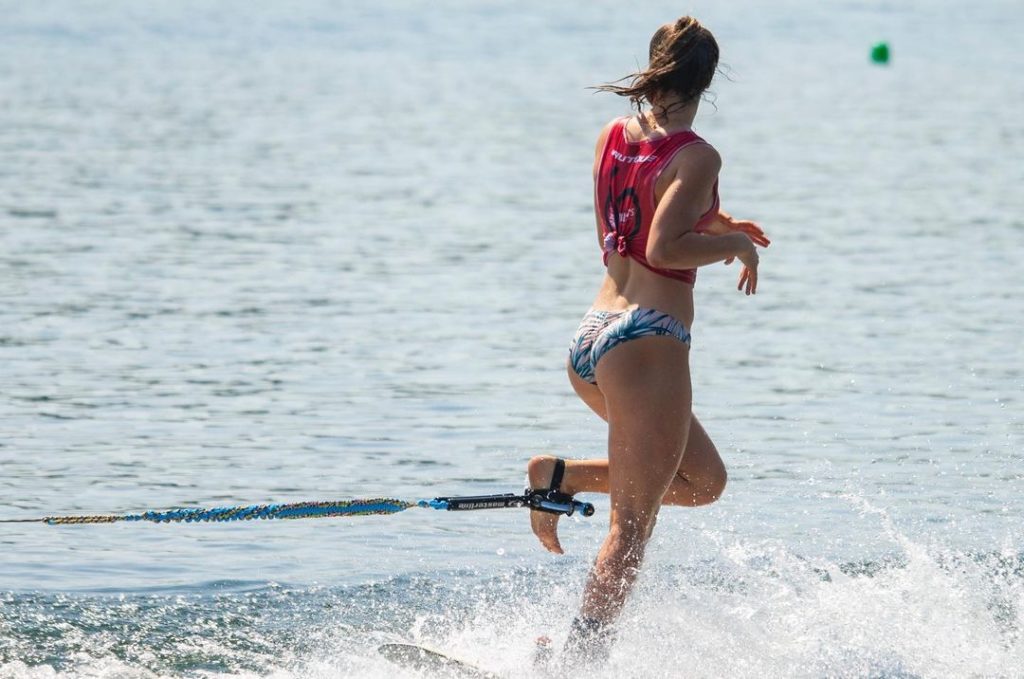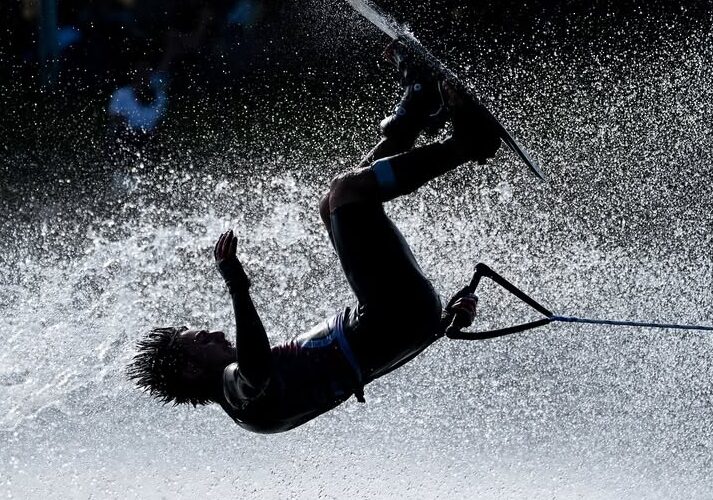
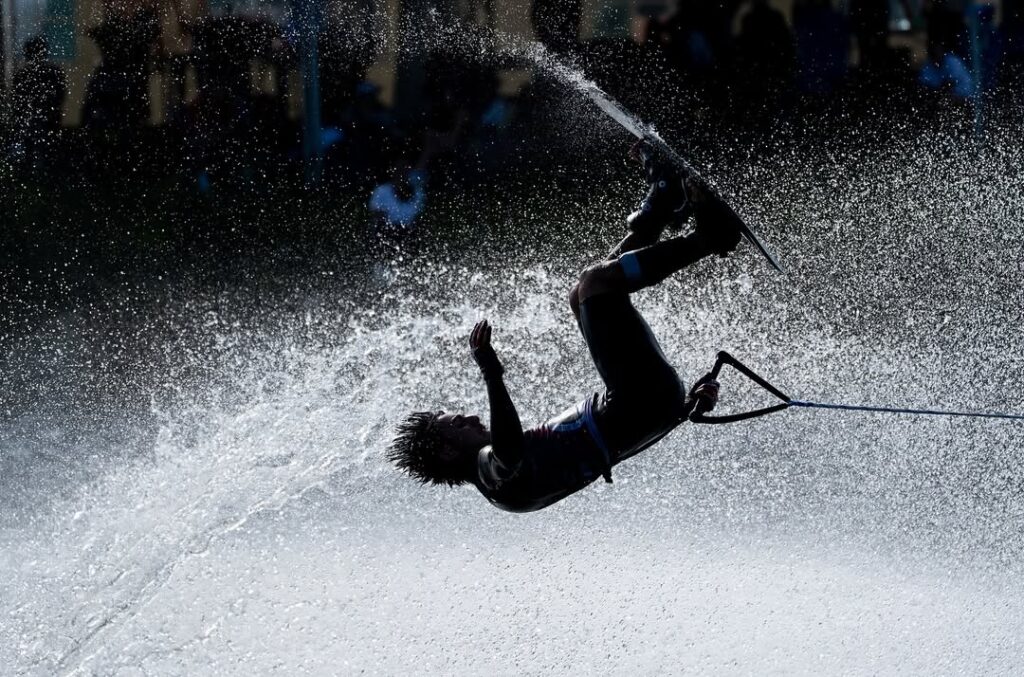
Axel Garcia tricks during the IWWF U21 waterski championships at Predator Bay waterski club in Calgary, Alberta, Canada.

Axel Garcia: The King of the Half Jack
Articles

Axel Garcia: The King of the Half Jack

Axel Garcia tricks during the IWWF U21 waterski championships at Predator Bay waterski club in Calgary, Alberta, Canada.

Axel Garcia tricks during the IWWF U21 waterski championships (image: @bearwitnesssportsphotos)

By Jack Burden


When the conversation turns to innovation in modern trick skiing, it almost always starts with Joel Poland. The multitalented Brit has made “super flips” part of the sport’s everyday vocabulary, turning his signature super-mobe-five into a tournament staple.

But there’s another name worth saying—one rising fast.

Seventeen-year-old Axel Garcia of France has been quietly building a résumé that demands attention. Third at last year’s Under-17 Worlds behind Mati Gonzalez and Jake Abelson. Multiple-time European champion. Top seed into the finals at the recently concluded Under-21 World Championships.

And above all, he’s developed a reputation for one thing: launching himself into frontflips with the kind of style and ease that makes fellow skiers double-take.

Among elite trick skiers, Garcia has been dubbed by some as the “King of the Half Jack.” The half jack—named after American skier Kevin Jack—is a frontflip variation where the skier edges into the wake from an inverted back position before throwing the flip. It’s a close cousin to the wakeboard “tantrum” and has quietly become one of the most common moves in top-level runs. These days, a mobe–reverse–half jack combo is almost as standard as a side slide.

Some, like world record holder Jake Abelson, still favor the more orthodox BFF (frontflip from a regular back position), but that’s becoming rare. The half jack’s speed, consistency, and smooth transition make it the go-to choice.

Garcia hasn’t just mastered it—he’s reinvented it. In 2023, he submitted a clip of himself landing a reverse FFLF, which the IWWF approved as a brand-new trick.

Recently, he posted an Instagram video that made waves: both regular and reverse FFLFs, plus both regular and reverse FFLBBs (frontflip 360s), all starting from the inverted back like a half jack. The reverse FFLBB isn’t even in the rulebook yet—but if Garcia submits it, he could add another flip to the official trick list.

Top names took notice. Pato Font, Mati Gonzalez, and Neilly Ross all jumped into the comments with praise.

Garcia’s skillset is a case study in a long-running debate: whether the IWWF’s trick scoring table needs an overhaul.

Take backflips. Progressing from a basic backflip (BFL) to a backflip 540 (BFL5F) is worth 350 more points—about a 70% increase. But frontflips? A basic FFL is worth 800 points. The 540-degree version (FFL5F) gets just 150 more—less than a 20% bump.

Why? Because of an arbitrary 1,000-point ceiling. Years ago, the double backflip was set at that max value, despite no skier ever landing it. Since then, every trick has had to fit between 500 and that cap, squeezing the spread for higher-difficulty frontflips into a narrow range.

The result: Garcia gains little by throwing his most jaw-dropping tricks. At the Under-21 Worlds, he topped the prelim leaderboard with a run of safe, fast mobes, half-twists, and just two frontflips. Why risk a reverse half jack or a front-full for an extra 100–150 points when a 750-point half-twist is cleaner and safer?

He’s not alone. Abelson regularly posts outrageous frontflips online—no-wake FFLBs, front-fulls from a regular wrap—that never see a start dock in competition. Pato Font has ski-line and spin variations that would make even Cory Pickos jealous. Every top trick skier has an ace or two they leave at home on tournament day.

Part of the reason is difficulty: in trick skiing, you can’t afford an early fall. Speed and consistency win. That’s not a flaw—it’s part of what makes the sport thrilling. But with a different point spread, more of those “party tricks” could become prime-time tricks.

Axel Garcia is exactly the kind of skier trick skiing’s future needs—innovative, fearless, and stylish. His flips are already redefining what’s possible off a ski wake, even if the scorebook hasn’t caught up.

For now, his wildest moves might remain for Instagram. But if the sport wants its brightest stars to keep pushing the limits, it needs to make sure the risk is worth the reward.

Because Garcia may not just be the King of the Half Jack—he might be next in line for the whole trick skiing crown.
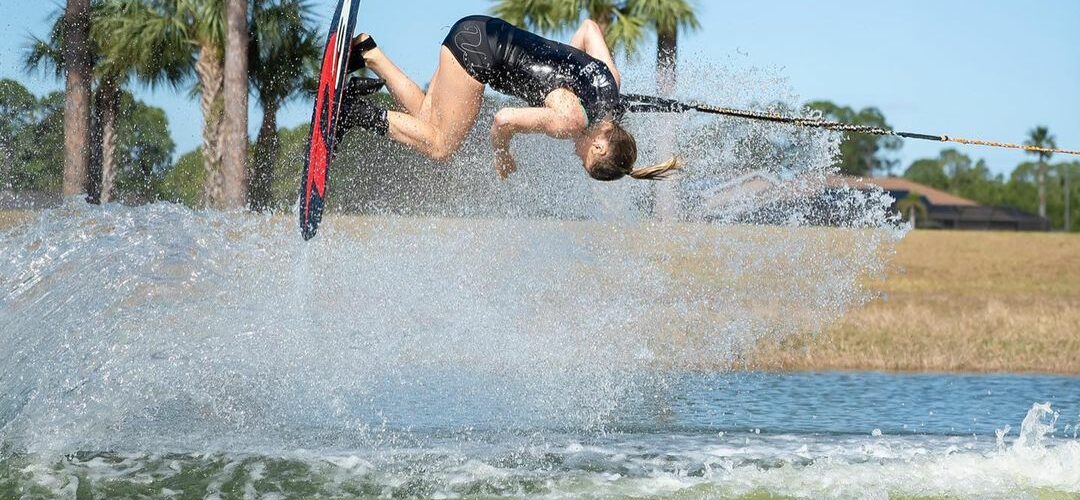
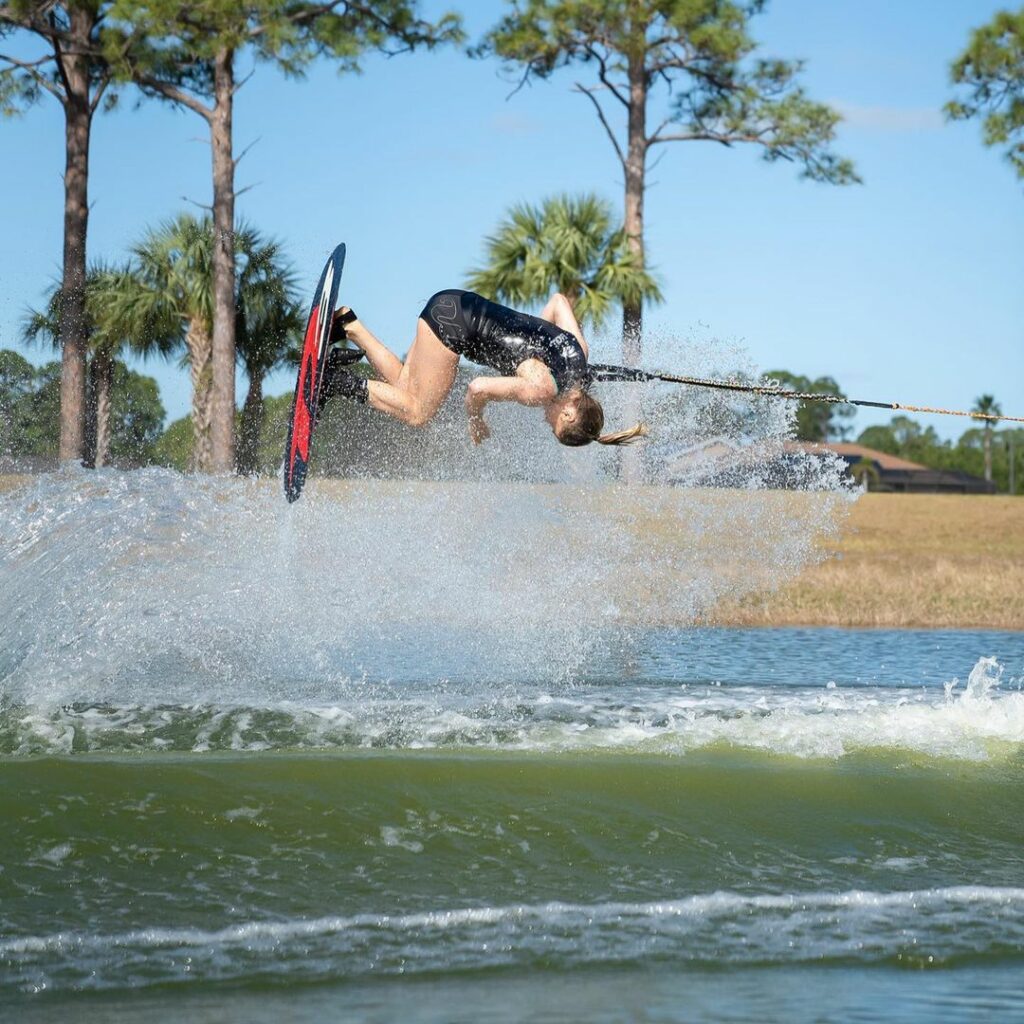
Erika Lang throws a frontflip

How Much Is a Trick Worth?

Articles

How much is a trick worth?

As the World Championships near, trick skiing faces a quiet reckoning

Erika Lang throws a frontflip

Trick skiers, like world record holder Erika Lang, have redefined what was though possible in the sport (image: @erikalang36)

By Jack Burden


As the World Championships approach, a quiet but consequential debate is coming to a head: how much is a trick really worth?

At stake is the very structure of trick skiing’s scoring system—a rigid points table that hasn’t fundamentally changed in more than two decades. For athletes like world record holder Joel Poland, that’s no longer acceptable.

“The point values for high-difficulty flips are crippling trick skiing,” Poland told the IWWF Water Ski Council. “It’s limiting what athletes can do.”

Poland should know. Two of his most innovative tricks—the 900-point “UFO” and the 950-point “Matrix”—were recently approved for competition but, in his own words, are “tricks you’ll never see in a tournament” unless something changes. He’s not alone in that sentiment.

A Broken Balance

Trick skiing is unique among board sports: every maneuver has a fixed value, from 40-point surface turns to 950-point flips. The goal is objective scoring. The result? Homogeny.

“Right now the trick point values reward doing more tricks versus doing harder tricks,” said Brooks Wilson on the GrabMatters podcast. “You can get more tricks in because you’re going fast. It’s a speed game.”

That tradeoff—efficiency over difficulty—has shaped elite competition. Instead of variety, most skiers now converge on the same sequence of reliable, high-value tricks.

“We want to see variation,” added Freddie Winter. “Instead, everyone’s forced to do the same kind of runs.”

The Repetition Problem

An analysis of over 100 score sheets at the 2023 World Championships shows just how narrow the tricking landscape has become.

Among hand tricks, backflips dominate. The half twist (BFLB), worth 750 points, appeared in every finalist’s run—typically paired with its reverse. In contrast, the only other trick worth 750, the ski-line seven back, was attempted just once.

The mobe (BFLBB), worth 800 points, was nearly as common, performed by three-quarters of the finalists—far outpacing other tricks in its point range. The basic backflip remains a staple, especially among intermediate-level skiers, tricks worth comparable points, such as W7B, SLBB, and SL5s, were attempted much less often and with much lower success.

Toe tricks show a similar pattern. Toe back-to-backs (TBB) are ubiquitous, appearing in 112 of 117 toe runs (the exceptions were early falls). Toe wake back-to-backs were also incredibly common; the regular and its reverse featured in every single finalist’s toe run. Toe wake tricks worth comparable points, such as TWO or TWLB, were less common, although some of this stems from them not having an easy reverse.

Misaligned Incentives

Not all frequently performed tricks are necessarily overvalued—some, like backflips, may be common because they serve as foundational building blocks for higher-scoring flips. And in toe runs, the inherent physical limitations naturally result in a narrower pool of viable tricks and sequences.

But some mismatches are hard to ignore. Why does the toe wake back-to-back (TWBB) score more than the toe wake 360 (TWO), despite similar difficulty? Why is the mobe front-to-front, attempted only three times at the tournament, valued the same as the standard mobe, which was performed over 100 times?

Take the half cab (BFLF) as another example. Worth 550 points, it was performed just once for every three half twists (BFLB), valued at 750. While it may be true that landing in the back is more difficult than taking off in the back, does that justify a 200-point gap? If so, why are half twists so common—and half cabs so rare?

Innovation Without Reward

In early 2024, the IWWF approved four new flips, including Clarens Lavau’s “Super Half Twist” and Poland’s “UFO.” But even with official approval, no one expects them to appear in major tournaments.

Poland’s “Matrix”—a frontflip with a ski-line 540 from the back position—was awarded 950 points. That’s just 150 more than a basic frontflip, and identical in value to the established super-mobe-five.

“There’s a point where you go, well, the slam it takes to learn this trick is just not going to be worth the extra 50 points,” said Poland. “I was trying to do a super-mobe-seven—a backflip 720 over the rope—but there’s not much point because they’ve made it very clear no trick can be worth more than 1,000 points.”

The scoring ceiling isn’t just discouraging; it’s actively stifling innovation.

“I tried three of them,” Poland added, “and they were the worst crashes of my life. I was like, ‘I’m never gonna try that again.’”

Without a meaningful scoring incentive, tricks like the Matrix may never make it into competition. Even Poland, one of the sport’s most creative skiers, is reconsidering the cost.

“You’re limiting creativity and progression,” said Winter. “Do we want to see the same runs forever—just a bit faster?”

A System Stuck in Neutral

The IWWF knows the problem exists. In a memo last year, Council Chair Candido Moz urged the Tricks Working Group to bring forward point values that better reflect “true difficulty levels.”

But attempts at reform have stalled for years.

“The skiers could never agree on point values,” Moz has explained. “So IWWF never received a proposal.”

That may change this September. A restructured Tricks Working Group, which includes Poland as a member, is expected to present formal recommendations during the World Championships in Recetto.

Time for a Reset?

Poland is done waiting. “In my opinion, [the current system] is crippling trick and limiting the athletes,” he said. He plans to stay vocal in the lead-up to Recetto.

Winter sees trick skiing as the discipline with the most untapped potential. “Right now, it’s just not reaching it,” he said. “But it could.”

The current system rewards repetition and safety. A modernized score table—one that truly values difficulty and risk—could transform the sport overnight.

“You’ve got to blow it up to build it up,” said Wilson.

The World Championships run August 27–31 in Recetto, Italy. A formal review of trick point proposals is expected to take place at the IWWF Water Ski Council meeting during the event.

Jake Abelson tricks at the Swiss Pro Tricks

It’s Official: Jake Abelson Sets Historic 13k Trick Ski World Record

News

It’s official: Jake Abelson sets historic 13k trick ski world record

Jake Abelson tricks at the Swiss Pro Tricks

Image: @shotbythomasgustafson

By Jack Burden


POLK CITY, Fla. — It’s official: trick skiing has a new benchmark, and Jake Abelson’s name is etched beside it.

The International Waterski & Wakeboard Federation (IWWF) confirmed today that Abelson’s 13,020-point performance at the Bill Wenner Memorial Record tournament on June 14 has been ratified as a new men’s world trick record.

The 17-year-old American becomes the first skier in history to break the 13,000-point barrier, surpassing his own previous record of 12,970 set last year.

“It’s always been my goal to trick 13,000, if it was even possible,” Abelson said on USA Water Ski’s Hit It! podcast. “After my 12,970, I realized that it could be done if I had the best round—and I was able to put the hand run and the toe run together.”

He did. And then some.

Abelson actually went higher in the following round of the same event, tricking a jaw-dropping 13,270 points. But that score was ultimately disallowed by the IWWF record review panel after his wake-seven-front (W7F) was ruled not credit. The panel reduced the score to 13,010 for ranking purposes, leaving the 13,020 from Round 1 as the new official world record.

Still, it’s a monumental achievement—24 years in the making.

The men’s trick world record has long moved at a glacial pace. In the 18 years following Nicolas Le Forestier’s 2004 mark, it was broken just once. The stagnation gave trick skiing a reputation as the most frozen of the three disciplines.

That changed in 2022, when Patricio Font jump-started a new era with a flurry of record-setting performances. Now, Abelson has taken that torch and launched it into uncharted territory.

His 13,020 wasn’t a fluke. It was the culmination of years of work—gymnastics-level strength, surgical timing, and tournament composure.

The hand pass opens with a blistering sequence of high-difficulty flips. At the bitter end of the 20-second window—when most skiers are clinging to their last breath—Abelson unleashes his most difficult combo: ski-line-seven-back-to-back into wake-seven-front. Together, those two tricks are worth 1,550 points and demand perfect placement and timing.

“Really the only place for it is at the end of the run,” Abelson said. “But at that time, I’m pretty tired, pretty gassed. So learning to do that while tired was a real challenge.”

That final sequence was the key. Without it, 13,000 wasn’t possible.

With the record now ratified, the obvious question follows: Is 14,000 next?

“People keep asking me that,” Abelson said, laughing. “I’m not brainstorming that point yet.” For now, the teenager says he’s focused on taking things “one trick at a time.”

He’s right to be cautious. Trick skiing is a race against the clock—20 seconds, no more. As tricks become more difficult, the challenge isn’t just execution. It’s speed, efficiency, and composure. And that means the margin for further progress is slim.

But Abelson isn’t done yet.

He’ll represent Team USA later this month at the IWWF World Under-21 Championships in Calgary, followed by the IWWF World Open Championships in Recetto, Italy, this August.

And it’s not just in trick. Abelson was recently named to the U.S. team in overall, a nod to his emergence as one of the sport’s most complete athletes.

His story is still in its early chapters. But already, the impact is clear.

Jake Abelson didn’t just break a world record—he shattered a mental barrier. And maybe a generational one too.

Canadian Neilly Ross Toe Tricking at the U.S. Masters Water Ski and Wakeboard Tournament

Quiz: Every Women’s Tricker to Score More than 10,000 points

Quizzes

Quiz: Every women’s tricker to score more than 10,000 points

Canadian Neilly Ross Toe Tricking at the U.S. Masters Water Ski and Wakeboard Tournament

Masters memories (image: Instagram)

By RTB


2 minute play

In this quiz, you need to name all the female skiers who have scored more than 10,000 points.

The list has only seven skiers, all of whom belong to the exclusive club of women who have tricked over 10,000 points at least once in a world ranking tournament. Three of the six women have scored in excess of 11,000 points. We have mentioned the number of scores over 10,000, as well as the country and top score.

Data updated as of July 15, 2025

Erika Lang's world record of 11,450 is officially approved by the IWWF

Erika Lang’s 11,450-Point Run Officially Recognized as World Record by IWWF

Repost

New IWWF World Open Women’s Trick Record

Erika Lang's world record of 11,450 is officially approved by the IWWF

Image: IWWF

IWWF


The IWWF is excited to announce the approval of a new IWWF World Open Women’s Tricks Record.

Erika Lang (USA) scored 11,450 points during the second round of the Bell Acqua Lake 3 Record Trick, held at Bell Acqua 3, in Rio Linda, California, USA on June 7th, 2025. Towed by the World Record-Setting Ski Nautique.

The record has been officially approved by the IWWF Waterski Council.

Congratulations Erika!

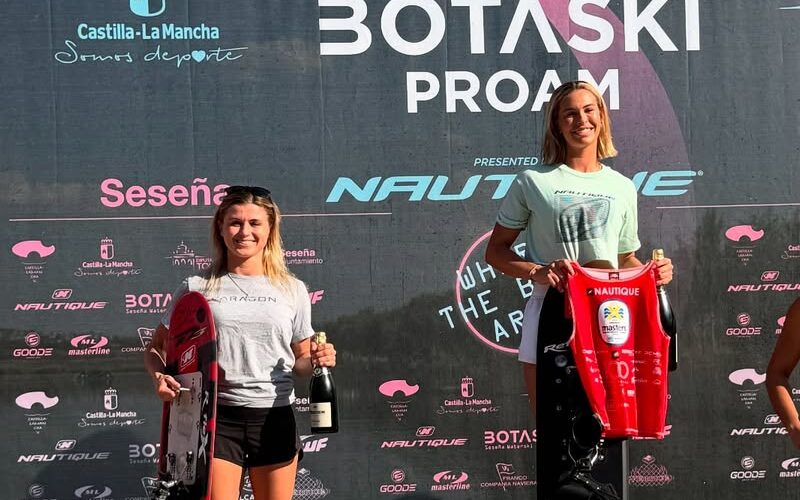
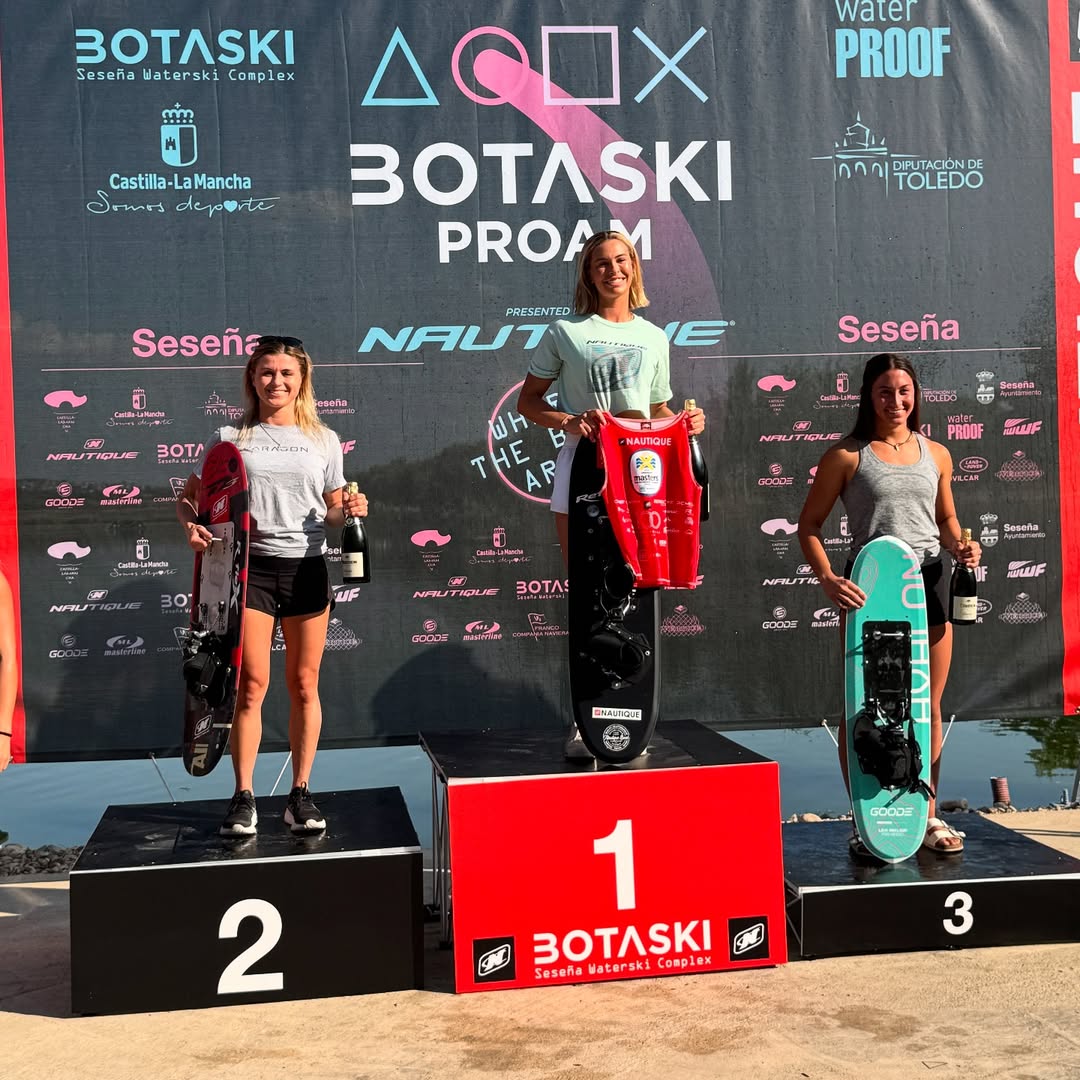
Women's trick podium at the 2025 BOTASKI ProAm

What Does It Take to Beat Erika Lang? Ask Neilly Ross

News

What does it take to beat Erika Lang? Ask Neilly Ross

Women's trick podium at the 2025 BOTASKI ProAm

Image: @erikalang36

By Jack Burden


SESEÑA, Spain — In the sweltering summer sun of central Spain, the 2025 BOTASKI ProAm may have just delivered the most dramatic women’s trick final in living memory — and perhaps the most significant result yet in the escalating rivalry between Erika Lang and Neilly Ross.

For most of the weekend, it looked like another Erika Lang masterclass. In the preliminary round, she tricked 11,450 points — her third pending world record in just two months. No woman had ever scored higher in any competition, professional or amateur. And yet, by the end of the weekend, Lang didn’t win.

Neilly Ross did.

The 24-year-old Canadian, who hadn’t beaten Lang or Anna Gay in a professional event in over three years, delivered a flawless final. Her score: 11,430 — tying the official world record she set last year and throwing down the gauntlet in what is becoming the defining rivalry of modern trick skiing.

That single moment flipped the script. For Lang to win, she would need another world record — not just to match her earlier performance, but to do it again, under pressure, with the title on the line.

She very nearly did.

Lang landed every big trick, running the same sequence that earned her 11,450 just a day earlier. But somewhere, in the dying seconds of a near-perfect hand pass, a minor sideslide — worth just 40 points — drew scrutiny. Judges ruled it incomplete. Her score dropped to 11,410. Twenty points short. Game over.

In any other era, 11,410 might have stood as a world record. At BOTASKI, it wasn’t enough to win.

It’s the closest a pro final has come to the world record since 2002, when Emma Sheers and Elena Milakova traded jumps — and history — at the Malibu Open. In a fitting parallel, the records and rivalry from that event helped define the next decade.

That the trick final even stole the spotlight is a story in itself. BOTASKI, now in its seventh edition, once again opted out of Waterski Pro Tour status — a decision that may have cost it international buzz. But with this final, it delivered a legacy moment anyway.

And perhaps, a changing of the guard.

Ross’s win doesn’t erase Lang’s dominance — not even close. Lang has won virtually everything over the past three seasons and turned scores once thought unreachable into something approaching routine. But the weight of this victory — Ross tying her own world record, beating Lang head-to-head, and ending a years-long drought — matters heading into the World Championships in August.

Frustratingly, this will be the last pro trick event before Worlds — a jarring contrast to the momentum the discipline has built in recent months. No more finals. No more record attempts. Just the long wait until Labor Day weekend, when Lang and Ross will meet again with a world title on the line and the rivalry entering its most anticipated chapter yet.

While the Lang-Ross showdown took top billing, the rest of the BOTASKI ProAm delivered its share of fireworks.

Jake Abelson continued his breakout season with another major win in men’s tricks, landing three scores over 12,400 — the kind of consistency once unimaginable. He held off Patricio Font, who also tricked over 12,000 in both prelims and finals, in what’s quietly becoming the premier head-to-head battle in men’s tricking.

In slalom, Jaimee Bull and Freddie Winter both looked untouchable, each picking up another win in what’s shaping into a dominant season. For Winter, it adds another notch to what may be one of the greatest injury comebacks in the sport’s history. For Bull, it reinforces her status as the most complete slalom skier on the women’s side — and continues her undefeated run through the European professional summer.

It’s rare for trick skiing to hold the spotlight this long. In a sport where slalom typically dominates coverage and prize money, the Lang-Ross rivalry has done more than bring attention back to tricks — it’s made it must-watch. Not just because of the scores, but because of the stakes. The pressure. The emotion.

Lang remains the most successful woman in trick skiing’s modern era. But for the first time in years, she has a rival who can match her, beat her, and push the sport forward in a new direction.

If this is what trick skiing can look like — tense, technical, thrilling — then maybe the question isn’t whether it deserves more attention.

Maybe the question is: why did it take this long?

Neilly Ross delivered a standout performance at the Portugal Pro, winning tricks, tying her slalom PB, and nearly breaking the world record.

Neilly Ross Steals the Show at Portugal Pro, Hones in on World Record

News

2025 Portugal Pro Waterski

Neilly Ross delivered a standout performance at the Portugal Pro, winning tricks, tying her slalom PB, and nearly breaking the world record.

Image: @vasco__trindade

Waterski Pro Tour


In a season full of firsts, the Waterski Pro Tour included a stop in Tomar, Portugal, just outside of Lisbon. The beautiful Portuguese countryside has never seen action like this before. Even the local mayor made an appearance, just to see it with their own eyes. There is one other thing that made this tournament extra unique: the slalom portion of the event only included women.

Yes, you heard that right. For the first time in Waterski Pro Tour history, the women athletes got the whole show to themselves. They certainly didn’t underdeliver on the action. 7 of the best female skiers in the world fought it out for the title in fairly challenging conditions. Abnormally high water levels and a wide open lake subjected the skiers to unexpected rollers and sudden gusts of wind. That didn’t seem to affect the scores, however. Neilly Ross continued to prove her slalom skills with a tied personal best (and new season best) of 3 at 10.75m to tie with Manon Costard in the finals. What’s even more impressive is that Neilly scored 2 in the previous qualifying round to vault herself ahead of Manon in seeding.

The penultimate athlete in finals was Allie Nicholson, who put out an extremely impressive score in qualifying. Allie took a risk in finals, aiming for a headwind on 10.75m, but unfortunately the risk didn’t pay off when she took an early fall at 11.25m. Last but not least, Jaimee Bull took to the water. Jaimee was the only skier to run 10.75m in qualifying and secured the highest score of the event. Now all eyes were on her as she made an attempt to match that score again in finals. Jaimee certainly didn’t disappoint when she made her 11.25m pass look like an opener before cruising around 5 at 10.75m to secure the title.

The excitement wasn’t exclusive to slalom, however. Some of the most talented trick skiers also joined the event. This year marks a big push for the trick discipline with events spanning across three continents. The world’s best are certainly seizing the opportunity. This time around 8 athletes, originating from 7 different countries, threw their hat in the ring for the Portugal Pro title.

Starting off with the women, Neilly Ross continued her dominance this weekend with an attempt at the world record. She just narrowly missed the time limit after a small bobble following her second flip sequence. Despite the significant point deduction, she still managed to claim top seed heading into finals. Brooke Baldwin and Kirsi Wolfisberg followed close behind in 2nd and 3rd place. As finals kicked off, the seeding was looking to hold true for placement. Neilly opted for an alternate run in finals, which didn’t quite score as high. However, it was still enough to position herself ahead of Brooke.

  There were no men slalom skiers but there were some trick skiers. The suspense started building as early as the first qualifying round when Danylo Filchenko snapped his rope on his first toe trick. Additionally, Tue Neilsen had some of his high scoring toe tricks cut after intensive review from the judges panel. Just to top things off, Matias Gonzalez fell relatively early in his toe pass and fell short of his typical score range. The qualifying rounds surely shook up the seeding as we headed towards finals. However, we saw the highest scores of the weekend in finals when the pressure was on. Danylo managed two stand up passes and took the lead with only two skiers remaining. He was quickly overthrown by Pato Font, who became the first skier in finals to clear the 12k point barrier. Matias was the final athlete to ski.

The whole crowd went silent as Mati stood up both passes. It couldn’t get any closer!  The suspense was building as the judges worked frantically to calculate the score. After what felt like forever, the final score came through the radio: 12,490! Matias slipped into first place over Pato by only 250 points.

All in all, it was an extremely successful event! In addition to the amazing skiing, the host town of Tomar was extremely beautiful and provided tons of historic scenery, flavorful food, and welcoming people. A massive thank you to The Waterski Academy, the city of Tomar, and all the other sponsors that made this event possible.

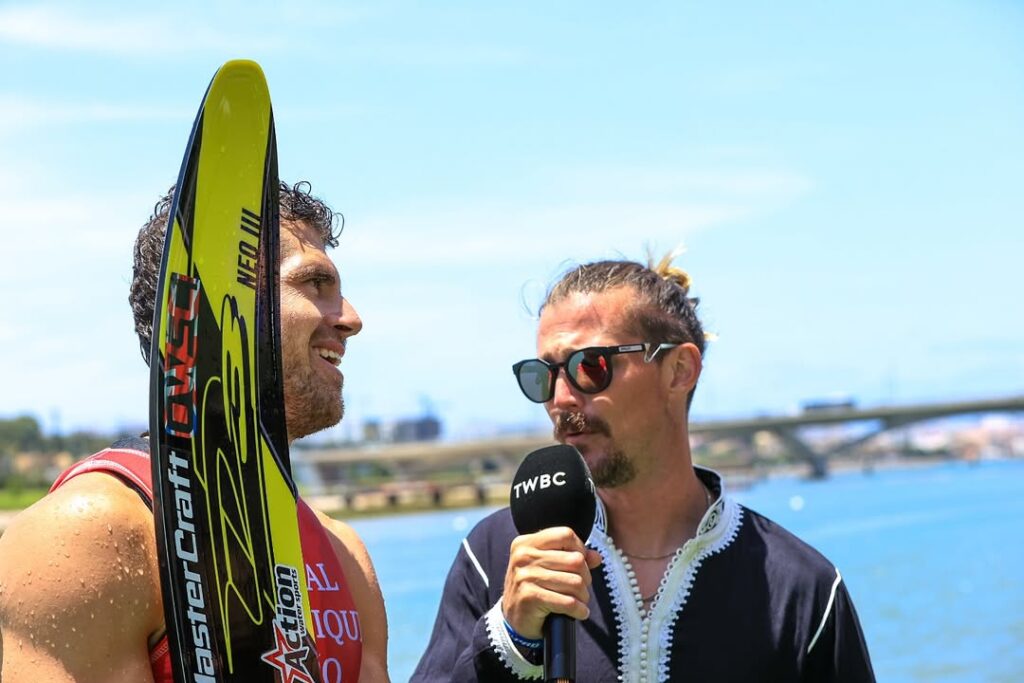
Freddie Winter is interviewed after winning the 2025 Royal Nautique Pro in Rabat, Morocco

Morocco Delivers Drama, History, and Incredible Skiing at Royal Nautique Pro

News

2025 Royal Nautique Pro

Freddie Winter is interviewed after winning the 2025 Royal Nautique Pro in Rabat, Morocco

Image: @thomasgustafson

Waterski Pro Tour


When the Tour landed in Marrakech, Morocco in the middle of last June it broke new ground for waterskiing. Until that day there had never been a professional event held on the continent of Africa. And what a first event it was. Hospitality was on a new level, as were the scores – we saw the first 10.25m/ 41off pass completed in 2024 and, simultaneously, in Africa – and the coverage from the wild desert outside Marrakesh from TWBC (also event organizers) was typically stellar. One could have been forgiven for wondering: how can the organizers follow this?

Well, very simply, they went bigger. The Royal Nautique Pro – so named because of its association with the Royal Nautique Club on the Bou Regreg river – had more disciplines with the addition of tricks and a far more ambitious venue. Last year’s remote man-made lake outside Marrakech was replaced by a tidal river directly in the center of the city of Rabat, between high-end hotels and the newly built Grand Theatre. More spectacle was on offer also, with a synchronised drone show that will likely never be topped in waterskiing for surprise – think animated waterskiers moving through the air followed by messages in the sky and tournament logos.

Of course the tidal river – so close to the sea that many skiers taxied just a mile up the road for a post-event surf session at the estuary –  brought a unique challenge. Many of the athletes present have competed at the Moomba Masters in March of each year but the Yarra river has a peak current of a small handful of mph. In Rabat it was many multiples of that. Wind was a factor also on the wide open river, typically starting low and increasing throughout the day. After practice there were some concerned faces. With skiers so used to bespoke man-made lakes in the middle of nowhere, the curveballs of the venue would be a challenge. But, as many mentioned on the broadcast coverage, the sport needs diversity in its events to remain interesting and this could not fit the bill more.

Across two qualifying rounds, despite the challenging conditions, the standard was, perhaps surprisingly, high. On the men’s side it took a pair of  3s at 10.75m to make the final. Tim Tornquist was unfortunate to be first out with a 3 and a 2. Corey Vaughn topped the bill with 2@10.25m, heroically showing big scores were possible on the river. Jaimee Bull had earlier done the same, just missing her exit gate as she lost balance having stroked a 10.75m pass. 

The trickers field had two seeding rounds to get used to the water, with scores into 10k and 11k by the women and men respectively. In the end Anna Gay, the class of the field all weekend triumphed, scoring just over 10,000. On the men’s side Pato Font ultimately took the win in the final with a huge 12,390. With consecutive wins in Monaco and now Morocco, Font’s resilience, after a disappointing 18 months or so having previously been undefeated for years, is commendable and another string added to his already impressive bow.

Jaimee Bull also took her second win of the season, winning every round. Last off the dock, she did enough by rounding 2 at 10.75, holding off TWBC’s audience-voted Skier of the Day Neily Ross who ran 1 early in the final. Allie Nicholson, never not a podium threat and winner at last year’s event, took third place with 5 at 11.25m. Bull, who was disappointed to lose the inaugural title last year, took her place as Queen of Africa.

The men’s final saw changing conditions as the tide changed. The risk of starting at 12m and taking 11.25m the trickier head current/ tail wind direction to have 10.75 the supposedly easier way resulted in split skier strategies. In the end only Freddie Winter and Corey Vaughn, who used it so successfully in the first round, rolled the dice. It came off for Winter, who scored 1.5@10.25m and then waited to see top seed Vaughn fall halfway down 11.25m to give him the title, his first on the Tour since catastrophically breaking his leg at Monaco less than a year ago. 

In so many ways, these sorts of events don’t come along very often. Many comments from the pro waterski fanbase around the web mentioned their enjoyment of seeing the top skiers, usually so adept and graceful, seem human in their struggle in the conditions. But it should be noted that despite the huge tides, the big wind and the salty water, there were scores out on the river that would have won many pro events not so long ago. To do so in front of such scenery, in the capital of such a great country, in a continent still new to waterskiing, was exceptional to see. We couldn’t be more excited for next year’s event.

Jake Abelson tricks at the Swiss Pro Tricks

Quiz: First Skier to Reach Each 1,000 Point Milestone in Tricks

Quizzes

Quiz: First skier to reach each 1,000 point milestone in tricks

Jake Abelson tricks at the Swiss Pro Tricks

Image: @shotbythomasgustafson

By RTB


3 minute play

In this quiz, your challenge is to name each skier who was the first to break a new 1,000-point milestone in trick skiing.

The list spans every milestone from 5,000 points to this month’s pending world records above 13,000, capturing over 50 years of progress in the sport. Each milestone reflects either a ratified IWWF world record or, for performances prior to 1975, a World Championships record. We’ve also included the year each milestone was achieved and the skier’s country.

* Pending word record.