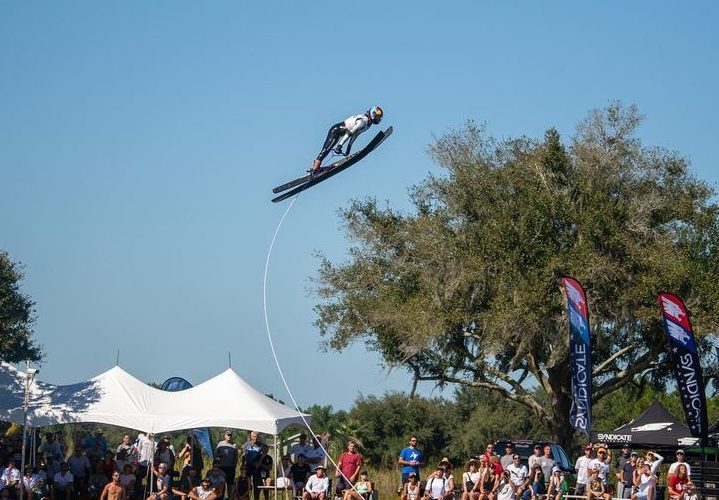
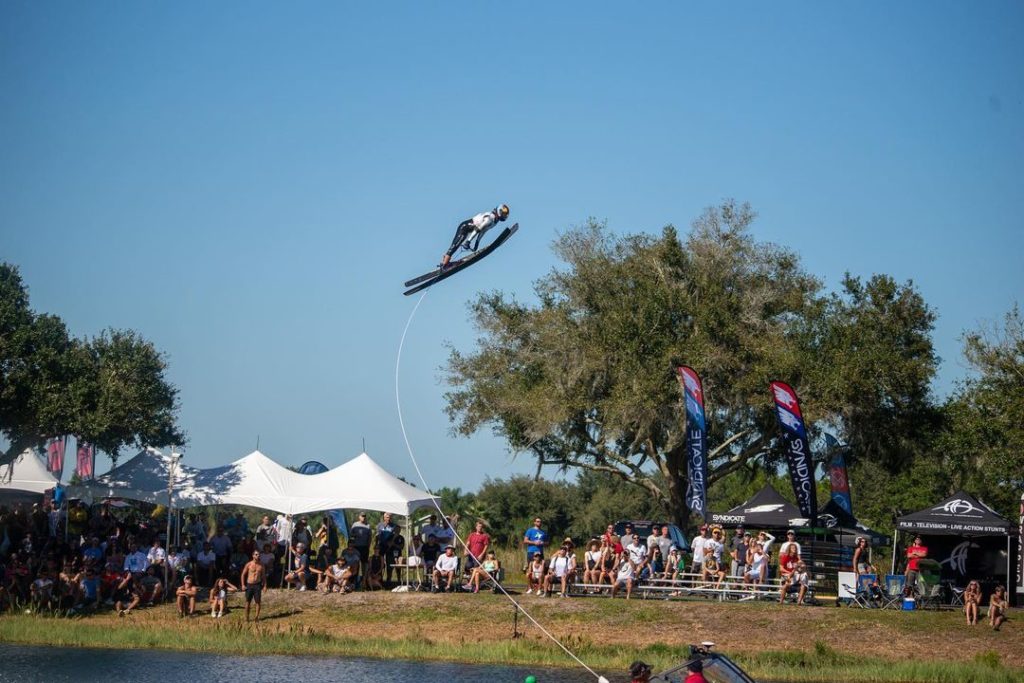
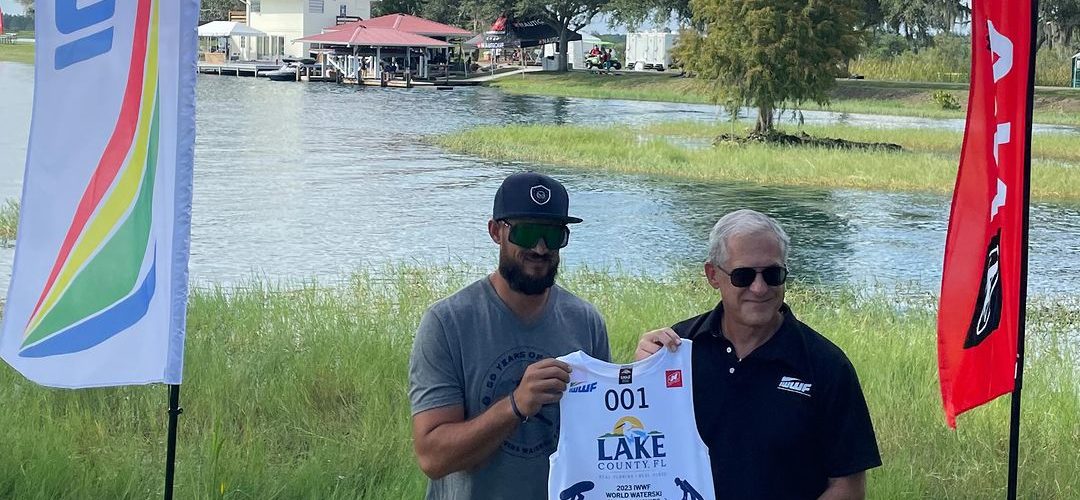
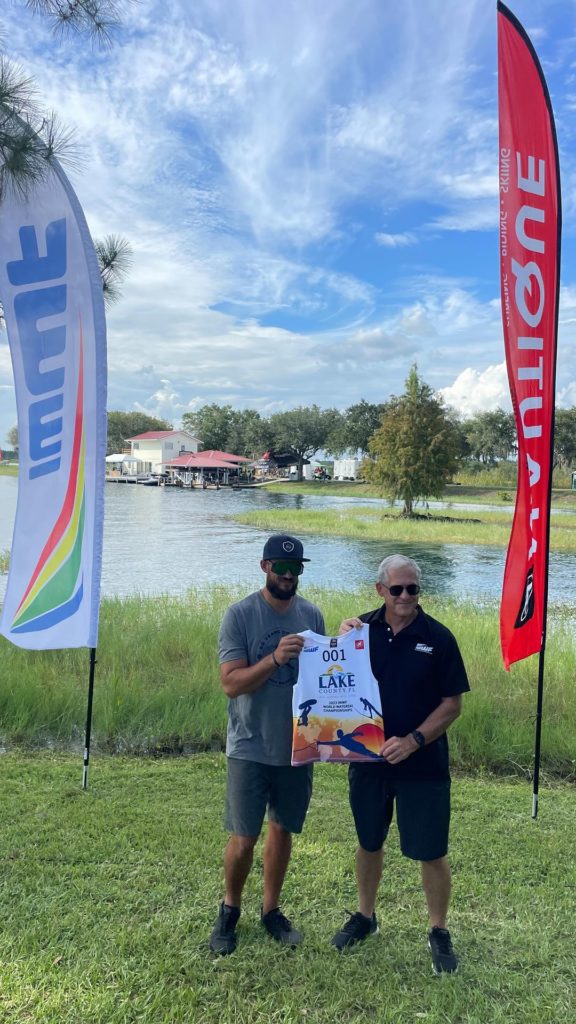
Get ready for an electrifying showdown at the 2023 IWWF World Championships! The world’s top waterskiing athletes are gearing up for an epic battle at the picturesque Sunset Lakes in Lake County, Florida. This marks the second consecutive time this venue has hosted the World Championships, and expectations are sky-high. To put things into perspective, the last time this event graced these waters, seven world championship tournament records were broken, setting the stage for a spectacular display of skill and athleticism.
Slalom
In the women’s slalom event, all eyes are on Regina Jaquess, who’s in pursuit of her fifth world title. She’s fresh off setting a new pending world record and finished as the runner-up in the last two World Championships. A gold medal here would not only surpass Helena Kjellander as the most decorated women’s slalom skier but would also equal Liz Allan’s record of 11 gold medals, the most in the sport. Jaquess faces strong competition from defending champion and Waterski Pro Tour leader Jaimee Bull, her long-time rival Whitney McClintock Rini, and the rising star of 2023, Allie Nicholson, any of whom could emerge victorious.
In the men’s slalom event, only five men have won more than one title in the over 70-year history of the World Championships. This is largely due to the nearly three decades of dominance by Bob LaPoint and Andy Mapple. In 2023, we are fortunate to have the other three repeat champions, namely Nate Smith, Will Asher, and Thomas Degasperi, all competing. Despite the challenging competition, Nate Smith is the favorite to secure his fourth world title, with Asher and former champion Freddie Winter in close pursuit.
Tricks
The most cutthroat of the three disciplines, tricks is the hardest event to predict even when the conditions are favorable. On the women’s side, another thrilling battle is expected among Erika Lang, Anna Gay, and Neilly Ross. Lang had a remarkable run earlier in the year, winning three consecutive professional events and extending her own world record. However, her focus has shifted to wakeboarding over summer, leaving her current form uncertain. On the other hand, Gay is chasing her fourth world title, which would draw her level with Tawn Larsen Hahn for the most ever in women’s tricks. Ross and Gianninna Bonnemann Mechler are also strong contenders.
In the men’s tricks event, any one of about 10 competitors could clinch the gold. What we can expect is for the podium to have a strong Latin American presence, with Mexico’s Pato Font, the world record holder, seeking his second world title, and Chileans Mati Gonzalez and Martin Labra displaying impressive recent form. European skiers Joel Poland and Louis Duplan-Fribourg have also been tricking over 12k with regularity and will look to push the Latin Americans.
Jump
With the absence of Jacinta Carroll, who has won the last five World Championships, we’re guaranteed to see a first-time champion in the women’s jump event. While there has been plenty of controversy in the buildup over the eligibility of Russian and Belarusian athletes, there should be no controversy over who the outright favorite is – Hanna Straltsova, who has won five out of six professional events she has entered this season and whose recent personal best of 58.6 meters (192 feet) is the biggest jump by a woman since Carroll at the 2022 Moomba Masters.
Since 1995, no one not named Llewellyn, Krueger, or Dodd has won men’s jump at the World Championships, making these three skiers the most decorated in the history of the event. With the old guard of Krueger and Dodd still producing winning performances, we could well see this era of dominance continue for one more year. However, Krueger at 48 years old is showing signs of slowing down and Dodd, who turns 40 next year, has been battling injuries in the last few seasons. Look for young challengers Jack Critchley, Taylor Garcia, and Joel Poland to try and break into the winner’s circle.
Overall
Undefeated all season on the WWS Overall Tour and knocking on the door of the world record, Gianninna Bonnemann Mechler is undoubtedly the favorite to take home her first world overall title. Expect stiff competition from top ranked Hanna Straltsova, defending champion Sasha Danishueskaya, young up-and-comer Paige Rini, and five-time world overall champion Regina Jaquess.
Similarly, the current world record holder and defending champion Joel Poland has come off an undefeated season on the WWS Overall Tour. He will look to be the first skier to go back-to-back since Jimmy Siemers in 2003/2005. Hot on his heels will be 2023’s break-out star in men’s overall, Louis Duplan-Fribourg, whose recent form in the jump event has lifted his overall scores to new levels. The dark horse will be Dorien Llewellyn, who has been absent since an ankle injury sustained at the LA Nite Jam back in June but is making a late charge for the World Championships. If Llewellyn can regain his previous form with a limited run-up, look for him to push Poland hard throughout the Championships.
Teams
Defending champions Canada will aim to secure their third consecutive title, and much of their chances will hinge on Llewellyn’s recovery, as they depend on him for scores in all three events. The United States, with Regina Jaquess returning from injury and competing in all three events, will be formidable contenders. France and Great Britain, building teams around their own overall superstars, will be determined to upset the North Americans. The stage is set for an intense battle for the World Championships title.
The World Championships run from October 10-15 and will be broadcast live on TWBC.
Groveland, Florida (October 6, 2023) – The International Waterski & Wakeboard Federation’s (IWWF) World Waterski Championships kicks off next week in Lake County, Florida from 10th to 15th October 2023. The biennial event, that was last held in 2021 in Lake County, will feature more than 200 water skiers representing 35 countries at the Jack Travers Water Ski School at Sunset Lakes.
“We are thrilled to be back here in Lake County to host the 2023 IWWF World Waterski Championships. Florida is the undisputed waterski capital of the world, where the best athletes either live or travel to train and compete, and we all feel at home here after having one of our best ever waterski events in 2021. Our return to Lake County will give the ones who could not previously attend two years ago the opportunity to experience the good vibe and an opportunity to perform to the best of their abilities at one of the premier waterskiing venues, Sunset Lakes.” said José Antonio Pérez Priego, President of IWWF.
The event also brings many International Federation representatives, who will be attending the IWWF World Congress, IWWF International Hall of Fame Induction Ceremony, as well as a final night’s Awards Banquet & Closing Ceremony that will conclude the week’s formalities. In addition to world-class waterski competition, there will be an exciting show on the water featuring the top athletes in show skiing performing unique and incredible barefooting, world-class swivel ski, strap doubles, pyramid and freestyle jumping acts. On shore, there will be live music, a waterski equipment village, food trucks and a playground for children to engage everyone attending the event.
“On behalf of our local partners at the Jack Travers Water Ski School and the Greater Orlando Sports Commission, we are thrilled to welcome the 2023 IWWF World Waterski Championships to Lake County!” said Ryan Ritchie, Director of Discover Lake County, Florida. “Our area continues to be a destination for championship waterskiing and our communities thrive off the visitation from spectators and athletes who stay in our hotels and visit our local establishments translating in positive economic impact. We are looking forward to hosting our national and international guests to the area and we hope they enjoy their time here!”
“The Travers family is very excited to welcome again the water ski community to Sunset Lakes. We will be celebrating the 50th Anniversary (October 1973-2023) of Jack Travers’ International Tournament Skiing next week while the IWWF World Waterski Championships is in full swing.” said Jack Travers.
The 2023 IWWF World Waterski Championships will be exclusively towed by the World record setting Ski Nautique and Masterline will be the Official Tow Rope of the event.
The event will be live-streamed all 6 days, from 10th to 15th October 2023, on IWWF’s YouTube Channel.
Quiz: Every medalist at the 2021 World Championships
Image: Jeremy Stephenson
By RTB
5 minute play
In this quiz, you have to name every medalist at the 2021 World Championships.
There were 24 medalists across 8 events at the 2021 World Championships held at Sunset Lakes in Groveland, Florida. The event is probably best remembered for the epic battle over the men’s overall title, culminating in a new world record. We have mentioned each medalist’s country, along with their placement in each event.
In this quiz, you have to name the female skiers with the most world championship titles of all time.
The list contains 17 skiers, all of whom have won at least three world titles. We have mentioned the years of their first and last gold medals, along with their country, and number of titles.
In this quiz, you have to name the male skiers with the most world championship titles of all time.
The list contains 20 skiers, all of whom have won at least three open world titles. We have mentioned the years of their first and last gold medals, along with their country, and number of titles.
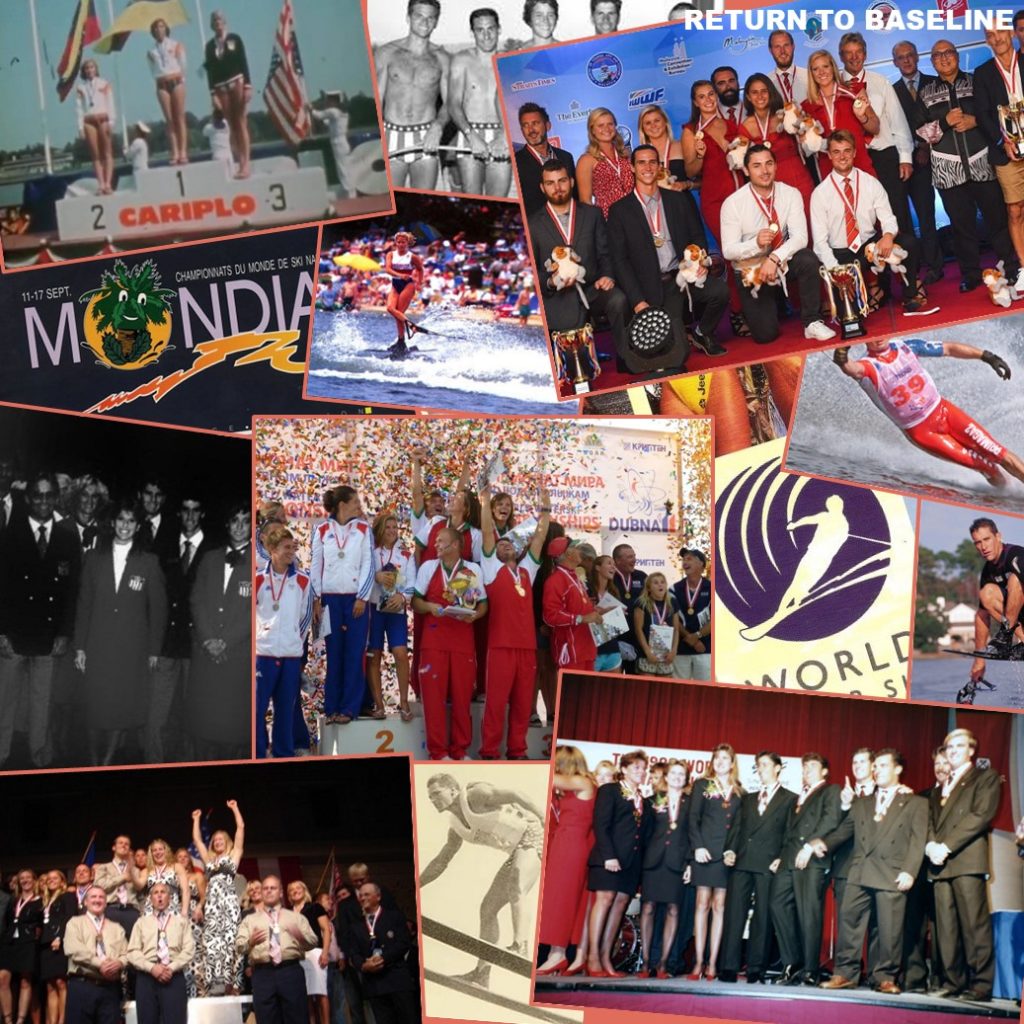
The World Championships have always delivered breathtaking competition, but perhaps the most exhilarating aspect has been the fiercely contested teams’ battles. Originally, these clashes were dominated by the United States, but in recent years, the field has become far more diverse, with four different countries claiming victory over the last three decades. As we approach the 2023 World Championships, the anticipation builds, and we find ourselves reminiscing about the ten most tightly contested team battles in the event’s storied history.
In this prestigious competition, each country assembles a team of six skilled skiers, with a limit of four from each gender. These athletes compete across all three disciplines: slalom, tricks, and jump, with the top three scores from each discipline contributing to the team’s total. This format places a premium on versatile all-around skiers, as teams that lean too heavily on specialists risk lacking depth and the margin for error becomes razor-thin. Join us on a journey through the most thrilling team competitions in the history of the World Championships.
Image: WATERSKI Magazine
10. Toulouse, France 1985
Contenders: Australia vs. the United States
Australia
Geoff Carrington
Sue Lipplegoes
Bruce Neville
Karen Bowkett Neville
Mick Neville
Glenn Thurlow
United States
Deena Brush (Mapple)
Camille Duvall
Sammy Duvall
Bob LaPoint
Lucky Lowe
Carl Roberge
Australia’s golden generation secured podium positions in six consecutive World Championships from 1979 to 1989. During this period, they came second to the United States on four occasions. However, it was the 1985 World Championships that marked their closest attempt to dethrone the Americans from the top of the podium. While the Australians boasted arguably the greatest jump team ever assembled, featuring Carrington, Thurlow, Lipplegoes, and Bruce Neville, as well as two of the best overall skiers of the 1980s, Mick and Karen Neville, they couldn’t quite match the star power of the Americans in the slalom event. LaPoint and Camille Duvall clinched gold medals for the United States, with Roberge and Brush also standing on the podium. The United States’ unbeaten streak would remain intact for yet another World Championships.
Key Moment: Lippelgoes’ mixed tournament, in the preliminary round she set a World Championship record of 40.5m (133 feet), but also missed her first pass in slalom.
Winning Margin: 175 points. Equivalent to roughly two passes in slalom.
Heading into the tournament, the United States boasted an incredible undefeated streak over the 40+ years of World Championships history. However, they were facing a vulnerable situation without their 1980s stars, including Brush, Roberge, and the Duvall siblings. Meanwhile, Team Canada, led by Steve Bush, had been quietly assembling a young team of future superstars, with veteran McClintock Messer anchoring the group. However, it was Kreg Llewellyn who stole the show in Austria. He not only secured medals in trick and jump but also finished as the runner-up in overall. Llewellyn’s margin of defeat was the tightest ever seen in the sport, with Patrice Martin claiming victory by a mere 0.2 overall points.
Key Moment: The U.S. Team selected two trick specialists, Baggiano and Pickos, both of whom failed to secure a podium finish. Yet the Larsen twins, who were not part of the team, claimed the gold and silver medals with the two highest scores of the tournament.
Winning Margin: 159 points. Equivalent to roughly 1,100 points in trick.
Early falls in the tricks event proved costly for Regina Jaquess, Erika Lang, and Whitney McClintock. Their slips left both the United States and Canada out of contention. From this wreckage emerged Belarus and France as the top contenders. Both countries exhibited exceptional strength in the tricks discipline. France held a clear advantage in slalom, but ultimately, Belarus surged ahead, driven by their remarkable jumping performances. Berdnikava led from the front, clinching three individual gold medals across the tricks, jump, and overall events.
Key Moment: Beliakou jumped a 3 meter (10 foot) personal best in the preliminary round, going over 60 meters for the first time in his life.
Winning Margin: 149 points. Equivalent to less than 5 meters in jump.
In another tournament of upsets, the United States faced an early elimination when both Rhoni Barton and Scot Ellis failed to run their first passes in the slalom preliminaries. The defending champions, France, were then left to defend their title against challenges from Canada and the emerging Italian team, which had not graced the podium in nearly four decades.
Italy fielded arguably their two greatest three-event skiers ever, with veteran Alessi and newcomer Mosti on their team. While France and Italy showed relative parity in tricks and jump, France managed to pull ahead thanks to Martin’s bronze in the slalom event and strong performances from the young talents Amade and Jamin.
Key Moment: Jamin ran close to a personal best in the preliminary round with 1@11.25m (38’ off), finishing one buoy short of the top score.
Winning Margin: 108 points. Equivalent to roughly a pass in slalom.
This World Championships finds its place on the list due to a technicality. The scoring system for teams was changed to the points system we use today for the next event in 1961. While the competition might not have been as tight in relative terms, it marked the closest any team came to putting pressure on the United States during the first two decades of World Championships.
The host nation, Italy, put up a valiant fight against the American superstars. Notably, all five members of the American team would later earn spots in the USA Waterski Hall of Fame. Castelverti’s exceptional tricking skills secured Italy’s first-ever gold medal, and she also clinched runner-up positions in women’s slalom and overall events. However, the Americans proved to be too dominant, securing six out of the eight individual gold medals and two-thirds of all individual medals.
Key Moment: 15-year-old Van Hook’s overall victory ahead of Castelverti and the favorite Rideout. Cypress Gardens, where Rideout was the poster girl, continued to bill her as the World Champion in advertisements for the next two years, only mentioning Van Hook in the fine print.
The first real challenge to the United States’ dominance of the team title emerged in the late 1970s, and it came from Venezuela. The South Americans showcased their prowess in tricks, with both world record holders Maria Victoria Carrasco and Suarez securing gold medals in tricks and finishing as runners-up in the overall standings. An unexpected standout, Rodriguez, even outperformed LaPoint in the preliminary round, achieving the highest slalom score of the tournament.
However, the Americans ultimately held the advantage in the jumping event. Suyderhoud claimed a late-career world title, and LaPoint, Todd, and Duvall all earned medals in the jumping competition. This collective effort in jumping proved to be the difference-maker, allowing the United States to maintain its grip on the team title.
Key Moment: the U.S. took a chance on a 13-year-old trick specialist by the name of Cory Pickos, while he may have only placed 6th, he produced the highest trick score for Team USA.
Winning Margin: 85 points. Only 2.5 meters (8 feet) in jump.
United States (7,614 points)
Venezuela (7,529 points)
Canada (7,118 points)
Image: Facebook
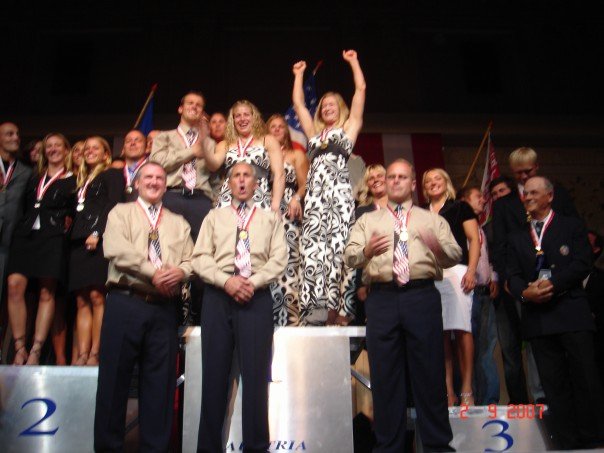
4. Linz, Austria 2007
Contenders: France vs. the United States
France
Anais Amade
Nancy Chardin
Jean Baptiste Faisy
Nicolas LeForestier
Clemetine Lucine
Marion Mathieu
United States
Rhoni Barton Bischoff
April Coble Eller
Regina Jaquess
Mandy Nightingale
Cory Pickos
Jimmy Siemers
This team’s result was all about the women, as both France and the United States fielded teams consisting of four women and two men for the tournament. The competition remained evenly balanced throughout. After both Amade and Lucine posted scores deep down the 11.25m (38’ off) pass, the American duo of Jaquess and Coble Eller responded by running it. While Lucine secured victory in the tricks event, earning 1,000 points for her team, Barton Bischoff and Nightingale of the United States both finished in the top five.
In the jumping event, there was only one meter separating Lucine, Jaquess, Chardin, Amade, and Barton Bischoff. In the end, the Americans finished on top, but it came right down to the wire.
Key Moment: Lucine broke Tawn Larsen’s World Championship trick record which had stood since 1989.
Winning Margin: 20 points. Less then a buoy in slalom.
After suffering consecutive defeats at the hands of Canada, the United States was determined to secure a victory and managed to assemble their strongest team since the 1980s. Loaded with overall talent, all four American overall competitors performed exceptionally well, with each of them finishing within the top five. However, the French team had the advantage of competing on their home turf and strategically built their team around a Martin who was performing at the peak of his abilities.
Both teams faced some challenges in the slalom event, as Martin was the only skier from either team to finish in the top five. However, the French team displayed exceptional strength in the trick event, with Savin achieving the highest score among the women during the preliminaries and a young LeForestier posting the top score among the men.
The American team excelled in the jumping event, with Nichols, Roberge, and Slone securing gold, silver, and bronze medals, respectively. When the final results were tallied, it was Team France that emerged victorious in this hard-fought competition.
Key Moment: After failing to ride out a jump in the finals, Martin had to watch from the shore as Roberge, the in form jumper in the world at the time, attempted to squash the French jump scores (all three of which came from the men’s side).
Winning Margin: 19 points. Equivalent to 0.7 meters (2 feet) in jump.
Contenders: Canada vs. France vs. the United States
Canada
Ryan Dodd
Dorien Llewellyn
Whitney McClintock Rini
Stephen Neveu
Paige Rini
Neilly Ross
France
Pierre Ballon
Emma Brunel
Manon Costard
Tanguy Dailland
Thibaut Dailland
Louis Duplan-Fribourg
United States
Taylor Garcia
Anna Gay
Brittany Greenwood
Regina Jaquess
Erika Lang
Adam Pickos
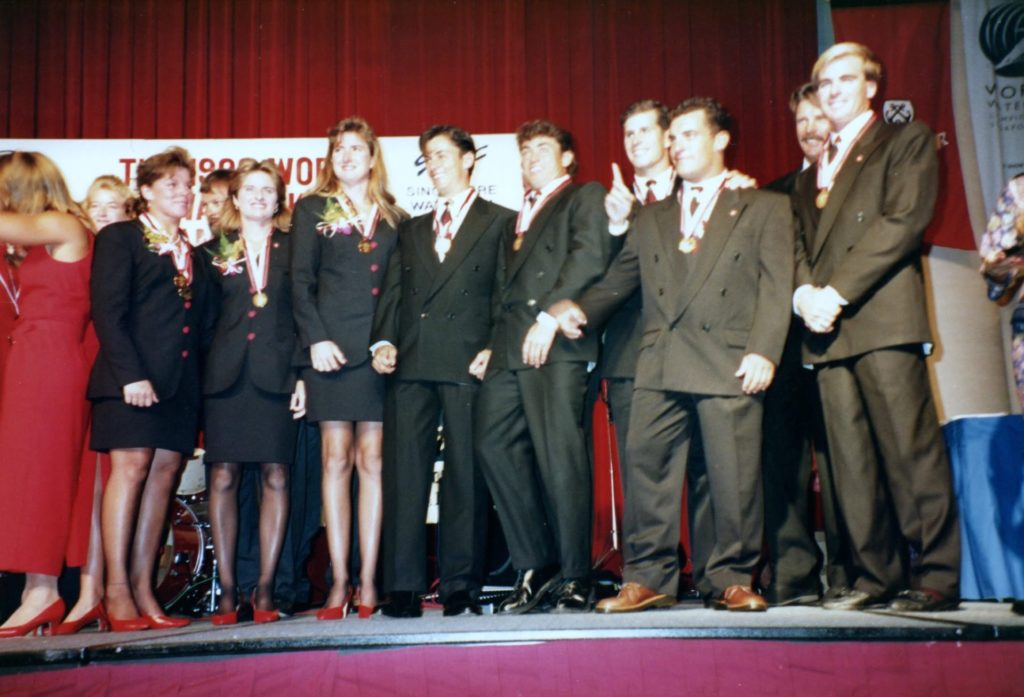
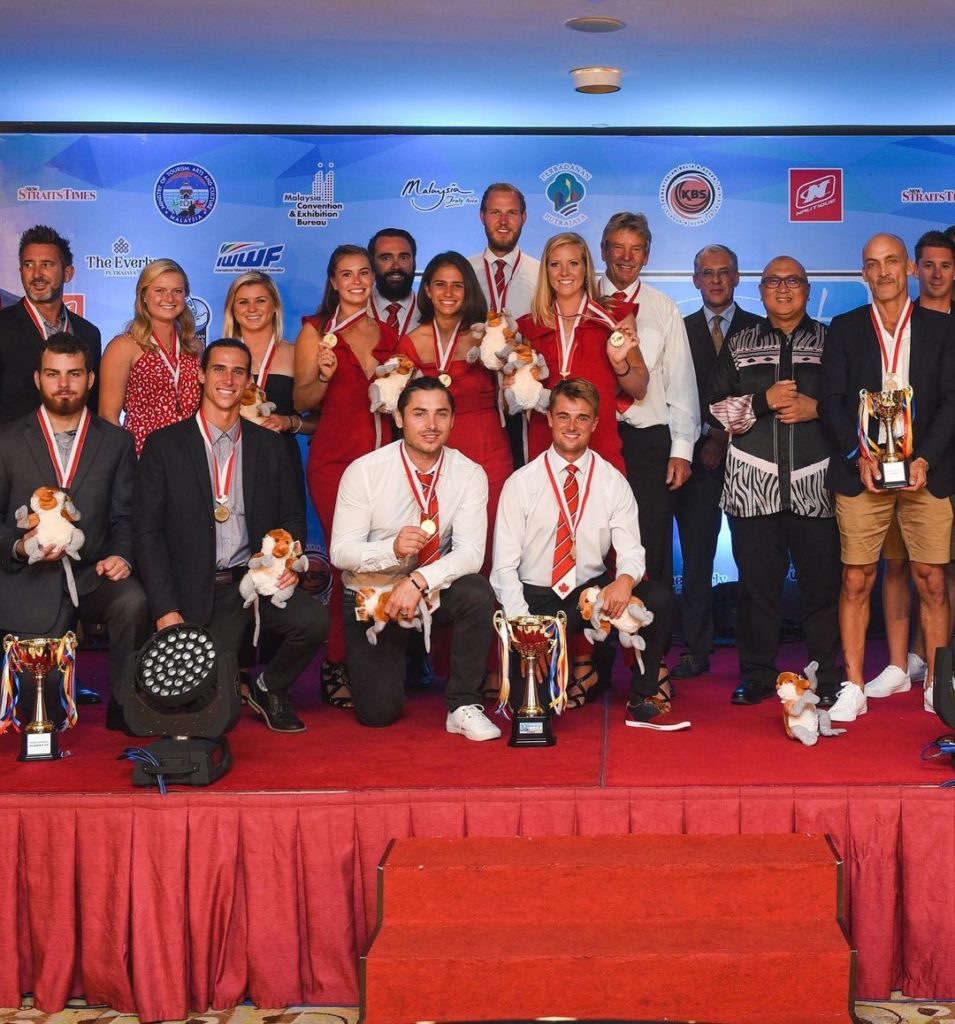
The only World Championships where three countries remained in contention right through to the final event was competed in challenging conditions in South East Asia.
The French team initially built a lead through slalom, thanks to Costard’s winning performance and Thibaut Dailland’s impressive preliminary score into 10.25m (41′ off). Canada and the United States caught up in the tricks discipline with strong performances from Llewellyn, Gay, and Ross.
After solid jump scores from Greenwood, Jaquess, and McClintock Rini, it all came down to the men’s jump final. An unknown teenager at the time, Duplan-Fribourg, led the way for France in the preliminaries but wasn’t able to improve in the finals. Garcia managed an extra 10 centimeters for Team USA, extending their lead with only one jumper left to compete. It was Dodd, the final skier of the tournament, who would decide the outcome. Despite the rough conditions, he managed a 67.9-meter (223-foot) jump, securing both the individual jump title and the team gold for Canada.
Key Moment: Canada was in third when Dodd left the dock, but by increasing on his preliminary score by a full 2 meters he squashed Garcia’s and all three French jump scores to leapfrog into first.
Winning Margin: 6 points. Equivalent to 0.2 meters (less than a foot) in jump.
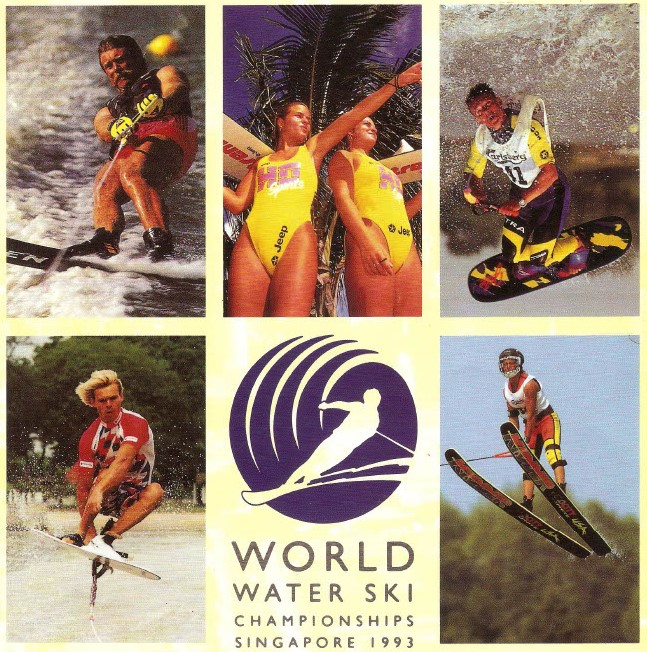
After experiencing their first defeat in 1991, the U.S. returned to the World Championships with a determined vengeance. They even convinced Kristi Overton, a previous U.S. Masters trick champion who had shifted her focus to slalom in 1989, to compete in trick and jump again for her country. Canada, on the other hand, faced challenges with their star from the 1991 Worlds, Kreg Llewellyn, unavailable due to injury.
Competition remained intense throughout the championship. Graham and Overton tied in slalom, just two buoys behind the leader. The American team dominated in the tricks event, with Larsen and Baggiano securing individual gold medals. Unfortunately, an early fall for Jaret Llewellyn ruled him out of the final. While Slone managed to secure 1,000 points in women’s jump during the preliminaries, Nichols missed the finals, only scoring 30.8 meters (101 feet) in the challenging conditions. Strong performances from De Macedo and McClintock Messer, who finished second and third in women’s overall, kept Canada’s hopes alive as they entered the men’s jump final.
With no American men in the final, the United States could only watch from the sidelines as Llewellyn improved his first-round score by over two meters, closing in on the Americans’ lead. The fate of the team’s title now rested with the fiery little truck driver, Clunie, who was the last to ski after posting the longest jump in the preliminary round. Team Canada had been good-humoredly teased for their meticulous approach to the team’s competition, including sending scouts to Singapore in advance to arrange accommodation and training, and using portable computers to calculate live results in the overall standings. One thing was certain: the team management would have made sure Clunie knew exactly how far he needed to jump when he left the dock. His best effort was 58.7 meters (192 feet), which might have seemed somewhat disappointing out of context, as it fell short of Andrea Alessi’s lead. However, for Team Canada, it was just enough to secure the title by the narrowest of margins.
Key Moment: De Macedo’s gold medal winning jump, the only individual gold Canada earned in 1993, where she improved her preliminary score by almost 5 meters.
Winning Margin: 2 points. Equivalent to less than a side slide in tricks.
Dorien Llewellyn made his return to training at Sunset Lakes over the weekend as he continues his recovery from an ankle injury that sidelined him since June of this year.
A twisted ankle during a jump crash at the LA Night Jam on June 10 left Llewellyn with two torn ligaments and bone fragments in his right foot. This injury forced him to miss the entire 2023 WWS Overall Tour and all subsequent jump events on the Waterski Pro Tour.
Instead of competing, Llewellyn spent the summer undergoing intensive rehab at the Red Bull Athlete Performance Center in Austria. Unfortunately, this injury was part of a series of setbacks he faced this year, which also caused him to miss the U.S. Masters earlier in the season.
Llewellyn, the current world trick champion and former world overall record holder, plays a crucial role on Team Canada’s squad for the upcoming World Championships, where they aim to secure their third consecutive team title. With only six skiers on the squad, having at least two world-class overall skiers is essential to ensure depth in all three events. Canada’s success over the past three decades has been built on skiers like the Llewellyns (Kreg, Jaret, and later Dorien) and the McClintocks (Judy and Whitney), who have excelled across all three events.
In contrast, the U.S. has faced challenges in the team competition despite having some of the most dominant specialists in the sport, including Freddy Krueger, Nate Smith, Anna Gay, and Erika Lang. While they have an all time great in Regina Jaquess on the women’s side, the U.S. has not claimed a medal in men’s overall since Jimmy Siemers won his last world title in 2005.
Canada received encouraging signs as Llewellyn tackled the slalom course at close to 100 percent in training just four weeks before the World Championships. To defend their title, they will rely on him returning to near-full fitness by the start of the event.
In this quiz, you need to remember all the male skiers who have won a world overall title since 1981.
The list has just nine skiers, all of whom have won the title at least once. While the quiz might seem easy, there’s a catch – you have to guess them in chronological order. We’ve given you the skiers’ country as a hint. Good luck!
Quiz: Most men’s World’s medals without winning a gold
Men’s trick podium at the 2017 Paris World Championships.
By RTB
June 29, 2021
4 minute play
In this quiz, you have to name the men with the most World’s medals without ever winning a gold.
The list contains 16 skiers, all of whom have won at least three medals at an open World Championships while never quite picking up a gold. Some of the names may surprise you. We have mentioned their country, along with the year of their last World’s medal, and number of medals.
Note: does not include Ski Fly, age group (U17, U21, etc.), or University World Championship medals/victories.
Independent perspectives on tournament water skiing