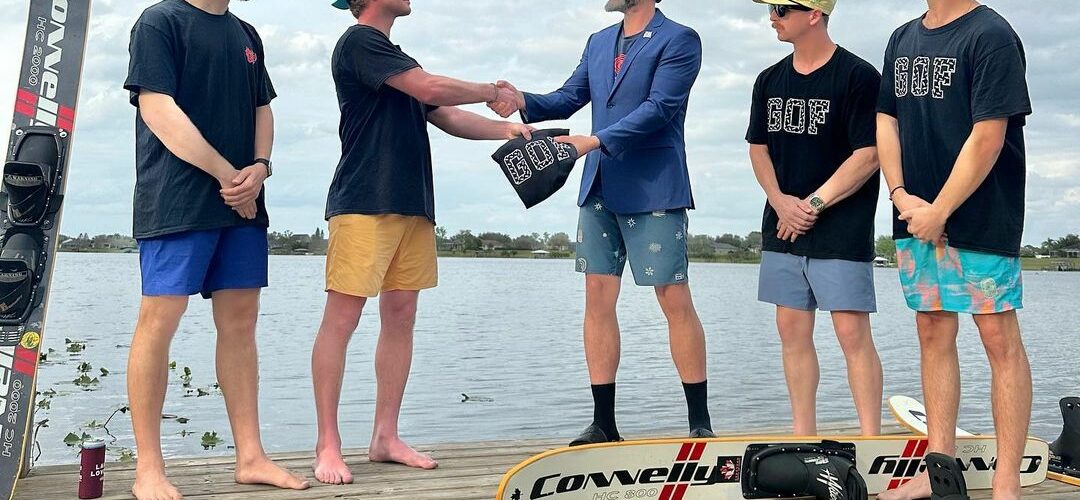
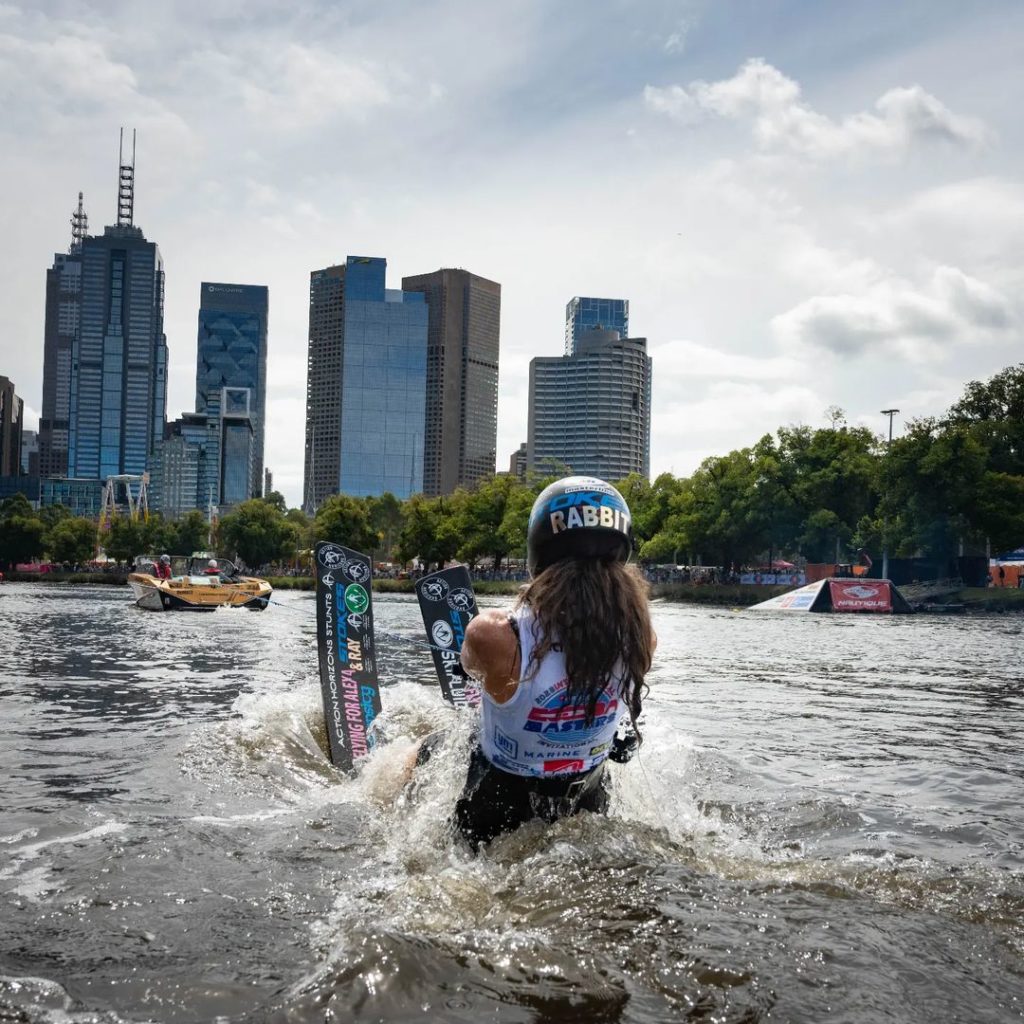
In many ways, Kevin Michael embodies what is great about the sport of water skiing. A laid-back Midwesterner with a penchant for cracking jokes and flashing smiles, his passion ignites when the conversation turns to the lake. Whether it’s slalom, wakeboarding, freestyle jumping, or any other watersport activity, if it involves enjoying a summer’s day behind a boat with friends, count Michael in. But can this man, recently appointed as the Executive Director of USA Water Ski and Wake Sports, effectively lead one of the sport’s most influential organizations, clad in board shorts and a blazer?
It’s a tough gig, to say the least. Steering and expanding towed water sports in the United States—the world’s largest market—is akin to pushing against the tide. By all accounts, Michael’s predecessors were highly competent and managed to navigate the organization through difficult times. Nate Boudreaux, the outgoing Executive Director, was an experienced manager of large sports organizations, excelling at financial stewardship and running a tight ship. However, it is hard to imagine an outsider to the sport, like Boudreaux, having the passion, reach, and insider knowledge to turn the tide on a sport in decline.
This is where Michael steps in. A 30-year industry veteran, his passion for towed water sports has taken him far and wide. With stints in marketing and media roles at Waterski and Wakeboarding Magazine, Malibu Boats, and as the executive director of the Water Sports Industry Association (WSIA), he’s well-versed in the industry’s ins and outs. In the latter role, he rubbed shoulders with politicians in Washington D.C., advocating for the industry’s interests—presumably, his wardrobe does include attire beyond just board shorts.
Michael’s strengths lie in marketing towed water sports and lobbying for the sport’s interests—an ideal fit for the organization’s needs. As a lifelong participant himself, he understands the importance of grassroots campaigns and broad audience visibility to drive participation. He injects fresh energy and innovative ideas into a sport often bogged down in tradition. While many in the sport focus solely on their preferred discipline, Michael has the cross-discipline passion to unite disparate groups under the same tent.
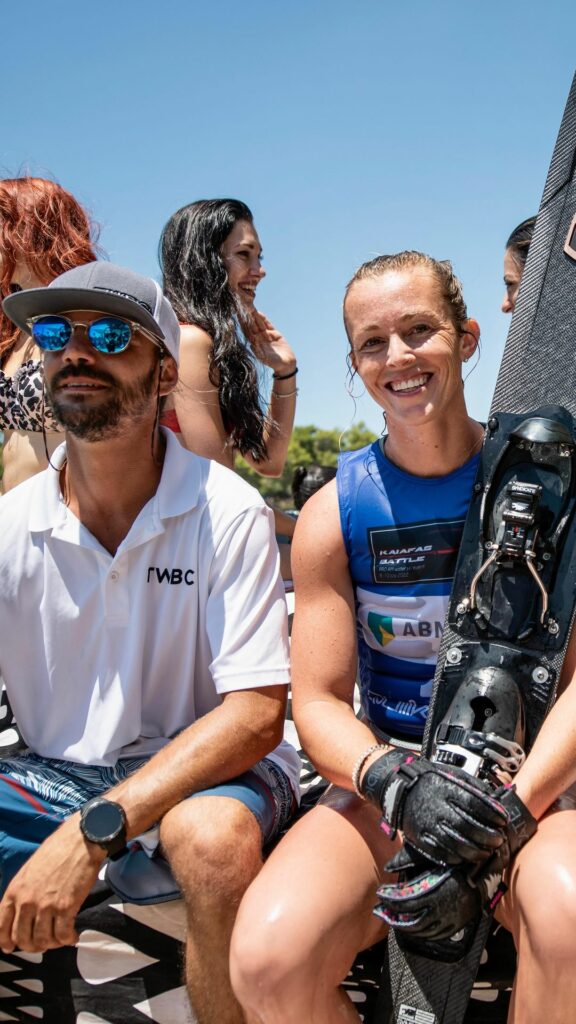
In his first month on the job, Michael has already made promising strides. He recently appeared on both the Water Skier Magazine’s Hit It! podcast and the TWBC podcast, sharing his vision for the future of the organization. His optimism and desire to build forward momentum are infectious. He’s even taken over the organization’s social media accounts, producing videos featuring some of the USA’s top athletes.
However, it’s crucial to temper expectations. Michael now oversees an organization with 14,000 members across nine sport disciplines—a monumental responsibility. Navigating relationships with the U.S. Olympic Committee and other government bodies, providing insurance for clubs and tournaments, and appeasing elected representatives from the various disciplines are no small feats.
Yet, Michael remains undaunted. Embracing the challenge, he emphasizes the need for grassroots involvement and hands-on participation from the water skiing community. Sharing on the Hit It! podcast: “Everyone asks me, ‘What can I do? How can I help?’ I keep telling everybody, I need you on the water, and I need you to teach people for the first time how to do anything behind the boat… introduce people to the sport.”
Author Frank Herbert once remarked, “Bureaucracy destroys initiative.” We hope that Michael, in his new role at USA Water Ski and Wake Sports, is the exception that proves the rule. He has the opportunity to challenge the norm and pave the way for a brighter future. As he embarks on this “revolution,” Michael’s leadership could redefine the landscape of towed water sports for generations to come.
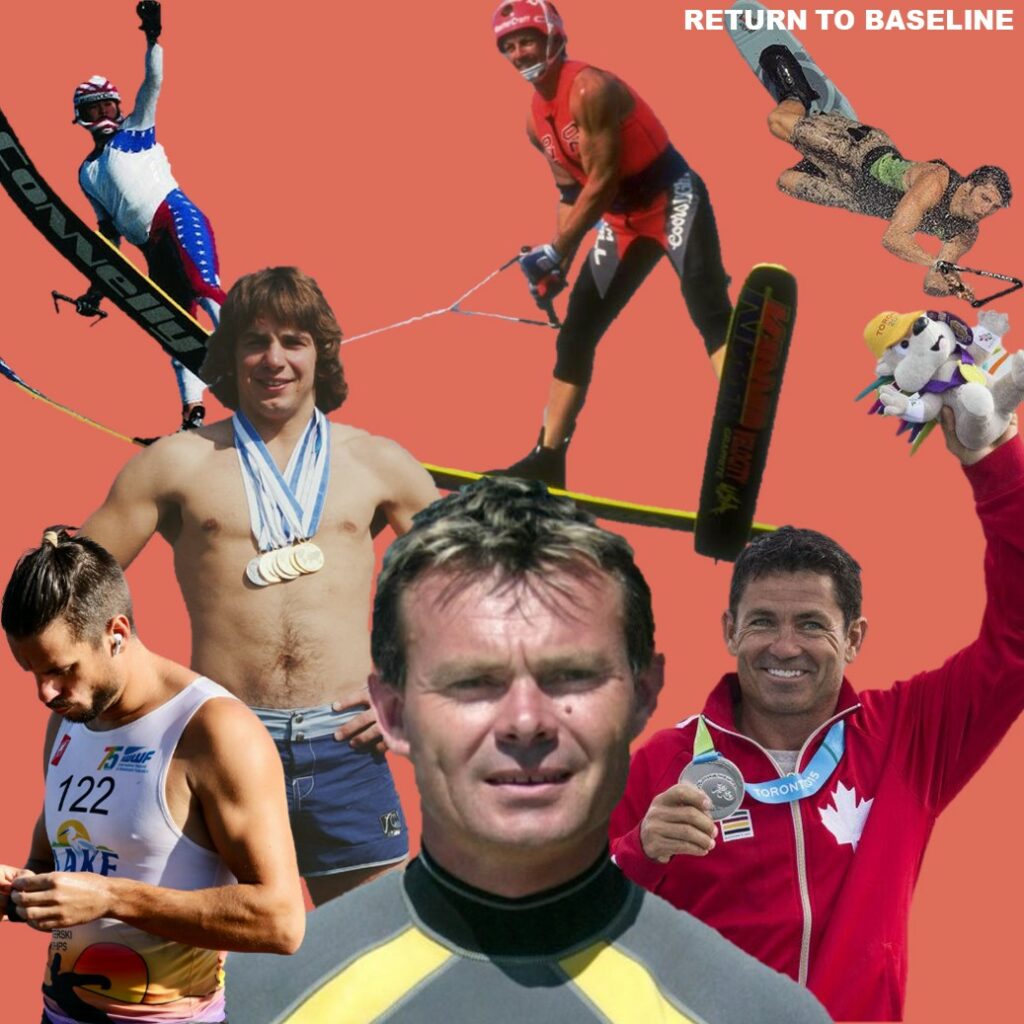
Finally, we turn to the overall event, where we celebrate the true giants of the sport. In a realm where versatility reigns supreme, these athletes stand head and shoulders above the rest. The term “greatest athlete” is subjective, but here, we explore the remarkable careers of those who have not only achieved excellence but have conquered three distinct disciplines – slalom, trick, and jump – earning them the title of the sport’s greatest overall skiers.
These individuals have not just excelled; they’ve transcended the boundaries of what was thought possible. From the early pioneers, through the discipline’s professional peak in the 1990s, to the modern-day resurgence, our journey takes us through each skiers triumphs and tribulations. These overall skiers represent the pinnacle of the sport, demonstrating unmatched athleticism and finesse across the spectrum of water skiing events.
‘Greatest Of’ lists in any sport are inherently subjective and water skiing is no exception. There’s no definitive checklist to crown someone as the absolute best. Every fan out there has their own opinion. But decisions had to be made. We proudly present our picks for the 10 best male overall skiers in the history of competitive water skiing. So sit back, enjoy, and maybe even debate a little over our choices—after all, that’s the fun of it!
Llewellyn competes at the 1999 World Championships in Milan, Italy.
10. Kreg Llewellyn
One of the first men to break 10,000 points in trick skiing, Kreg, the elder of the renowned Llewellyn brothers, was an incredibly well-rounded skier. The sole athlete in the professional era to secure World Championship medals across all four disciplines (slalom, trick, jump, and overall), Kreg played a pivotal role on the Canadian team during their groundbreaking victories in the 1990s. At the 1991 World Championships in Austria he not only secured medals in trick and jump but also finished as the runner-up in overall. Llewellyn’s margin of defeat was the tightest ever seen in the sport, with Patrice Martin claiming victory by a mere 0.2 overall points.
His performances laid the foundation for Canada’s inaugural victory in the teams competition, the first time the U.S. lost the title in the history of the tournament. Although he never quite clinched top honors, he achieved runner-up placements in men’s overall again in 1997, along with a bronze in 1999. His professional achievements include victories at the U.S. Open, U.S. Masters, and Moomba Masters.
Siemers poses next to his photo in the USA Water Ski Museum (image: @jimmy_siemers)
9. Jimmy Siemers
An exceptionally talented skier from an early age, the Texan prodigy demonstrated his prowess by clinching victories in tricks, jump, and overall at the 1998 U17 World Championships. In a remarkable feat, at the age of just 18 in 2000, he broke the world overall record, bringing an end to Patrice Martin’s nine-year reign as the world’s number one ranked overall skier. His dominance continued at the inaugural U21 World Championships in 2003, where he triumphed again in tricks, jump, and overall. Later the same year, he came tantalizingly close to replicating these achievements at the Open World Championships, securing wins in tricks and overall, along with a runner-up finish in jump. Siemers would then go back-to-back, winning a second overall world title in 2005.
However, Siemers’ ascent to the pinnacle of the sport coincided with the decline of professional overall tournaments. Unfortunately, 2000 marked the final year of overall competition at the U.S. and Moomba Masters, while the U.S. Open continued until 2003. His lone professional victory in the discipline came at the 2002 U.S. Open. Ahead of his time, it would take nearly two decades for another skier to match his incredible feat of scoring over 12,000 points in trick skiing and jumping over 70 meters (230 feet).
After securing bronze at the 2019 World Championships in both jump and overall, Poland found another gear, breaking the world overall record in 2021 before winning one of the greatest overall battles in the sport’s history against Dorien Llewellyn and taking the world record back off Llewellyn in the process.
Dominant on the WWS Overall Tour, Poland emerged victorious as tour champion after an epic season long battle with Dorien Llewellyn and Louis Duplan-Fribourg in 2022, including one memorable tour stop where he won on all borrowed equipment. He followed up with an undefeated season in 2023, winning the final stop in style by breaking his own world record. After an early fall in the trick event at the 2023 World Championships, Poland was written off in the overall event before he produced the statement performance of the tournament the following day by running 10.25m (41’ off) for the first time to secure himself a runner up finish in the overall.
A quadruple threat, Poland is capable of winning events in slalom, tricks, jump, or overall as a member of the three most exclusive clubs in the sport; the 10.25m (41’ off), 70 meter (230’), and 12,000 point clubs. He stands as only the second man this century to secure podium finishes across all three disciplines at professional events. If Poland is able to maintain his current trajectory we expect him to finish his career much higher on this list.
The first of a new generation of overall skiers, Sedlmajer’s foundation for success rested upon his slalom skills. Demonstrating remarkable versatility, he held the distinction, until last year, of being the sole male skier in the 21st century to secure podium placements across all three disciplines in professional tournaments. During his peak years, Sedlmajer dominated the World Championships, clinching two world overall titles and two runner-up finishes, showcasing his prowess at the only elite competition for overall skiers.
It’s one of the greatest tragedies of our sport that a skier of Sedlmajer’s calibre was given so few opportunities to showcase his talents. One poignant example is when he was left out of the invite list for the 2016 U.S. Masters, despite being the reigning world overall champion and the world’s number one ranked overall skier. Unfazed, he proceeded to claim victory in the U.S. Open slalom event later that year.
In 2017, Sedlmajer broke Jaret Llewellyn’s longstanding world overall record, a record that had remained unbroken since 2002. What adds to the remarkable nature of this accomplishment is the fact that he achieved this under the rules established almost two decades earlier, rules that significantly undervalued slalom in comparison to today’s standards.
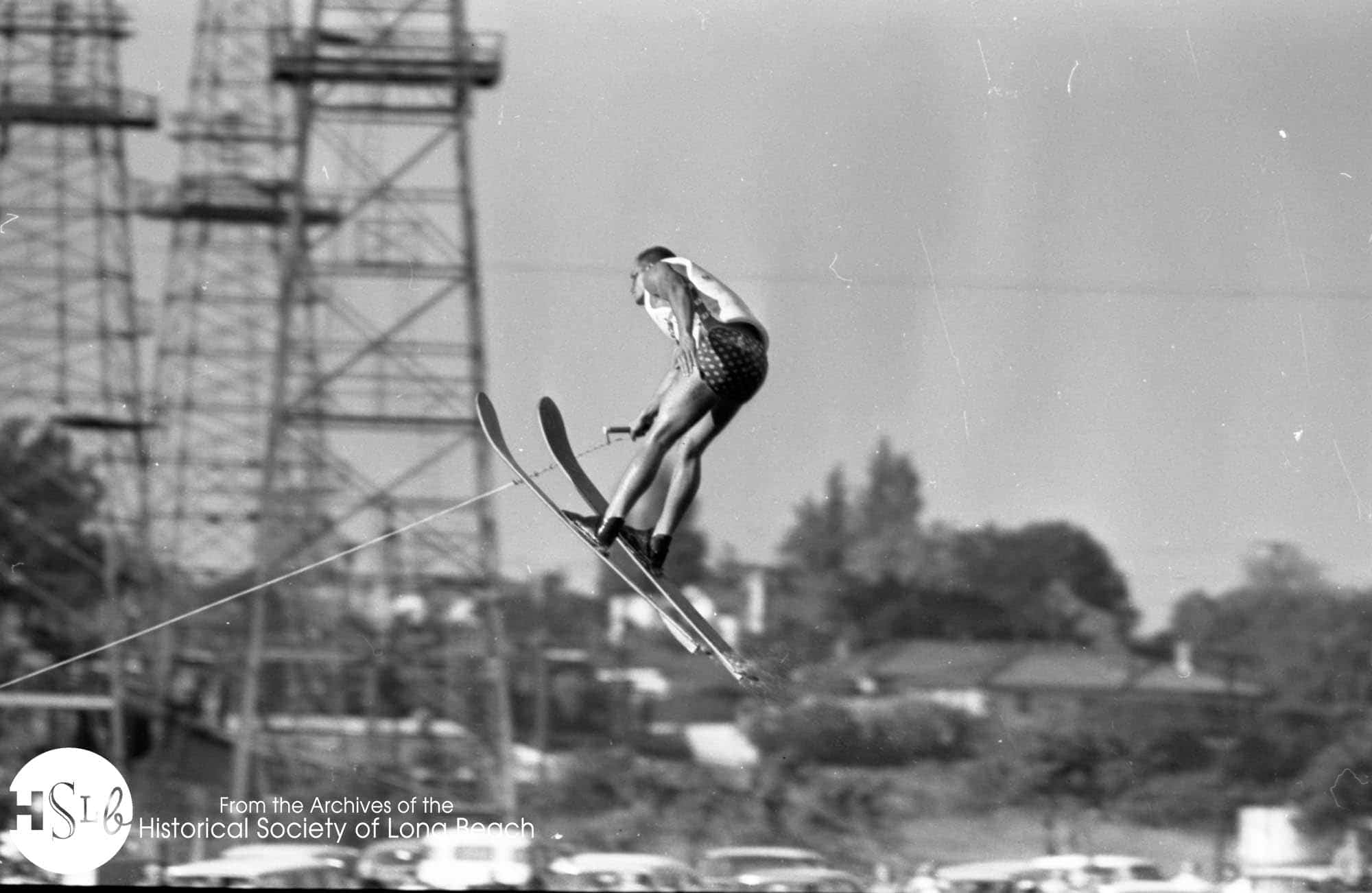
Chuck Stearns jumps at the 1961 World Championships in Long Beach, California (image: HSLB)
6. Chuck Stearns
Water skiing’s first ever superstar, Stearns was a household name across America during the 1960s. From 1957 to 1967, he clinched an astonishing 11 World Championships medals across all four disciplines, still one of only a handful of skiers to earn medals in slalom, tricks, jump and overall to this day. At the 1959 World Championships in Milan, he claimed the men’s overall title.
The first man to dominate at the U.S. Masters, Stearns secured overall victory four times from 1960 to 1965. Additionally, he was among the first Americans to receive an invitation to the Moomba Masters, the world’s only professional competition at the time. Stearns won the overall event on his debut visit in 1963 and followed up with an incredible showing in 1966, where he emerged victorious in the slalom, jump, and overall categories.
A truly versatile athlete, Stearns is the only skier in history to simultaneously hold top positions in both tournament skiing and ski racing. He boasts a remarkable record in the latter sport, being a 10-time winner of the Grand National Catalina Ski Race and setting the drag racing speed record at over 120 miles per hour. In an era when most competitive water skiers retired young, Stearns’ strict fitness regimen allowed him to remain at the pinnacle of the sport for over two decades.
Suyderhoud takes a spill at the Cal Cup in Berkeley, CA (image: Gary Warren)
5. Mike Suyderhoud
The son of a rags-to-riches Dutch immigrant, who had served in the underground resistance during the Nazi occupation, Mike inherited his father’s tenacity and channeled it into water skiing as a young man. At 17 years old, he won his first of five World Championships, and by 18, he had set his first of three world jump records.
Suyderhoud helped the U.S. Team secure five World Championships team titles from 1967 to 1977, accumulating a total of 11 individual medals. His achievements included consecutive overall victories in 1967 and 1969, a runner-up finish (bolstered by golds in slalom and jump) in 1971, and a bronze in 1975. Domestically, he became a U.S. Masters overall champion, finally clinching the title in 1973 after six consecutive years of either second or third-place finishes. Furthermore, he claimed five consecutive overall titles at the U.S. Nationals from 1968 to 1972. Suyderhoud also achieved back-to-back victories in slalom, jump, and overall at the Moomba Masters during his visits to Melbourne. His remarkable career featured triumphs in every major tournament of his era.
Image: Yvon le Gall
4. Mike Hazelwood
Following his triumph in the men’s overall at the 1977 World Championships, Hazelwood was a constant presence on the podium for the next six years, securing back-to-back runner-up finishes in 1981 and 1983. While jump skiing undoubtedly stood as his strongest event, Hazelwood’s versatility was exceptional, earning him membership in the exclusive club of skiers to secure World Championship medals in all four events, totaling an impressive count of 10 medals.
Within Europe, Hazelwood claimed an incredible eight consecutive European Championships titles in overall from 1976 to 1983. Furthermore, he is one of only four men to win European Championships in all four events. A fierce competitor in all conditions, Hazelwood’s tenacity shone through as he secured four consecutive overall titles at the U.S. Masters from 1978 to 1981 and an impressive five consecutive Moomba titles from 1977 to 1981. His victory list extended to every major overall tournament across the globe, solidifying his legacy as a true champion of water skiing.
Duvall held No. 1 world ranking in either jump or overall for eleven consecutive seasons from 1983 to 1993.
3. Sammy Duvall
Duvall’s first major victory in overall came as a 19-year-old at the inaugural World Games in 1981, where he won gold in jump and overall. Notably, Duvall remains the sole skier with a perfect undefeated record in overall at the World Championships. He secured four consecutive overall titles from 1981 to 1987, before retiring from amateur competition following the 1987 World Championships. Duvall’s contributions were not limited to individual achievements; he played a pivotal role in the United States’ dominance in the teams competition throughout the 1980s, successfully repelling strong challenges from Australia during that decade.
Among his numerous accolades, Duvall stands as one of only two men to attain three U.S. Masters titles in a single year, with four of his impressive tally of 13 U.S. Masters titles coming in the overall event. His prowess extended to the Moomba Masters, where he secured four overall titles, including three consecutive victories from 1984 to 1986. As a U.S. Open overall champion as well, Sammy’s exceptional talents were on full display in an era predating official world records. For six consecutive years, from 1983 to 1988, he reigned as the number one ranked overall skier in the world. His scores in his final season as the world’s best, including 4@11.25m (38′ off), 8,600 points, and 61.7m (202′), would have undoubtedly set the mark had official records existed at that time.
Canadian Jaret Llewellyn still walking on water at age 45 (image: Bernard Weil)
2. Jaret Llewellyn
A late bloomer in the jump event, Llewellyn’s initial success came in tricks when he won the inaugural Junior World Championships in 1986. It would take him until age 20 in 1990 to jump 50 meters (164 feet), but within two years he was jumping over 200 feet and broke his first world jump record at the U.S. Masters in 1992.
No man can match Llewellyn’s 16 World Championships medals, with majority of these coming in the overall event where he finished on the podium nine times between 1991 and 2015. His breakout performance as a 21-year-old at the 1991 World Championships was particularly memorable, as he and his older brother Kreg picked up the overall bronze and silver respectively, leading Canada to teams victory. Across his career he was up against a peak performing Patrice Martin, then Jimmy Siemers, and finally Adam Sedlmajer, and was unlucky to only finish on top of the World Championship podium twice in 2001 and 2007. He broke the world record twice, with his final record of 5@11.25m (38’ off), 10,730, and 71.7 meters (235’) standing for an incredible 14 years, 7 months, making it the longest standing world record of all time.
On the professional circuit he was a five-time U.S. Masters overall champion. In 1996, he ended the Neville family’s stranglehold on overall at the Moomba Masters and would go on to dominate the event through the late nineties. He was also a two-time U.S. Open overall champion. Unfortunately for Llewellyn, the industry turned away from overall right at the peak of his career and the event was eliminated from legacy events such as the U.S. Masters, Moomba, and U.S. Open in the early 2000s. Fittingly, he has spearheaded the WWS Overall Tour in recent years, heralding a resurgence for the discipline.
Martin is one of the finest achievements in French sport (image: Graine de Sport)
1. Patrice Martin
Known as “Le Petit Prince,” this French prodigy burst onto the water skiing scene as a teenager, securing his first World Championships victory in tricks at just 15 years old in 1979. Initially specializing in trick skiing, he gradually mastered all three disciplines throughout the 1980s and, by the decade’s end, had risen to the pinnacle of the sport.
His extraordinary collection of 10 World Championships gold medals is only exceeded by Liz Allan on the women’s side. Immovable from the top of the podium, his winning streak of six consecutive World Championships in overall from 1989 to 1999 is the longest in our sport across any discipline. The most decorated skier in the history of the World Games, Martin clinched six golds, one silver, and one bronze from 1981 to 2001. Finally claiming gold in overall at the twilight of his career when it was reintroduced after a 20-year absence at the 2001 event. Within Europe he was virtually unstoppable, winning a total of 30 European Championship golds across slalom, trick, and overall, including nine overall titles spanning from 1984 to 2001, matching Hazelwood’s record.
On the professional circuit, he proved his mettle as a Moomba Masters champion, securing the overall title five times at the U.S. Masters and reigning supreme in the U.S. Open during the 1990s, with six consecutive titles from 1992 to 1997. Even though his two strongest events, tricks and overall, were not part of the pro tour, Martin remained a regular contender, even clinching a tour stop victory in slalom in 1996, edging out formidable opponents like Andy Mapple and Wade Cox. His reign as the number one ranked overall skier in the world spanned nine consecutive seasons, from 1991 to 1999. When the IWWF began recording world overall records in the mid-1990s, Martin was the first holder and broke the record three times throughout his illustrious career. His final record, set in 2001, of 4@10.75m (39.5’ off), 11,550 points, and 62.5 meters (205’), remains a highly competitive score in the sport to this day.
Honorable Mentions:
Dorien Llewellyn
Sport can be cruel, and it’s not hard to imagine a world in which Llewellyn emerges victorious at a few additional tournaments, avoids injury, retains the world record, and ends up ahead of Poland on this list. After breaking the overall world record a month earlier, he finished 2nd in overall, winning the tricks, at the 2021 World Championships. Llewellyn’s other major victories include the 2019 and 2023 Pan American Games, the 2018 Latrobe City Invitational, and multiple stops on the WWS Overall Tour.
Felipe Miranda
The Chilean won the world overall title at his home site in 2013 and backed it up with a second title in challenging conditions at the 2017 Paris World Championships. ‘Pipe’ is also a Pan American Games overall champion and won the 2017 Latrobe City Invitational.
Javier Julio
The Argentinian secured five medals in men’s overall between 2001 and 2013, including a gold medal in 2009, and finished his career with three years as the number one ranked overall skier from 2009 to 2011 and gold at the 2011 Pan American Games.
Bruce Neville
Although primarily known as a jumper, he clinched an impressive five consecutive Moomba Masters overall titles from 1991 to 1995, matching Hazelwood’s record.
Carl Roberge
A three-time overall champion at all three major professional tournaments of his era, Roberge had great success at the Moomba Masters, U.S. Masters, and U.S. Open. While never claiming the highest honors, he finished on four consecutive overall podiums at the World Championships from 1983 to 1989, including finishing second to Patrice Martin by a margin of only 6 overall points in 1989.
Mick Neville
Despite finishing on the podium at the World Championships eight times between 1981 and 1987, Mick could never quite claim the gold. He lost two of the tightest ever overall battles to Sammy Duvall in 1985 and 1987, with the margin less than 25 overall points each time. He did manage overall victories at both the U.S. and Moomba Masters.
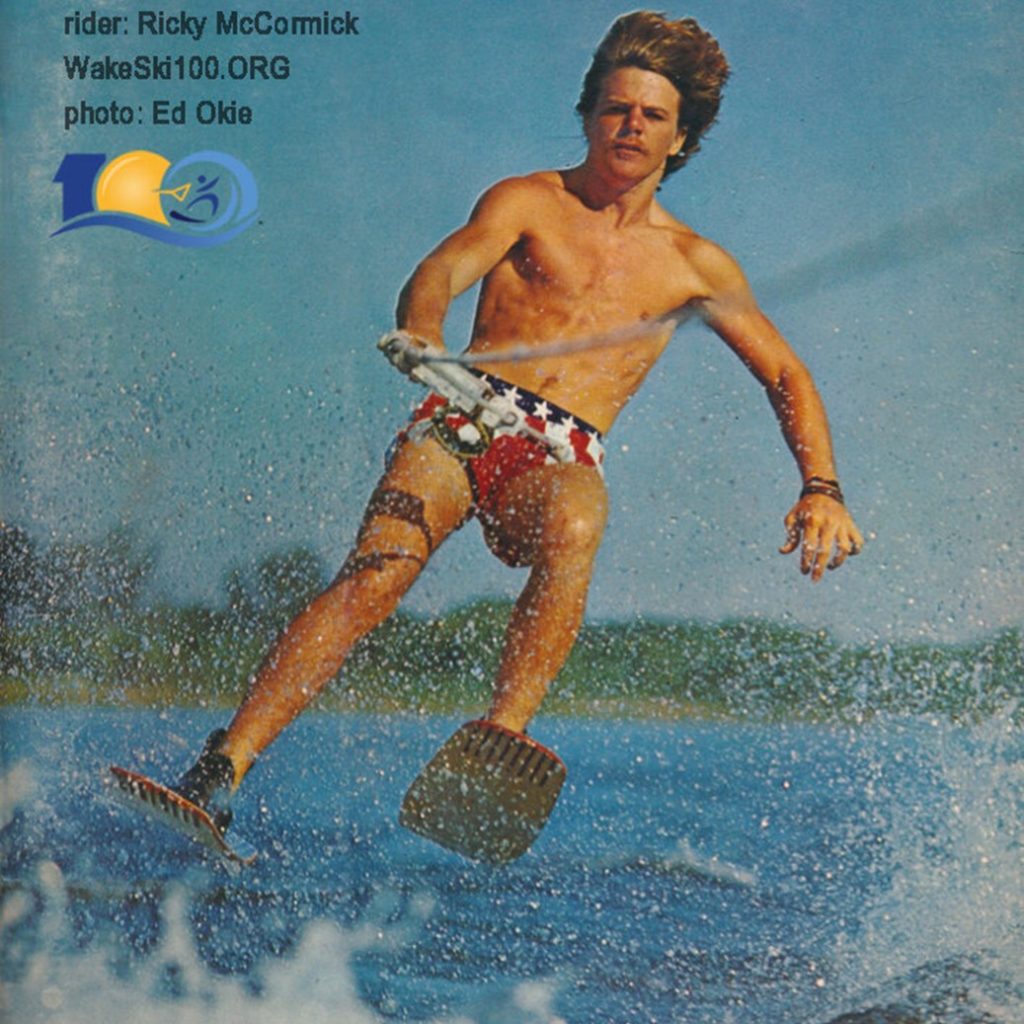
Ricky McCormick
Featured on the podium in at least one discipline at every World Championships from 1967 to 1975, including medals in all four disciplines and runner-up finishes in overall in 1973 and 1975. McCormick won three Moomba Masters overall titles. Additionally, four of his 13 U.S. Masters titles came in overall, and he joins Sammy Duvall as the only other man to win three titles in a single year.
George Athans and Alfredo Mendoza
Both of these men deserve recognition as two-time world overall champions.
As the water ski community eagerly anticipates the 2024 season, there are five burning questions on our mind, shaping the narrative of what promises to be another exhilarating year. From records under threat to a potential changing of the guard, here are some of the key storylines to watch:
1. Is Berdnikava’s Overall Record in Danger?
Natallia Berdnikava’s overall world record, set in 2012, has seemed unassailable for over a decade. However, Hanna Straltsova and Giannina Bonnemann Mechler may pose a threat to the longest standing open world record in three-event water skiing. In 2023, both Straltsova and Bonnemann Mechler posted scores that, if performed in the same round, would have surpassed Berdnikava’s mark. Straltsova, now the joint second-highest scoring women’s jumper of all time (tied with Berdnikava), begins the season as the top-ranked overall skier in the world. Likewise, Bonnemann Mechler, one of only six women to score over 10,000 points, put herself in contention after running 11.25m (38’ off) for the first time last season.
2. Who Will Be the Next Man to Win a Professional Slalom Title?
Men’s slalom in 2023 was dominated by just two men, Nate Smith and Freddie Winter. The only other man to win a professional title was Thomas Degasperi, making him the oldest-ever professional slalom champion with his victory at the Malibu Open. Since Daniel Odvarko won the Ski Stillwaters Pro Team Challenge in 2020, no one other than Smith, Winter, Degasperi, or Will Asher has claimed an event. A whole generation of superbly talented slalom skiers, including several members of the 41-off club, has never won an event. Look for the likes of Dane Mechler, Cole McCormick, Brando Caruso, and Rob Hazelwood to challenge for their first professional victory in 2024.
3. Will the Old Guard of Krueger and Dodd Continue to Dominate Men’s Jump?
Similarly, men’s jumping has been dominated by two men for the last decade. Since 2010, Freddy Krueger (55) and Ryan Dodd (43) have won more than twice as many professional jump titles as all other skiers combined (17). The next closest on the list, Jack Critchley and Zack Worden, have only managed four apiece. However, Krueger turns 49 this season, and Dodd will reach 40 later in the year. Will the old guard continue to dominate for another season, or will we see some young blood start to edge out these two, among the greatest to ever compete?
4. What’s the Ceiling on Trick Performances?
2023 witnessed the highest-scoring year of tricks ever, by a considerable margin. Over 25% of all scores over 12,000 points were achieved in the year. Patricio Font continued to extend the world record, approaching 13,000 points. Similarly, on the women’s side, Erika Lang extended her world record, and both Neilly Ross and Anna Gay broke 11,000 points for the first time. Perhaps most excitingly, these record-breaking scores were not confined to amateur ‘backyard’ events. Font equaled his world record at two professional tournaments and at the World Championships, and Lang broke 11,000 at the Swiss Pro Tricks and the U.S. Masters. With the level of tricks so high, even under pressure on the big stage, what kind of scores will it take to win across 2024?
5. Who Will Emerge Victorious in Women’s Slalom This Year?
The battle for the season championship on the Waterski Pro Tour was hotly contested throughout 2023. No one skier was able to dominate, with Jaimee Bull, Regina Jaquess, and Whitney McClintock Rini all winning multiple events. Also in the mix was Allie Nicholson, the only skier to compete in every event, showing incredible consistency. Ultimately, Bull edged Jaquess by two tour points in a field where only 40 points separated 1st through 4th. Who will claim the season title in 2024?
The IWWF Water Ski Council has given the green light to four new flips for the upcoming season, potentially infusing the sport with a sense of novelty and innovation. However, despite this approval, one of the creators of these flips is expressing skepticism, stating, “you will never see them in a tournament” at current point values.
1. BFLSLB (“Super Half Twist”)
Backflip with a ski-line-back
Submitted by Clarens Lavau
Approved at 850 points
2. BFLSLO (“Supermobe Front-to-Front” or “UFO”)
Backflip with a ski-line-360
Submitted by Joel Poland
Approved at 900 points
3. RFFLF (“Reverse Half Jack”)
Frontflip from the back-to-the-front (regular and reverse)
Submitted by Axel Garcia
Approved at 850 points
4. FFLSL5F (“Super Front Five” or “Matrix”)
Frontflip with a ski-line-540 from the back-to-the-front
Submitted by Joel Poland
Approved at 950 points
Joel Poland, the architect behind two of these flips, revealed his reservations about the process for assigning point values to new tricks. Both the ‘UFO’ and ‘Matrix’ were successfully executed in 2022, with Poland debating whether it was worthwhile to submit them for approval. In correspondence with the IWWF, he shared, “[I] didn’t feel like it was worth sending them in as the point values would make them another trick on the list we would never see in competition.” Poland remained hopeful, stating, “But I have hope that we can come together and create a point value that makes them worthwhile.”
Upon learning the IWWF-assigned point values, Poland expressed understandable frustration. Regarding the ‘Matrix,’ a frontflip with a 540-degree spin over the rope, he voiced disbelief that it was valued only 150 points more than a regular frontflip. In his words, “The point values for high difficulty flips, in my opinion, are crippling trick and limiting the athletes.”
Poland’s frustration resonates with many top trick skiers and fans, who are in agreement that there is a pressing need for change in the point values assigned to high-end flips.
The most perplexing aspect of this issue is that no one seems opposed to a revision of the trick points in principle. IWWF Water Ski Council Chairman Candido Moz has expressed vocal support in the past for rationalizing trick values. As recently as October, he urged the newly formed Trick Working Group to bring forth proposals for better recognizing “the true difficulty levels” across tricks.
As Freddie Winter highlighted in an insightful Waterski Journal article on the subject, the issue is how to get a consensus on specific changes when each skier, or coach, has a vested interest in elevating the value of tricks they excel at while suppressing the value of those they do not. In the past “the skiers could never agree on point values, so [the] IWWF never received a proposal,” shared Moz.
Instigating change, especially in the face of entrenched interests, is difficult. It may require a new generation to step forward and advocate for reforms. Poland, for his part, remains steadfast. “[I] intend to be very vocal about [point values] in the coming months.”
As we bid farewell to 2023, it’s time to revisit the unforgettable moments from this year’s water ski season. From seemingly impossible comebacks to record-breaking feats, each competition created its own narrative filled with anticipation, intensity, and sheer excitement.
Throughout 2023, skiers showcased their talents across three World Championships—Under-17, Under-21, and Open—two professional tours, the Waterski Pro Tour and WWS Overall Tour, and legacy events like the Moomba and U.S. Masters. The year witnessed record-breaking prize purses, and the quality of streaming for water ski enthusiasts continued to soar. Join us as we count down our selection of the top 10 unforgettable moments from the 2023 season.
Nate Smith flew to Europe this summer on an incredible run of form. After winning the Fungliss ProAm in France, his unbeaten streak in professional competitions tallied an impressive 27, one of the longest winning streaks in water ski history.
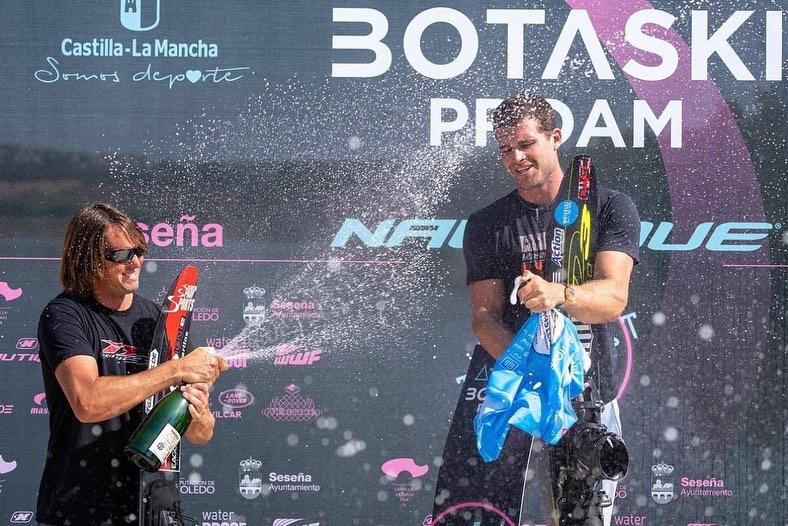
Following the qualifying rounds of the Botaski ProAm in Spain, where he finished with an equal top score of 1 @ 9.75m (43’ off), Smith seemed on track for another victory. He made easy work of his first head-to-head bracket, advancing to the semifinals. However, up against the young and relatively unknown Italian Brando Caruso, Smith faltered at 10.25 meters (41’ off), coming up half a buoy short of Caruso.
Facing defeat graciously, Smith shared, “After 27 wins in a row, I got to spray a competitor above me in the face with champagne. Congrats [Brando Caruso] for knocking me out… and Freddie [Winter] for ultimately taking first.”
One of the hardest workers on the professional circuit, Allie Nicholson had been threatening to post a big score for some time. As the only skier to attend all 12 Waterski Pro Tour slalom events in 2023, her breakthrough came during the European leg at the Kaiafas Battle ProAm. In a qualifying round, the American became only the 12th woman ever to run 10.75m (39.5’ off). Announcer Matteo Luzzeri remarked, “We were waiting for the next lady to run 39, and here we have her; she just hammered it, super confident. She decided now, today’s my day.” Nicholson was elated with the performance, stating, “I almost didn’t ski; I wasn’t feeling good before I skied, and I’m so glad I did. I’m on cloud nine right now.”
Nicholson’s success continued with a victory at the San Gervasio ProAm the following weekend and multiple more successful attempts at 10.75m, including at the Calgary Cup the following month.
Erika Lang had one of the closest things our sport has seen to a perfect season. In May, she broke her own world record during the Master’s LCQ. Throughout the season, she won three out of four professional events, broke the World Championships record on the way to her second world title, and closed out the season with a Pan American Games gold.
This incredible season was marked by Lang’s consistency, surpassing 11,000 with increasing regularity. The standout moment for Lang was at the U.S. Masters, where she achieved the second-ever score over 11,000 in a professional tournament by a woman. Her winning score, in the challenging conditions of Robin Lake, would have been enough to secure her a podium place in the men’s event.
During the final series of the men’s slalom elimination round at the World Championships, the sun dipped lower on the horizon, presenting competitors with a challenging glare. Joel Howley became the first skier to wear sunglasses during his run, with the boat driver handing them to him for each pass into the glare. Others attempted to mitigate the increasingly difficult glare with eye black. In a candid interview, Freddie Winter commented on the conditions, emphasizing that “we’re all trying to survive as opposed to perform.” Further stating “it’s dangerous, it’s scary, and it minimizes our performance.”
Despite the challenging conditions, most of the top skiers successfully advanced to the finals. Notably, two-time former champion Will Asher suffered an early exit at 10.25m (41’ off). The day concluded with an electrifying eight-way runoff for the final two spots, with young Vincenzo Marino attempting a 10.75m (39.5’ off) pass in what might be the coldest start ever after not skiing for three days. In the end, Cole McCormick and Corey Vaughan secured their tickets to the finals.
Before Patricio Font broke the world trick record in 2022, it had been the longest-standing record in three-event waterskiing, remaining unbroken since 2011. Proving that it was far from a one-off performance, Font extended his world record to 12,690 at the Master’s LCQ in May, before pulling out the record run in his victories at the Botaski ProAm, setting a professional tournament record, and in the preliminary round of the World Championships, setting a World Championships record.
This top seed position proved critical, as Louis Duplan-Fribourg, after executing a superb hand pass, seemed poised to achieve another big score. However, an equipment malfunction caused his toe strap to release before his final toe trick, preventing a score that could have totaled 12,580 points. Patricio Font, realizing the opportunity presented by Louis’ misfortune, opted for a less challenging run, omitting his Ski-Line-Seven, and cruised to victory with another huge score of 12,470 points.
With a stated goal of breaking 13,000 points, Font is at the forefront of a new wave of trick skiers redefining the boundaries of the sport. Although his potential record of 12,770 was ultimately downgraded upon IWWF review, we expect more big scores from him in the future.
Although still a regular at the top of the podium, Freddy Krueger showed signs of slowing down throughout the season. At the MasterCraft Pro, his second professional win of the season, he very nearly missed the final after failing to qualify on his first two jumps. The 48-year-old veteran then delivered the biggest jump of the tournament on his third and final attempt with 70.7 meters (232 feet).
The following weekend at the Malibu Open, Joel Poland set the pace early with a jump of 69.3 meters (227 feet), which held firm through six skiers and seemed poised to force a jump-off for the title. However, Krueger clinched the championship with an extraordinary 71.0-meter (233 feet) jump on his third and final attempt.
Finally, at the World Championships, Krueger was in serious danger of missing the final, not to mention jeopardizing U.S.A.’s chances in the teams competition, after managing only 56.4 meters (185 feet) from his first two jumps. Yet again, his wealth of experience came to the fore, enabling him to qualify on his third attempt, ultimately going on to finish runner-up in the final and help Team U.S.A. to a world title.
In a picturesque setting in the south of France, the WWS Overall Tour opened its 2023 season with an extraordinary performance by Louis Duplan-Fribourg. The Frenchman soared to new heights, setting a national jump record at 68.1 meters (223 feet), igniting the local crowd and taking the lead in the overall competition. Announcer Glen Williams acknowledged Duplan-Fribourg’s achievement, stating, “We’ve talked for a long time about Joel Poland and Dorien Llewellyn, and now there are three names in that category.” Duplan-Fribourg’s performance positioned him among the world’s top overall skiers.
“I was a little stressed after Louis’ big jump; when someone goes out and jumps that far, it’s intimidating,” said Poland in his post-jump interview. In the tightest overall battle of the year, Poland managed to win the event by the razor-thin margin of less than 3 overall points—equivalent to a quarter buoy or a side slide.
As the WWS Overall Tour unfolded, the French contender’s newfound jump form combined with his world-class tricking kept him ahead of the rest of the pack, finishing close second to Poland in all four tour stops. The final stop in Florida saw him extending the French national jump record, and shortly after, he clinched his first professional jump placement at the MasterCraft Pro.
His trick performance at the World Championships broke both the French national and World Championships records in the preliminary round. This impressive foundation paved the way for his breakthrough world title, cementing his status not just as a trick skier but as a rising star among the world’s top overall skiers.
The Malibu Open, with over two decades of history, returned to LymanLand in Alabama for the second consecutive year, delivering nearly nonstop record-breaking excitement. First, Regina Jaquess solidified her status as one of the greatest women’s slalomers of all time by setting a new world slalom record of 5 at 10.25 meters (41‘ off) in the preliminary round. Then, Hanna Straltsova became only the third woman ever to jump over 190 feet during the finals, not only claiming victory in the tournament but also securing the season title of the Waterski Pro Tour. Finally, Joel Poland broke his second world overall record in as many weeks, achieving scores of 2@10.25m in slalom, 11,680 in tricks, and 69.3 meters (227 feet) in jump. The latter score very nearly won him the jump event too.
In an interview following her record-breaking performance, Jaquess shared her elation and gratitude, saying, “Oh my gosh, I don’t even know what to say, I’m shaking. I think getting out of two this morning unlocked a little bit of mental pressure because it was my best score. I haven’t gotten a three since my ACL [surgery], so thank you, Andrews Sports [Medicine], for getting me back together. This is unbelievable, and to do it at the Malibu Open behind Malibu Boats… I got mental; I should have run it… it felt so amazing.”
For number two, we go all the way back to the very start of the year, to the Under 17 World Championships in Santiago, Chile. This tournament was filled with promising young talents and exhilarating moments on the water. However, the peak of tension unfolded during the boys’ slalom final. Skiing early in the lineup, positioned 3rd and 5th off the dock, respectively, Australian Lucas Cornale and Mexican Nicolas Nelson set an early pace with 3 @ 10.75m (39.5’ off), falling just half a buoy short of the World Championships record. This combined lead persisted through all 12 competitors, necessitating a runoff to determine the winner.
Starting at 11.25 meters (38′ off), Nelson skillfully navigated the pass, narrowly missing four ball at 10.75 to match his initial score. As Cornale entered the course for his chance to challenge, announcer Tony Lightfoot noted, “Nicolas Nelson [is] still in the course.” Cornale fell early around buoy two but promptly signaled for a reride by raising his ski in the air. Meanwhile, Nelson, having initially stayed within the buoy line, was slowly making his way to the shore, perhaps overwhelmed by the occasion. After a split decision from the judges, Cornale’s request for a reride was denied. Nevertheless, the Australian team lodged a formal protest citing unsafe skiing conditions, which was ultimately upheld.
Seizing this opportunity, Cornale successfully completed the 11.25-meter pass, matching Nelson’s runoff score of 3 @ 10.75m. Once again, the young men found themselves in a runoff, this time with Cornale starting first. Unfortunately, the Australian fell early at 11.25m, leaving the door open for Nelson, who ultimately claimed the world title by navigating around three buoys. This dramatic double runoff set the stage for an intense start to the year.
It should come as little surprise that our top pick for the number one moment of 2023 involves the hottest commodity in world water skiing right now – Joel Poland. Many moments came to mind for the extraordinarily talented Brit: his first 70-meter (230-foot) jump at the California Pro Am, and his back-to-back world records set live on webcast to close out the professional season—any of these could have easily made this list. However, it was his World Championships effort, ironically one of the only events he didn’t win, that stood out the most.
Poland, who only needed 10,000 points to make the trick final, stood up in his opening toe pass “like clockwork,” as remarked by announcer Glen Williams. Williams added, “I don’t think he has a B run; [he] pretty much just goes for it no matter what.” Fifteen seconds later, Poland, along with his overall aspirations, were in deep water after he fell during his signature Super-Mobe-Five, ruling himself out of the final and overall contention—or so it seemed.
The following day, the down-and-out Joel Poland, who had shaved his head overnight, skied with the determination of a man with nothing to lose. Poland took a bold approach, attacking the 10.25m (41’ off) pass rather than taking the safer route of securing his spot in the final with an S-turn mid-pass. The Brit produced the defining performance of the World Championships, becoming the newest member of the 41-off club. Suddenly, he was back in the overall title race.
Poland described his emotions, saying, “I’m not gonna lie. I lost sleep over that trick run, I’ll probably lose a little more too. But, the job was not done and giving up is not an option. After a small talk with myself and a new f*cking haircut, I felt like I had nothing to lose… that’s a dangerous feeling. Now the rest is history.”
Poland would ultimately come up short of the 70.6-meter (232-foot) jump he needed to secure the world overall title, finishing in second to the well-deserving Louis Duplan-Fribourg. However, his comeback will be remembered as one of the greatest World Championships performances of all time.
Honorable Mentions
Jacinta Carroll’s continued dominance on the Yarra
Three skiers running 10.25m (41′ off) in a single round at the Kaiafas ProAm
Three skiers jumping over 70m (230′) in a single round at the California ProAm
The incredibly tight battle for Waterski Pro Tour season title in women’s slalom
Nate Smith’s close call with the jump ramp at the Traver’s Grand Prix
Dorien Llewellyn’s and Lauren Morgan’s injury comebacks for World Championships medals
The 2023 water ski season proved to be a historic one, with outstanding performances and records tumbling across various categories. Here’s a glimpse into the remarkable achievements that defined this unforgettable season:
1. Rabbit Remains Unbeaten
Jacinta Carroll’s victory at the 2023 Moomba Masters was her 34th consecutive* professional jump title, maintaining an unbeaten streak since 2013. Her career winning percentage stands at an impressive 79%.
2. The Highest Scoring Year, Ever!
Over 25% of all trick scores exceeding 12,000 points were accomplished in 2023. Even more remarkable is the fact that over half of the female trick scores surpassing 11,000 points were achieved in this same year.
3. A ‘Joel of All Trades’
Throughout 2023, Joel Poland attained podium finishes in slalom, trick, jump, and overall in professional competition. He stands as the sole individual in the 21st century to accomplish this remarkable feat within a single year, and only the second man this century, following Adam Sedlmajer, to achieve it over the course of his career.
4. Among the Greats
Securing his fifth consecutive World Championships victory, Ryan Dodd became the second oldest skier ever to clinch a world title, only three days younger than Andy Mapple. Only Mapple in slalom and Patrice Martin in overall have won more golds (six) in a single event.
5. Records on the Big Stage
Joel Poland’s performance at the WWS Florida Cup marked the first instance of a world record being broken at a professional tournament since the 2005 U.S. Masters. Additionally, the two world records set by Regina Jaquess and Poland at the Malibu Open marked the first time multiple world records were set in a professional tournament since the 2002 Malibu Open.
* Carroll’s 34 consecutive victories did not include Moomba Night Jump victories. If you add those and her World’s titles it is an astounding 42 consecutive wins at elite events!
Within the dynamic realm of trick skiing, a select group of female athletes have etched their names into the annals of the sport’s history. With a blend of unmatched performances on grand stages, record-shattering feats, and an unwavering commitment to their craft, these remarkable skiers have woven an unforgettable narrative. This article embarks on a journey through the rankings of trick skiing’s finest, illuminating their accomplishments and profound impact on the sport. Each woman’s extraordinary voyage and unparalleled achievements have solidified their positions as revered icons in the realm of trick skiing.
‘Greatest Of’ lists in any sport are inherently subjective and water skiing is no exception. There’s no definitive checklist to crown someone as the absolute best. Every fan out there has their own opinion. But decisions had to be made. We proudly present our picks for the 10 best female trick skiers in the history of competitive water skiing. So sit back, enjoy, and maybe even debate a little over our choices—after all, that’s the fun of it!
Legend has it that a young Natallia was waiting in line to swim laps as part of her competitive swim training when she accidentally wandered into the shorter queue for cable trick skiing. After successfully getting up on her first attempt, the coach noticed her potential and pulled her into the Belarusian water ski program, setting her on a trajectory that would significantly alter the course of her life.
Although jump and overall were arguably her strongest events, Natalia picked up four World Championships trick medals between 2007 and 2017, including a runner-up finish in 2007 and being crowned world champion in 2011. She won the 2017 World Games, two U.S. Masters trick titles, and four Moomba Masters trick titles, including three consecutive victories from 2010 to 2012. She was the first woman to score 9,000 points in trick skiing, breaking the world record three times and coming agonizingly close to 10,000 with a personal best of 9,990 points.
Clementine Lucine is the IWSF 2007 Female Athlete of the Year (image: IWSF)
9. Clementine Lucine
In 2011, the Frenchwoman made history by becoming the first woman to trick 10,000 points. This achievement was the culmination of a long and fruitful career. As a junior, she clinched trick and overall titles at the 1998 U17 World Championships. She continued her success, winning a total of eight medals at the Open World Championships between 2003 and 2013.
Clem broke the world record four times throughout her career. She picked up three World Championships medals in trick skiing, with her greatest success coming in 2007 when she won both the tricks and overall disciplines. She also won a U.S. Masters in 2006, a Moomba Masters in 2009, and the World Games in 2013. Clem had the benefit of her professional peak coinciding with the IWWF World Cup era, winning six world cup stops between 2005 and 2013, with a winning percentage of just over 33%.
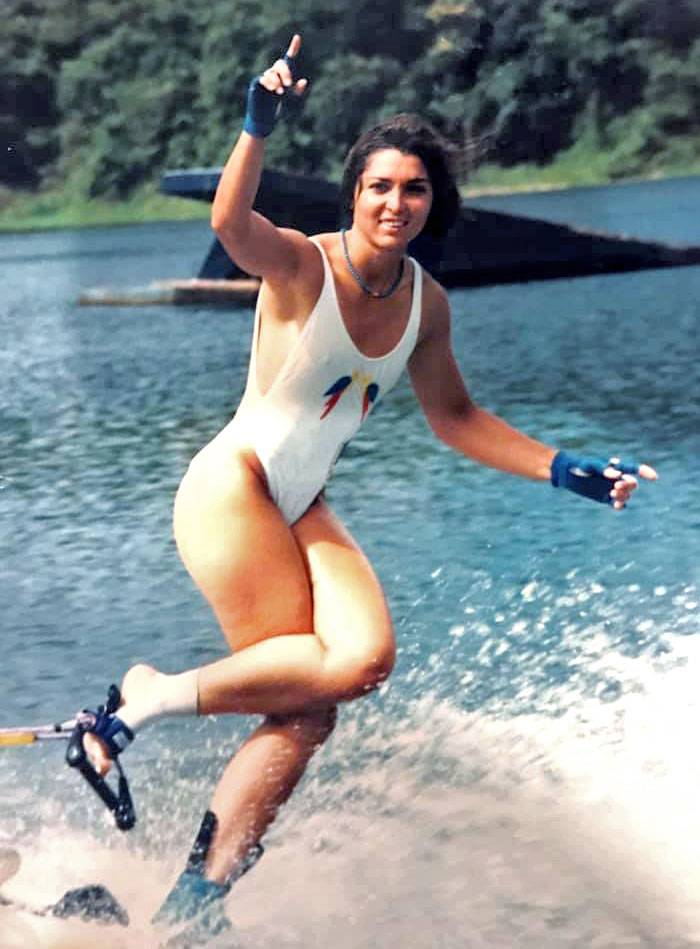
The youngest of the legendary Carrasco sisters from Venezuela, Ana Maria featured on eight World Championship podiums between 1979 and 1989, including clinching the world trick title in 1981 and the world overall title in 1983. In total, she picked up four World Championships medals in the trick event. Competing at the inaugural World Games in 1981, she won took gold in tricks and overall. Ana Maria was also a four-time U.S. Masters champion, including three trick titles. She broke the world trick record five times through the 1980s, becoming the first woman to score 8,000 points in 1984. Ahead of her time in the trick event, her top score of 8,350 would only be exceeded by a handful of women over the next two decades.
Maria Victoria made history by winning three consecutive World Championships from 1973 to 1977, becoming the first woman to achieve this feat in any discipline. Her prowess extended to the U.S. Masters, where she clinched victory three times. Throughout the 1970s, she broke the world record on four occasions, maintaining her hold on the record for nearly the entire decade. A pioneer of the sport, she significantly elevated the standard of women’s tricking from 4,000 points to her final record of 5,880 points in 1979.
A 20-year Career of Consistent Trick Runs (image: USA-WWF)
6. Britt Larsen-Kovak
It feels almost cruel to separate the identical twins, especially when they were inducted into the IWWF Hall of Fame as a joint entry in 2009. Although not quite ascending to the same extraordinary heights as her sister, Britt showcased remarkable prowess in trick skiing, forming one half of the most dominant trick skiing duo in the sport’s history. The twins frequently performed nearly identical trick runs, with victory often hinging on their precision and speed of execution.
Britt featured on every World Championships podium from 1989 to 1999, earning two coveted gold medals in 1993 and 1997. Her achievements also included triumphs in three out of four stops on the short-lived 1987 U.S. Grand Prix of Water Skiing, along with four U.S. Open championships. During the mid-1990s, Britt had an exceptional run of form, edging ahead of her sister to secure a three-year consecutive streak of U.S. Masters victories from 1993 to 1995 and a 1994 Moomba Masters win.
Natalia Rumjantseva at the 1981 World Championships (image: Youtube)
5. Natalia Rumjantseva
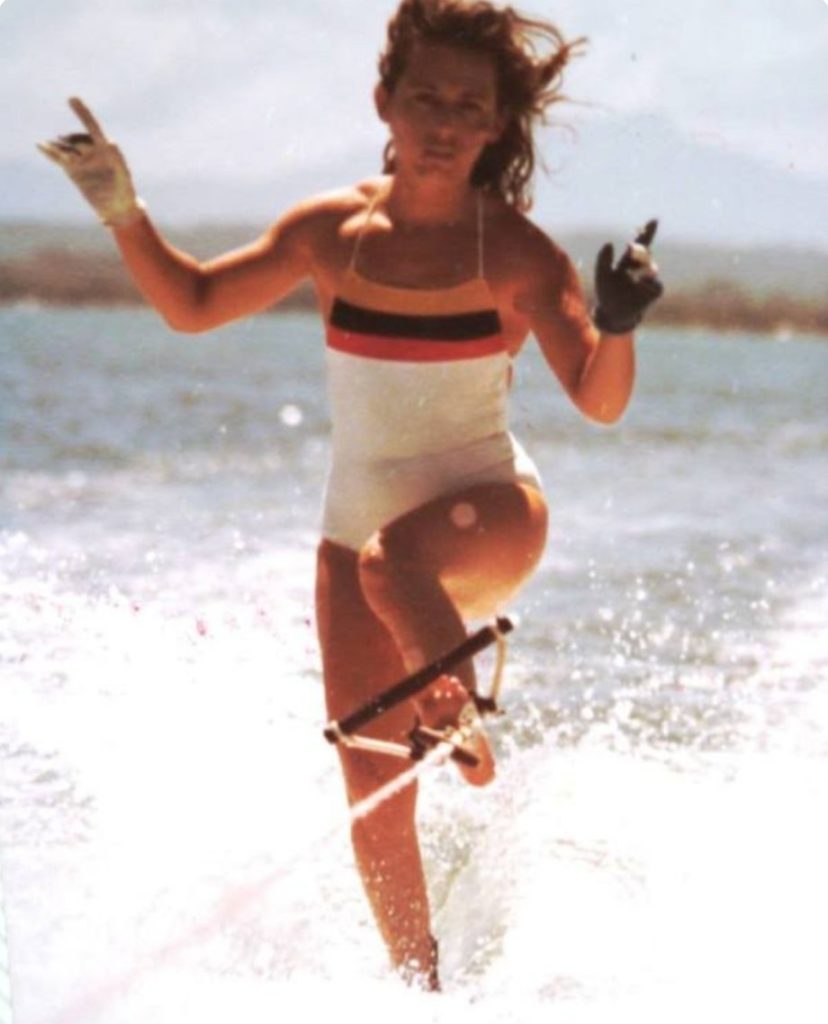
Being a Soviet Union skier during the height of the Cold War, Natalia faced restricted opportunities to compete on the global stage, mostly limited to the World Championships. Despite these limitations, her intense rivalry with Ana Maria Carrasco throughout the 1980s significantly propelled the advancement of women’s trick skiing. From 1979 to 1993, Natalia secured three World Championships trick titles and achieved runner-up positions on three additional occasions. Notably, she broke the world record five times between 1979 and 1984, distinguishing herself as the first woman to surpass both the 6,000 and 7,000-point marks.
Had she been afforded the chance to participate in events like the U.S. and Moomba Masters, there is little doubt that Natalia could have secured an even higher position on this list.
With a water ski pedigree that proudly boasts two U.S. National Champion trick skiers as parents, Anna was always destined for greatness. She ascended to the summit of the elite ranks in 2015, securing victories at the U.S. Open and the World Championships. This accomplishment was followed by an undefeated season in 2016, where she claimed triumphs at the Moomba Masters, U.S. Masters, and successfully defended her U.S. Open title. As the pinnacle of her achievements that year, she broke the world record, a feat she would replicate once more and uphold for two years.
Anna’s accolades also include consecutive U17 World Championships in 2014 and 2016, along with successive U21 World Championships in 2017 and 2019, culminating in an overall victory at the latter competition. In aggregate, she is a three-time open world champion, a two-time U.S. Masters and Moomba Masters champion, and stands among a select group of three women who have achieved trick scores surpassing 11,000 points.
Still in her early 20s, Anna has the potential to ascend even higher on this list if she continues her current trajectory.
Mandy Nightingale competing at an IWWF World Cup Stop in Changshu, China (image: IWSF)
3. Mandy Nightingale
The most dominant female tricker during the golden era of professional trick skiing. Her first major victory came at the 1994 U17 World Championships. However, it was in the 2000s that she ascended to the pinnacle of the elite ranks.
She clinched consecutive World Championships in 2003 and 2005, maintaining a presence on every World Championship podium from 2003 to 2007. Mandy was also a four-time U.S. Open champion and triumphed at the U.S. Masters in 2003 and 2005. In 2006, she broke Tawn Larsen’s seemingly unbeatable world trick record, which had endured for seven years, making it the longest-standing women’s trick record. Perhaps most remarkably, during the period when women’s tricking boasted the largest cash prizes, Mandy emerged victorious in over 50% of IWWF World Cup stops between 2005 and 2009, finishing on the podium in all but two World Cup stops she competed in.
A top-level competitive gymnast during her teenage years, the Arizona native exhibited her remarkable talent from an early age. Erika had a golden run in 2013, clinching victory in both the trick and overall disciplines at the U17 World Championships, and despite her diminutive frame, she narrowly missed securing the slalom title, finishing second in a runoff. Within the same year, she won the Moomba Masters, an IWWF World Cup stop in Mandurah, and the Open World Championships. Adding the icing on the cake, she finished the season by breaking her first world record—becoming only the second woman to reach 10,000 points.
Erika has since elevated women’s skiing to new heights, revolutionizing the sport. Her flipping ability rivals that of the leading male skiers and has transferred into success on the professional wakeboard circuit. She has broken the world record a total of seven times, holding the record for eight of the past ten years. Over the last decade, she has extended the record from a little over 10,000 points to her current mark of 11,360 points.
Thriving in a field of fierce competition, Erika boasts a winning rate just shy of 50% in professional tournaments since her breakout season in 2013. Her accomplishments include five Moomba Masters titles, four U.S. Masters championships, and a U.S. Open victory. On the global stage, she has also earned the title of U21 world champion, Pan American Games champion, and her achievements encompass podium finishes at the Open World Championships in 2017, 2021, and 2023, finally clinching a second world title at the latter event. Erika’s groundbreaking performances have undeniably redefined the landscape of women’s trick skiing.
Image: WATERSKI Magazine
1. Tawn Larsen-Hahn
In the realm of water skiing, many remarkable siblings have left their mark over the years. Families like the LaPoints, Duvalls, Roberges, Llewellyns, McClintocks, and Carrascos have taken turns dominating the sport. However, few siblings can rival the sustained supremacy held by the Larsen twins in women’s trick skiing during the late 1980s and 1990s. Over their two-decade-long career, it was Tawn Larsen who ultimately emerged as the preeminent trick skier in the world. Talented from a young age, she clinched her first Open Women’s title at the U.S. Nationals in 1985, followed by victory at the inaugural U17 World Championships in 1986.
The twins exerted an iron grip on the World Championships, with one of them triumphing in every event from 1989 to 1999. Tawn missed the podium only once during this ten-year period, winning four gold medals in 1989, 1991, 1995, and 1999, along with a runner-up finish to Britt in 1997. At the U.S. Masters, the sisters experienced defeat just once from 1989 to 2000, with Tawn securing victory seven times—more Masters’ trick titles than any other woman. Additionally, she claimed eight U.S. Open titles, won multiple stops on the Budweiser Water Ski Tour, and dominated on the Women of Waterskiing Tour in the late 1990s.
Among her remarkable feats, Tawn’s tenure as the world record holder stands out. She held the record for an astonishing 18 years, which remains the longest streak in the sport’s history. She broke the record four times between 1988 and 1999, solidifying her status as a trailblazer in women’s trick skiing.
Honorable Mentions:
Neilly Ross
Unbeaten throughout 2017, she secured titles at the Moomba Masters, U.S. Masters, and the U17 and Open World Championships. She holds the distinction of being a two-time U.S. and Moomba Masters champion, and is one of only three women to achieve over 11,000 points in trick skiing.
A victim of the most competitive field in the sport’s history, Neilly only narrowly misses the top 10. However, at just 22 years old, we anticipate her ascending the ranks as her career advances.
Whitney McClintock Rini
In 2009, she clinched victories in slalom, tricks, and overall at both the U21 and Open World Championships. Additionally, Whitney secured three consecutive U.S. Masters trick titles from 2009 to 2011.
Karen Bowkett Neville
Best known for her achievements in the overall event, trick skiing stood out as Karen’s strongest discipline. She earned a runner-up position in the tricks category at the 1985 World Championships and dominated the Moomba Masters throughout the 1980s, accumulating numerous trick titles.
Marina Doria & Dany Duflot-Privat
These Europeans are both two-time world champions, dominating the sport in the 1950s and early 1960s.
In the world of trick skiing, certain athletes have left an unforgettable mark on the sport’s history. From dominating performances in prestigious tournaments to breaking records and achieving unparalleled feats, these trickers have showcased their exceptional talent and dedication. In this article, we delve into the rankings of the greatest trick skiers of all time, celebrating their achievements and contributions to the sport. Each skier’s remarkable journey and extraordinary accomplishments have solidified their status as legends in the world of water skiing.
‘Greatest Of’ lists in any sport are inherently subjective and water skiing is no exception. There’s no definitive checklist to crown someone as the absolute best. Every fan out there has their own opinion. But decisions had to be made. We proudly present our picks for the best male trickers in the history of water skiing. So sit back, enjoy, and maybe even debate a little over our choices—after all, that’s the fun of it!
During the 1980s, the Moomba Masters was the most significant professional tournament for trick and overall skiers, as the U.S. Masters remained amateur until 1985, and the Coors Light Water Ski Tour focused solely on slalom and jump events. Amidst this competitive landscape, one skier stood out as the dominant force in the trick event on the Yarra River – Mick Neville. His prowess in trick skiing was further highlighted by his podium appearances at every World Championships from 1981 to 1987, including a runner-up finish to Patrice Martin in England during the 1987 event.
The Colorado native was the only man to rival the dominance of Patrice Martin and Cory Pickos during the late 1980s and early 1990s. His exceptional skills allowed him to end Pickos’ six-year streak as national champion, winning the U.S. Nationals in 1986 and the U.S. Open in 1988. In 1990, he made history by becoming the first man to break the 11,000-point mark in trick skiing. Notable victories include the 1993 World Championships, 1990 Pan American Championships, and three U.S. Masters titles. Despite significant progress in the sport over the past 30 years, Baggiano remains one of the greatest toe trickers of all time.
Siemers named to Hall of Fame Class of 2023 (Image: USA-WWF)
8. Jimmy Siemers
Known primarily for his overall skiing, the exceptional talent hailing from Texas was equally formidable in the trick event. As a junior, Siemers was an Under-17 and Under-21 World trick, jump and overall champion. He clinched the tricks title along with the overall title at the 2003 World Championships in Florida, showcasing his versatility and excellence in both disciplines.
Throughout his career, he was always a contender on the professional circuit, winning tricks four times at the U.S. Masters, in 2006, 2008, 2009, and 2011, and twice at the Moomba Masters, in 2011 and 2018. Additionally, he secured victories at four IWWF World Cup stops held in Doha, Qatar (twice), Putrajaya, Malaysia, and Mandurah, Australia. Finally, in 2008, he dethroned Nicholas Le Forestier and ascended to the number one spot on the elite rankings, a testament to his exceptional talent.
In the 1970s, Venezuela produced some of the greatest water skiers in the world, and Suárez was chief among them. As a four-time world record holder, he was the first to achieve the impressive feats of tricking over 6,000 and 7,000 points. His skill and consistency earned him back-to-back world titles in 1975 and 1977, along with a runner-up position in 1979. Additionally, Suárez secured two U.S. Masters titles in 1976 and 1979, cementing his status as a prominent figure in trick skiing during that era.
Pato Font celebrates after his winning trick run at the 2023 World Championships (Image: Johnny Hayward)
6. Patricio Font
Hailing from Mexico, the young prodigy, Pato Font, has taken the water skiing world by storm, leaving a trail of broken records on his path to the top. Font’s talent has been evident from an early age, securing back-to-back Under-17 World Championships in 2016 and 2018, followed by repeat victories in the Under-21 World Championships in 2021 and 2023. His incredible journey continued as he claimed the World Championships title in both 2019 and 2023, with a runner-up finish in between in 2021, further cementing his status as one of the sport’s biggest rising stars.
Font has dominated the professional circuit in recent years, securing four consecutive U.S. Masters titles from 2019 to 2023, back-to-back Moomba Masters titles in 2020 and 2022, and victory at the 2021 U.S. Open. To top it all off, Font etched his name in history by breaking Aliaksei Zharnasek’s long-standing world record in 2022, and remarkably, he has since exceeded it twice.
Just twenty-one years of age, Font is on track to become one of the greatest trickers of all time.
McCormick’s incredible talent in waterskiing was evident from a young age when, at only 14 years old, he wowed audiences with his jumps and tricks as the opening act on The Ed Sullivan Show. He shared the stage that night with none other than the Rolling Stones.
McCormick held the world trick record and was a consistent presence on every World Championships podium from 1967 to 1973, ultimately claiming the gold medal in 1971. Additionally, he was a seven-time U.S. Masters trick champion, over a twelve year span from 1966 to 1977. He competed at the 1972 Munich Olympics, where he secured the sport’s only Olympic gold in the trick skiing category, further solidifying his status as one of the sport’s legends.
Perhaps McCormick’s greatest legacy in trick skiing is his claim to being the first to land a flip on skis. Valued at only 350 points when first approved, his flip didn’t make it into his regular trick run. However, he would often throw it for the crowd on his way back to the dock.
The muscular Belarusian, known simply as “Ace” for his remarkable talent in trick skiing. Zharnasek held the title of the number one ranked elite tricker for seven seasons, including four consecutive years from 2011 to 2014. His world trick record of 12,570 stood for eleven and a half years, making it the longest-standing trick record in the history of the sport. His contributions were pivotal in Belarus’ unexpected victory at the 2011 World Championships, and he maintained an unyielding presence on every World Championships podium from 2005 to 2013. Notably, he secured three consecutive world titles in 2009, 2011, and 2013.
With an impressive resume boasting over 20 professional victories, Zharnasek maintained a winning record of greater than 50% in the 2010s. His accomplishments include being a four-time U.S. Masters champion, five-time Moomba Masters champion, along with five U.S. Open champion titles. He secured three IWWF World Cup stop victories in 2009, 2010, and 2012. Ace’s prowess on the water and his remarkable achievements place him amongst the top trickers of all time.
The European champion Patrice Martin performs a Trick in 1979 on the Castel Gandolfo lake (image: Le Monde)
3. Patrice Martin
The Frenchman burst onto the world stage as a trick phenom while still a teenager and eventually concluded his career as one of the greatest overall skiers of all time. He was the second man to trick 10,000 points, achieving the feat a mere two months behind Cory Pickos. Throughout his illustrious career, Martin broke the world trick record seven times between 1978 and 1996, helping extend the record from 7,000 to 11,000 points.
Martin’s achievements in trick skiing include an impressive haul of seven World Championships trick medals, which includes four world titles secured in 1979, 1985, 1987, and 1991. At the World Games, Martin was unbeaten through the first four editions from 1981 to 1993, earning himself a spot among the top 10 all-time medal winners across all sports. Moreover, he boasts 16 European trick titles, with victories spanning from 1978 to 2001. His dominance extended to the professional circuit, where he clinched numerous victories, such as three U.S. Masters titles in 1978, 1988, and 1989, and three U.S. Open titles in 1991, 1993, and 1995. Martin’s remarkable talent and achievements have firmly cemented his status as one of the sport’s legends.
Image: IWSF
2. Nicholas Le Forestier
The first man to trick 12,000 points, this Frenchman left his mark on the sport by breaking the world record five times and holding it for an impressive eleven and a half years during the early 2000s. He showcased his exceptional talent on the world stage, securing top-two finishes in seven out of nine World Championships from 1995 to 2011. He won the World Championships in 2001, and had back-to-back wins again in 2005 and 2007. Le Forestier’s peak performance coincided with the heyday of professional trick skiing in the early 2000s, during which he asserted his dominance at IWWF World Cup events, clinching gold at an impressive nine out of eleven events between 2004 and 2007.
Throughout his career, he maintained the distinction of being the number one ranked elite tricker from 2002 to 2007. At the U.S. Masters, he secured an incredible nine titles, including an unbeaten streak of five consecutive wins from 2001 to 2005. Additionally, Le Forestier was a frequent champion at the Moomba Masters, with three consecutive victories from 2001 to 2003, adding to his long list of professional victories.
Tricks skier Cory Pickos among Hall of Fame Class of 2012 (Image: The Ledger)
1. Cory Pickos
Competing in an era where professional trick tournaments were scarce, Pickos may not have as many professional titles as Le Forestier, but he undoubtedly stands as the greatest tricker our sport has ever seen. A true trailblazer in world trick skiing, his career spanned a remarkable four different decades. Pickos achieved the historic feat of being the first man to break the 10,000-point mark in trick skiing. Moreover, he set an astounding 24 world records between 1977 and 2000. At the young age of 13, he set his first record at 6,860 points, and by the twilight of his career, he had raised the bar to an impressive 11,920 points. Remarkably, Pickos held the world trick record for 17.5 years during this 23-year period.
His accolades in competitions further solidify his standing in the sport. Pickos secured back-to-back World Championships in 1981 and 1983, setting the tone for his consistent podium appearances over the next two decades, where he earned another four medals. Domestically, he boasted an impressive ten U.S. national champion titles, including six U.S Open titles. He won eight U.S. Masters titles and maintained an undefeated record in the short-lived 1987 U.S. Grand Prix of Water Skiing, winning all four events. Moreover, he showcased his dominance on the Coors Light Water Ski Tour during the 1980s, triumphing at the few stops that included the trick event—such as Vallejo, CA in 1987 and 1989, and Wichita, KS in 1989.
Honorable Mentions:
Joshua Briant
Remarkable as a junior, Briant won the Under-17 World Championships in 2012, back-to-back Under-21 World Championships in 2013 and 2015, the 2014 Moomba Masters, featured on the podium at the World Championships in 2015 and 2017, and took gold at the 2017 World Games. He suffered serious injuries after a jump crash in 2017, and although he has since posted scores back over 11,000 points, he appears to have effectively retired from top-level competition.
Russel Gay
Among the first 10 men to trick 10,000 points, he picked up medals at three consecutive World Championships from 1999 to 2003, matched Pickos’ 10 U.S. national titles, was the 1996 U.S. Open champion, and won an IWWF World Cup stop in Changshu, China in 2004.
Kreg and Jaret Llewellyn
The brothers from Canada were among the first to trick over 10,000 points and between them picked up a World Championships gold, a U.S. Masters title, and multiple U.S. Open and Moomba Masters victories.
Aymeric Benet and Adam Pickos
Both are two-time world champions, but narrowly miss the top 10 based on a lack of professional victories.
The 2023 IWWF World Water Ski Championships proved to be a thrilling showcase of skill and determination, with each day bringing its own set of remarkable moments and challenges. From the impressive kickoff early in the week, to the unexpected turns in the tournament caused by adverse weather conditions, this competition was a rollercoaster of excitement and resilience. The water skiing world watched in anticipation as emerging talents and seasoned champions went head-to-head, vying for world titles and displaying the sheer tenacity that defines this sport. Here, we delve into the highlights and surprises from this extraordinary event, setting the stage for the action-packed journey that followed.
Young Talent Shines Early
Day one featured a full day of slalom skiing under perfect conditions, with over 70 skiers in total. While some might consider these early rounds as a curtain raiser, they still delivered some incredible performances. Notably, 17-year-old Italian skier Vincenzo Marion took the lead by running 2 at 10.25 meters (41′ off). Setting the pace early with 38 of the world’s top-ranked skiers yet to compete.
Moving on to Wednesday, it was time for the lower-seeded competitors in the jump and trick events to showcase their skills. This day was marked by numerous emerging talents achieving personal bests in the jump competition. Jutta Menestrina, making a remarkable comeback from knee surgery, posted an impressive score in the third series of the women’s jump. On the men’s side, Marino once again delivered an outstanding performance, achieving a personal best jump by 5.6 meters, crossing the 60-meter mark for the first time in his career.
Battling the Elements
Thursday marked the onset of dramatic developments as heavy rain showers and strong winds intensified throughout the morning. These adverse conditions prompted officials to suspend the women’s slalom competition midway through the third series. Following consultations with officials and team captains, the decision was made to postpone the women’s slalom to the following day. The weather conditions proved extremely challenging, with intermittent heavy rain and white caps on the lake, making it extremely difficult for both skiers and even the boat drivers to navigate the course for much of the day.
This postponement, although necessary for safety, came at a cost due to the tight schedule for the weekend. Despite the forecast predicting better conditions on Friday, the early seeds of women’s slalom and the top seeds of men’s slalom would have to contend with sun glare and reflection in the morning and afternoon, as the lake runs from east to west.
In the midst of these weather challenges, the men’s tricks elimination round proceeded as scheduled on Thursday afternoon. Skiers faced the daunting task of battling strong winds and bumpy conditions in the first completed elimination round of the tournament. The quality of tricks, which has been steadily rising in recent years, remained exceptional despite the unfavorable conditions. The French team exhibited remarkable prowess, with both veteran Pierre Ballon and newcomer Pol Duplan-Fribourg leading the pack out of series two.
As the saying goes, the overall event is won or lost in the trick event, and this held true at this World Championships. Notably, Italian skier Edoardo Marenzi, who was nursing an Achilles injury, exited early, effectively ending his campaign. Defending trick champion Dorien Llewellyn, competing in his first trick tournament in six months, and former overall champion Martin Kolman did enough to secure their spots in the finals. However, the biggest upset of the tournament occurred when the clear favorite, Joel Poland, who only needed 10,000 points to make the final, fell during his signature Super-Mobe-Five, ruling himself out of the final and overall contention—or so it seemed.
In a defining moment, as Poland experienced this unexpected setback, the next skier off the dock, Frenchman Louis Duplan-Fribourg, emerged as the new favorite in the overall event. Instead of succumbing to the mounting pressure, he took a daring approach, opting for the hardest run in his repertoire. In doing so, he set a new personal best with 12,510 points, earning himself the French national trick record and a World Championships record. The skier who previously held the latter record, Patricio Font, responded in thrilling fashion by reclaiming his World Championships record only three skiers later, matching his own world record and securing the top seed position.
Nonstop Action Shines Through (A Little Too Bright)
Friday delivered another action-packed day of slalom skiing, with the top three series of both women’s and men’s slalom running. On a separate lake, the women’s trick preliminaries took place concurrently throughout the afternoon. Among the top female slalomers, there were no major upsets, but unexpected subpar performances from prominent overall contenders Giannina Bonnemann Mechler and Paige Rini set them back considerably. The cut for the finals remained comparable to 2021, with a runoff at 1.5 @ 10.75m (39.5’ off).
The afternoon treated viewers to one of the most thrilling and engaging broadcasts ever produced by TWBC. It featured simultaneous men’s slalom and women’s trick skiing, earning comparisons to “NFL’s RedZone.” The excitement peaked during the start of the women’s series one tricks. On one lake, the women’s overall title was being determined, with the likes of Hanna Straltsova, Kennedy Hansen, and Paige Rini competing. On the other lake, the down-and-out Joel Poland, who had shaved his head overnight, skied with the determination of a man with nothing to lose. Poland took a bold approach, attacking the 10.25m (41’ off) pass rather than taking the safer route of securing his spot in the final with an S-turn mid pass. The Brit produced the defining performance of the World Championships, becoming the newest member of the 41-off club. Suddenly, he was back in the overall title race.
Women’s trick skiing concluded in spectacular fashion, with three athletes surpassing 10,000 points. Erika Lang claimed the pole position with a World Championships record of 10,930 points. As all eyes shifted to the slalom lake for the final series, the sun dipped lower on the horizon. Competitors had to adapt to the challenging glare. Joel Howley became the first skier to wear sunglasses during his run, with the boat driver handing them to him for each pass into the glare. Others attempted to mitigate the increasingly difficult glare with eye black. In a candid interview, Freddie Winter commented on the conditions, emphasizing that “we’re all trying to survive as opposed to perform.” Further stating “it’s dangerous, it’s scary, and it minimizes our performance.”
While the conditions were far from ideal and arguably hazardous for the top series of men’s slalom, in an event with limited time and significant weather-related disruptions, the officials made the right call. The alternatives, such as running the women’s slalom in the rainy and whitecap-filled conditions from the previous day or scheduling the jump preliminaries in similar glare or strong gusty tailwinds the following day, would have been significantly more dangerous.
Despite the challenging conditions, most of the top skiers successfully advanced to the finals. Notably, two-time former champion Will Asher suffered an early exit at 10.25m. The day concluded with an electrifying eight-way runoff for the final two spots, with young Marino attempting a 10.75m pass in what might be the coldest start ever after not skiing for three days. In the end, Cole McCormick and Corey Vaughan secured their tickets to the finals.
The First World Champions Are Crowned
The penultimate day of the competition brought an abundance of excitement with five series of jump preliminaries. As anticipated, the cut in women’s jump was lower than two years ago, mainly due to an injury-plagued field. Straltsova had an unusual off day, still managing to secure the top seed position but failing to cement her overall title chances. She finished the prelims just behind Bonnemann Mechler after an underwhelming, by her standards, 54.1-meter (177-foot) performance.
The men’s jump competition provided non-stop excitement, with an impressive 21 men surpassing the 200-foot barrier. Overall hopefuls Louis Duplan-Fribourg and Llewellyn narrowly missed the finals, leaving room for a potential comeback from Poland, who secured the second-to-top seed. The veteran Freddy Krueger put Team USA and the fans through some nerve-wracking moments, as he didn’t secure his finals spot until his third jump. It was the defending champion, Ryan Dodd, who claimed the top seed position.
Attention then shifted to the trick lake as the first world champions of the tournament were to be crowned. The early seeds, including many young skiers competing in their first-ever finals, encountered a series of stumbles and early falls while attempting to achieve high scores. Straltsova made significant improvements over the preliminary round, effectively securing the overall title. Three-time world champion Anna Gay led the event early, despite a fall on her final flip, and had to watch from the shore as Peruvian Natalia Cuglievan came up just 10 points short of her lead. Then, Bonnemann Mechler and Neilly Ross went down early while chasing big scores. It all came down to Erika Lang in the end, who, despite being one of the most dominant trickers in the sport over the last decade, had not secured World Championships gold since 2013. Although she appeared shaky at times, she managed to complete both passes and earn a well-deserved second world title.
In stark contrast to the low-scoring final in 2021, the men’s field posted impressive scores throughout, with six skiers surpassing 11,000 points. Llewellyn improved upon his preliminary trick score, securing fourth place in the trick event and a bronze in the overall competition, a remarkable feat considering his injury comeback timeline. Chilean phenom Martin Labra took the lead with two skiers left to go, guaranteeing himself a medal. The stage was set for an epic battle between the two standouts from the preliminaries. Louis Duplan-Fribourg, after executing a superb hand pass, seemed poised to achieve another record score. However, an equipment malfunction caused his toe strap to release before his final toe trick, preventing a score that could have exceeded Aliaksei Zharnasek’s long standing world record, totaling 12,580 points. Patricio Font, realizing the opportunity presented by the Louis’ misfortune, opted for a less challenging run, omitting his Ski-Line-Seven and cruising to victory with another huge score of 12,470 points.
Schedule Shake-Up Ignites Controversy Among Outstanding Performances
A last-minute schedule change stirred some controversy as the start time was moved up to 8:30 am, and the order was reversed to begin with the jump event. The weather forecast had predicted increasingly strong winds throughout the afternoon, prompting the schedule adjustment. This change allowed for an earlier start, avoiding the morning sun glare for slalom and offering safer jump conditions. Nevertheless, many skiers expressed their dissatisfaction with the shift. Regina Jaquess, after taking the lead in the event with her longest jump of the season, gave a defiant interview referring to the early start as “ridiculous” and questioning the feasibility of “throwing big scores down that early.” Similarly, Jack Critchley, also in an emotional speech following a disappointing performance, voiced concerns, lamenting that he “was in bed when they changed the event, how do you prepare for that?”.
Despite the emotional outbursts from some skiers, it’s important to note that schedule changes at World Championships are quite common. In this case, the alteration significantly improved the skiing conditions for the final day. A team captains meeting was held at the conclusion of skiing on Saturday, where the revised schedule was communicated to representatives from all participating countries. Thus, there should have been no excuse for not being aware of the change.
The early start at 8:30 am might not have been preferred by some, but it proved to be beneficial for the performances. 10 out of the 12 finalists in the women’s jump improved on their preliminary scores, some by several meters. Lauren Morgan, in her first major event after knee surgery, secured her second consecutive World Championships medal. Notably, the two former Belarusian skiers, now competing under the USA Water Ski banner, claimed the top two spots. Hanna Straltsova, who has shown incredible form throughout 2023, clinched gold medals in both jump and overall.
Similarly, the men delivered strong performances in the jump event, with over half of the field improving on their preliminary scores. However, some skiers like Rodrigo Miranda and Joel Poland ended up with lower rankings after failing to convert their late cuts into big jumps. Poland faced the Herculean task of achieving a 70.6-meter (232-foot) jump to secure the world overall title, but he came up short on all three attempts, setting the stage for Americans Freddy Krueger and Taylor Garcia to secure podium finishes. The defending champion, Ryan Dodd, was the final skier to go, needing to chase a score of 69 meters (226 feet). Dodd succeeded, clinching his fifth consecutive World Championships victory on his first attempt.
The winds, as predicted, had intensified into a strong head/tailwind by the time the slalom event began. This left the women with a dilemma – whether to take the challenge of running 11.25m (38′ off) with the tailwind, or to play it safe with a headwind. Most of the early seeds opted for the aggressive approach, aiming to win, but they struggled to run 11.25m with the wind behind them. Neilly Ross from Canada, one of the few who chose the conservative path, led the pack with 2 @ 10.75m (39.5’ off), with four skiers remaining. The defending champion, Jaimee Bull, was only the second skier to successfully navigate 11.25m with a tailwind, securing the crucial headwind 10.75m. She took the lead with 3.5 and anxiously awaited the outcome. The top two seeds, Allie Nicholson and Regina Jaquess, took the safe option, setting up a comfortable 11.25m pass but facing the critical 10.75m pass with the tailwind. Ultimately, both fell short of the lead, granting Bull her second consecutive world title and rewarding her brave decision to tackle 11.25m downwind.
The men encountered a similar dilemma, needing to choose between a safe 10.75m pass or taking the risk for 10.25m (41′ off) with a headwind. Several skiers aimed high but couldn’t complete the 10.75m pass downwind. Cole McCormick, Stephen Neveu, and Dane Mechler played it safe, running 10.75m and achieving 3 @ 10.25m with the wind at their backs. Freddie Winter, skiing in the middle of the pack, attacked 10.25m with his characteristic aggressive style after running 10.75m downwind. He managed to reach 4, ending with a spectacular crash on his way to ball 5. Then, he had to watch the next five skiers try to surpass his lead. Nate Smith and Joel Poland, the top two seeds, both set themselves up for a headwind 10.25m pass but failed to make it past three ball, ultimately granting Winter his second world title.
Meanwhile, the team competition was a closely contested battle, with France, Canada, and the USA closely matched during the trick event. Yet, the American team’s substantial lead in the slalom event proved to be a significant advantage. Despite Canada’s strength in the jump event, it was challenging for them to bridge the gap. France, on the other hand, required one more big jump score to truly contend for the top spot.
A World Championship for the Ages
As the 2023 World Championships came to a dramatic close, it was clear that this year’s competition had surpassed the expectations of many. The competition unfolded in a fashion that kept spectators on the edge of their seats from start to finish, with each day bringing its own unique set of challenges and triumphs. The weather, although at times a hindrance during the preliminary rounds, added a layer of strategy and intrigue to the finals, intensifying the excitement of the World Championships. As the sun set on this extraordinary event, the memories of thrilling performances and unexpected twists will endure, leaving an unforgettable mark on the annals of water skiing history.
In the thrilling realm of water ski jumping, a group of remarkable women have etched their names in the sport’s history. With every jump, these athletes defied gravity and pushed the boundaries of human potential. As we embark on this journey through the annals of women’s jumping, we invite you to witness the trailblazers who have elevated the sport to new heights. From historic victories to ground breaking records, their stories paint a portrait of passion, perseverance, and sheer excellence.
‘Greatest Of’ lists in any sport are inherently subjective and water skiing is no exception. There’s no definitive checklist to crown someone as the absolute best. Every fan out there has their own opinion. But decisions had to be made. We proudly present our picks for the 10 best female jumpers in the history of competitive water skiing. So sit back, enjoy, and maybe even debate a little over our choices—after all, that’s the fun of it!
Sue represented Australia in six World Championships, featuring on every jump podium from 1979 to 1985, and securing runner-up positions in three of those World Championships. She was dominant on the Yarra, winning multiple Moomba Masters titles during the 1980s. Although it was a difficult trip for Australians to justify while still an amateur event, she traveled to and won the 1984 U.S. Masters. A true pioneer, she marked history in 1981 as the first woman to surpass the 40 meter mark, extending and maintaining the world record for five years throughout the 1980s.
June Fladborg kæmper for EM-guld (image: Claus Beyer)
9. June Fladborg
Hailing originally from Denmark, June, like many Europeans, relocated to Florida to facilitate year-round training. She embarked on an incredible journey of success in the latter half of the 2000s, securing victory in just shy of 50% of all professional tournaments she competed in between 2005 and 2010. Throughout this period, she attained the coveted number one elite jumper position three times, achieved runner-up positions at the World Championships on two occasions, clinched four U.S. Masters titles (including an impressive streak of three consecutive wins from 2008 to 2010), and secured back-to-back Moomba Masters titles in 2008 and 2009. In 2010, capping off an extraordinary career, she broke Elena Milakova’s long-standing world record.
Since her retirement from professional water skiing, June, alongside her husband Tom Asher, is dedicated to carrying forward the legacy of her coach, mentor, and former partner, Ray Stokes, through their involvement with Stokes Skis.
An exceptional overall skier, Natallia held a pivotal role in securing victory for the Belarus team at the 2011 World Championships, where she won individual gold in the tricks, jump, and overall disciplines. Her collection of World Championships medals tallies to an impressive 10, including podium finishes in jump at the 2007, 2013, and 2017 events. Natallia also secured World Games titles in tricks and jump in 2017.
On the professional circuit, Natallia was incredibly consistent, securing top-three placements in 75% of all jump events she participated in from 2005 to 2019. Her notable victories include the Moomba Masters, U.S. Open, and three U.S. Masters jump titles, triumphing in 2007, 2011, and 2012. Natallia broke the world jump record three times between 2011 and 2012 and becoming the first woman to achieve a 190-foot jump.
Angeliki Andriopoulou jumps 54.9m to keep her title of World Champion. (image: IWSF)
7. Angeliki Andriopoulou
A consistent presence on the World Championships podium throughout the 2000s, the Greek champion earned a remarkable tally of seven medals between 2001 and 2009. This collection included three notable runner-up finishes in the overall category and one in trick skiing. However, it is her triumphant streak of three consecutive world jump titles from 2005 to 2009 that stands as her paramount achievement.
Within the professional circuit, Angeliki maintained an exceptional track record. She secured a podium placement in a staggering 85% of all tournaments she entered, and a winning rate exceeding 40%. Adept in all conditions, she ended Emma Sheers’ era of dominance on the Yarra River by clinching the Moomba Masters title in 2007. Other notable professional victories include the 2007 U.S. Open, back-to-back wins at the Malibu Open in 2006 and 2007, and four victories in IWWF World Cup stops spanning from 2005 to 2008.
Raised in Kansas, Sherri began her skiing in a local sand pit before becoming one of the first in a long list of elite jumpers to blossom under the coaching of Jay Bennett in Louisiana. Sherri’s entrance on the professional circuit was instantly felt when she became the first individual to defeat Deena Brush Mapple on the pro tour in almost three years. She went on to win four consecutive stops that year on the 1990 Michelob Dry Waterski Tour, eventually earning her the coveted title of tour champion. Her success continued into the following year, 1991, where she defended her title with five out of seven wins on the pro tour, in addition to clinching victories at the U.S. Open and the World Championships. Unfortunately, women’s jump was dropped from the pro tour in 1992, right at the peak of her career. Undeterred, Sherri managed to accumulate over 20 professional titles throughout the 1990s. In 1995 she had another notable season, winning the U.S. Masters, a third U.S. Open title, claiming a bronze at the World Championships, and equaling Deena Brush Mapple’s world record.
Off the water, she played a pivotal role alongside Jennifer Leachman in the formation of the Women of Waterskiing (WOW) tour that gave a platform to female athletes in the late nineties after they were excluded from the pro tour.
Growing up on the outskirts of Moscow during the waning years of the Soviet Union, Elena honed her skills by practicing in a swimming pool during the winter months. Her initial international triumph materialized at the 1997 World Championships in Colombia, where she secured victories in both jump and overall categories. In the jump event, she followed up with another victory at the 2001 World Championships, and even in the later phase of her career, achieved a runner-up position in 2007 while competing for Switzerland under her married name, Elena Thomsen.
On the professional circuit, she clinched a Moomba Masters championship and was a three-time U.S. Masters champion. She broke the world jump record on three occasions, becoming the first woman to jump over 55 meters and 180 feet. Her final record of 56.6 meters remained unbroken for over eight years.
During the short-lived era of women’s Ski Fly, Elena excelled. Her world Ski Fly record, established at 69.4 meters during the 2002 U.S. Masters, holds to this day, making it the longest-standing record in world water skiing.
Demonstrating extraordinary talent from an early age, Liz made her entrance onto the water skiing stage in 1965, becoming only the second woman to achieve a 100-foot jump while just 14 years old. Even more astonishingly, the same year, she traveled to Surfer’s Paradise in Australia for the World Championships and emerged victorious in the jump and overall events. This remarkable feat set the tone for her future accomplishments.
Liz would go on to win a total of four World Championship jump titles, only missing the podium once between 1965 and 1975. Her dominance was equally impressive on home soil, where she secured six U.S. National jump titles and seven U.S. Masters jump championships, including five consecutive victories as a teenager from 1966 to 1970. In addition, Liz broke the world jump record on five occasions throughout her illustrious career.
Emma and her younger brother Curtis came up under the tutelage of Ray Stokes, whose innovations in jump ski design and technique played a pivotal role in revolutionizing the sport during the 1990s. Displaying talent from an early age, Emma accomplished the remarkable feat of clinching back-to-back U17 World Championships in 1990 and 1992, a record that remains unbroken among girl’s jumpers to this day. Particularly dominant on her home turf, Emma’s prowess was highlighted by a streak of five consecutive Moomba Masters jump titles throughout the 1990s. Her domination continued with another impressive run of six consecutive titles in the early 2000s, suffering only a single defeat on the Yarra between 1994 and 2005.
After securing the runner-up position at the 1995 World Championships, Emma claimed gold in the jump event at the 1997 World Games and both the 1999 and 2003 World Championships. On the professional circuit, she won the season championship of the Café de Columbia World Cup in every year that women’s skiing was included from 1997 to 1999 and followed up with victory on the 2000 U.S. Pro Water Ski and Wakeboard Tour. Emma was also a six-time jump champion at both the U.S. Masters and U.S. Open, losing only once between 1996 and 2003 at the latter event.
Despite narrowly missing the distinction of becoming the first woman to jump 50 meters, Emma broke the world jump record three times during her career. Notably, she also co-held the women’s Ski Fly record with compatriot Toni Neville for two years, achieving a distance of 66.6 meters.
Known as the “queen of water skiing,” this California native was a perennial contender across the slalom, jump, and overall disciplines throughout her illustrious 25-year career. Her notable achievements include a ‘grand slam’ in 1987, securing overall victories at the World Championships, U.S. Nationals, and U.S. Masters. Additionally, she holds the distinction of being the only woman to simultaneously hold the world slalom and jump records. However, it was in the jump event where her talents truly shone.
Deena clinched the world jump champion title an impressive four times, only missing the podium once between her first medal in 1979 and her last victory in 1989. Her dominance extended to the U.S. Masters, where she claimed the jump title on nine occasions, including an extraordinary streak of seven consecutive victories from 1986 to 1993. In addition, her visits to Melbourne resulted in multiple Moomba Masters jump titles.
On the pro tour, her prowess was unmatched throughout the late 1980s. Deena secured the season champion title for three consecutive years, from 1987 to 1989, on the Coors Light Water Ski Tour. Her exceptional streak included a run of 22 consecutive tour stop victories spanning from 1987 to 1990, and she simultaneously accomplished an unbeaten season on the 1987 U.S. Grand Prix of Water Skiing. Moreover, she broke the world jump record five times over her career, significantly advancing women’s jumping distances from 39.3 meters in 1979 to 47.5 meters by her final record in 1988.
Another of Ray Stoke’s protégés, the Australian known as “Rabbit” has redefined the boundaries of achievement in women’s jumping. While still a teenager, she secured victories in the Moomba Masters, LA Nite Jam, and the U21 World Championships all in 2011. At her final U21 World Championships she clinched both the jump and overall titles.
Since losing to Jutta Lammi at the 2013 Moomba Masters, Jacinta has won every single professional event she has competed in. Nobody, not even the great Andy Mapple, has ever achieved this level of sustained dominance in the sport. Her unparalleled streak includes nine consecutive Moomba Masters titles and seven consecutive U.S. Masters titles, with the latter streak only ending after a forced absence in 2021 due to Covid-related travel restrictions. After finishing as the runner-up at the 2011 World Championships, Jacinta went on to secure five consecutive world titles between 2013 and 2021. She has held the world record since 2015, breaking it five times, and in 2021, became the first woman to jump 200 feet.
After she was controversially dropped by Nautique, her major sponsor, for setting the world record behind the ‘wrong boat,’ it appears Jacinta has effectively retired from the professional circuit. She has made only brief cameos over the last two years to continue her winning streak at the Moomba Masters. Only recently turning 30, she will be a substantial loss to our sport. However, having won everything there is to win, we can’t blame her for moving on to the next chapter of her life.
Honorable Mentions:
Hanna Straltsova
The Belarusian is one of only three women to jump over 190 feet and finished runner up to Carroll at both the 2019 and 2021 World Championships. She has dominated women’s jump in the Australian’s absence, clinching two U.S. Masters titles and finishing on top of the Waterski Pro Tour leaderboard every year from 2021 to 2023.
Toni Neville
Featured on the World Championships jump podium three times, including a runner-up position in 1999, she was also a U.S. Masters and U.S. Open champion. In an extraordinary streak of form, she broke the world record four times in 2000, achieving this feat twice in a single weekend.
Brenda Nichols Baldwin
Remembered as the first woman to jump 50 meters, she accomplished this feat in only her second tournament after women were allowed to raise the ramp to five and a half feet in 1997. Brenda was also a world jump champion in 1995 and U.S. Masters jump champion in 1997.
Cindy Todd
A two-time world jump champion, clinching gold in 1979 and 1983, along with a runner-up finish in 1977. She also triumphed at the 1982 U.S. Masters. She held the world jump record for a single day in 1982.
Willa Worthington, Nancie Rideout, and Renate Hansluwka
Assigning rankings to skiers from the 1950s and 1960s is a complex task, yet all three of these exceptional women merit acknowledgment as two-time world jump champions.
Updated: in the original article Sherri Slone’s home state was incorrectly listed as Arkansas.
Independent perspectives on tournament water skiing